Bank vs NBFC for a Vehicle Loan: Which One Is Actually for You
Lakshay Khanna·03 June 2026
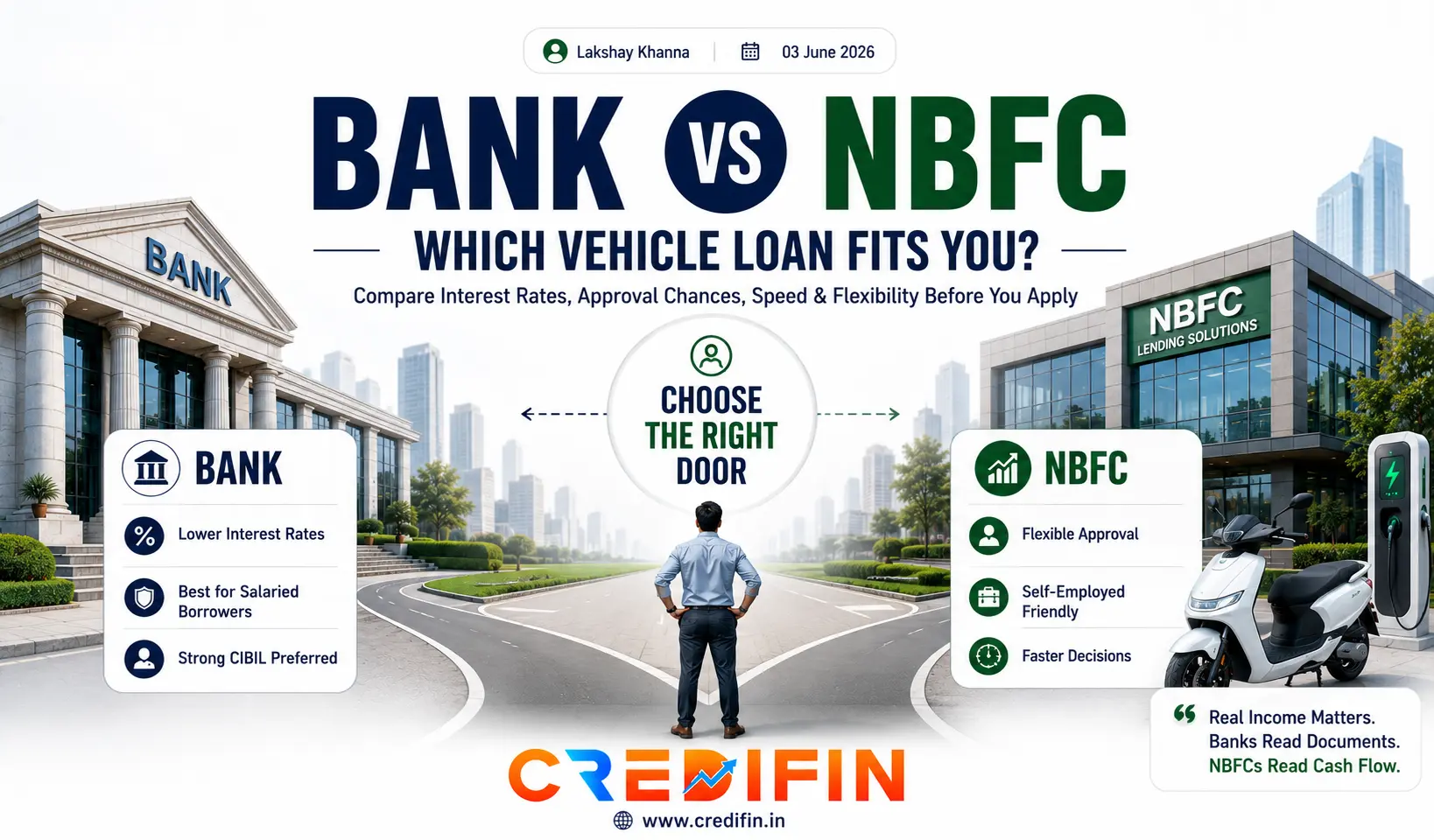
Two guys I know bought EVs the same month. Both needed a loan. One walked into his bank, the other came to an NBFC. Both got approved. And both, weirdly, made the right choice for completely opposite reasons.
The first guy is salaried, 760 CIBIL, salary hitting his account on the 1st like clockwork. He got 13 percent at his bank and would've been silly to go anywhere else.
The second runs a small catering business. Real income's good, but his ITR is modest because, like most self-employed people, he files to save tax. His bank took one look at that ITR and basically shrugged. The NBFC read his bank statement instead, saw the actual money moving, and approved him. A bit higher on rate, but approved, while the bank had left him standing.
Same product, vehicle loan, two totally different doors. And which door is right for you depends almost entirely on who you are, not on which one is "better." So let me break down how each actually works and who each one suits.
Not sure if a bank will take your profile?
Apply with Credifin online, we read your real income and cash flow, approve where banks can't, and tell you honestly if a bank would serve you better. Decision in 3-7 days.
Check My Eligibility →What a bank actually is, for a borrower
A bank is the cheaper, stricter option. They have the lowest cost of funds, so they can offer the best rates, usually 12 to 14 percent for a clean profile. But they're cautious, and their underwriting is rigid. Their system wants neat, documented, predictable income, and if you don't fit the template, it doesn't matter how much you actually earn.
Banks love salaried borrowers with strong CIBIL. They're slower, seven to fourteen days typically, and they ask for more documentation. But if you tick their boxes, nobody beats them on price. Government employees in particular pull the sharpest rates of all — see our government-employee EV loan guide.
What an NBFC actually is
An NBFC (Non-Banking Financial Company, regulated by the RBI) is the more flexible option, and that flexibility is the whole point. We have a slightly higher cost of funds than a bank, so our rates run a touch higher, but we underwrite differently. We read bank statements, gig payouts, business cash flow, the messy real-world stuff banks can't process.
That's exactly why Credifin exists as an NBFC rather than trying to be a bank. The people banks turn away, self-employed with conservative ITR, gig riders, cash-income traders, first-time borrowers, are precisely the people we're built to assess. We're also faster, usually three to seven working days, because the application is online and the underwriting is built for these profiles from the ground up.
The head-to-head
Here's the honest comparison:
| Factor | Bank | NBFC (like Credifin) |
|---|---|---|
| Typical interest rate | 12% to 14% | 13% to 19% |
| Speed | 7 to 14 days | 3 to 7 days |
| Best for | Salaried, strong CIBIL | Self-employed, gig, cash income |
| Income proof | Salary slip / clean ITR | Bank statement, payouts |
| Flexibility | Rigid | High |
| CIBIL needed | Usually 730+ | 650+, lower with guarantor |
| Application | Mostly branch-based | Mostly online |
Read that table as "different tools for different jobs," not "one is good, one is bad." A salaried borrower forcing themselves into an NBFC overpays. A gig rider banging on a bank's door wastes two weeks for a polite no. The mistake is using the wrong one, not picking the "worse" one.
Banks — choose if...
Your situation is clean and documented. Specifically:
- You're salaried with strong CIBIL (730+). The bank's lowest rate is yours.
- Your income lands as a predictable monthly salary credit.
- You're not in a hurry — 7 to 14 days is fine.
If this is you, honestly, go to your salary bank first — SBI, HDFC, or whichever bank holds your salary account. We'd tell you the same thing. A clean salaried borrower belongs at a bank for the rate.
NBFCs like Credifin — choose if...
Your income is real but doesn't fit a bank's template:
- You're self-employed and your ITR understates your real income.
- You're a gig worker with platform payouts (Zomato, Swiggy, Blinkit, Uber).
- You earn in cash — shopkeeper, trader, builder.
- You have thinner CIBIL or you're a first-time borrower.
- You need the vehicle quickly — 3-7 days vs 7-14.
Match yourself to the right door — at a glance
| Your situation | Best fit | Why |
|---|---|---|
| Salaried, CIBIL 730+ | Bank | Bank's cheapest rate slab is yours |
| Salaried, CIBIL 650 to 730 | NBFC | Bank may reject; NBFC takes 650+ |
| Government employee | PSU bank | Premium rate slab dedicated to govt staff |
| Self-employed, clean ITR matching real income | Bank | Clean docs win at bank rate |
| Self-employed, conservative ITR | NBFC | NBFC reads bank statement, not just ITR |
| Gig worker (Zomato, Swiggy, Blinkit) | NBFC | Banks can't read platform payouts |
| Cash-income trader or shopkeeper | NBFC | NBFC reads bank statement turnover |
| First-time borrower, no CIBIL history | NBFC | NBFCs more flexible on thin files |
| Need vehicle in under 7 days | NBFC | 3-7 day decision vs bank's 7-14 |
⚠ The mistake almost everyone makes
People pick the lender based on who they walked past first, or whose ad they saw, or where their cousin got a loan. Not based on their own profile. That's backwards.
The catering guy from the start almost made this error in reverse, actually. He nearly didn't apply at all because his bank had effectively told him no and he assumed that was the final word on his creditworthiness. It wasn't. It was just the wrong door. The day he understood that banks and NBFCs read income completely differently, the whole thing opened up for him.
So before you apply anywhere, ask one question: is my income easy for a computer to verify, or does someone need to actually read my bank statement to see it? Easy to verify, bank. Needs reading, NBFC. That one question saves most people their wrong-door rejection.
A note on rates so you don't overthink it
Across both banks and NBFCs, vehicle loan rates currently sit in a 12 to 19 percent band. Banks anchor the bottom for clean salaried files. NBFCs cover the middle and top, where the more complex profiles live. The "higher" NBFC rate isn't a penalty, it's the price of being assessed on your actual income instead of being rejected for not fitting a template. For a lot of borrowers, a slightly higher rate that gets approved beats a lower rate they'll never qualify for. The full picture is in our EV loan India guide, and the rate-per-profile maths is in our EV down payment guide.
Right door, right rate.
Tell us your profile and we'll quote honestly — or send you to your bank if that's the better deal. No wasted CIBIL hits, no wrong-door rejections.
Get a Quote →Where Credifin fits in all this
We've basically been telling you throughout: if you're clean salaried, go enjoy your bank's cheap rate. We mean it.
But if you're self-employed with a conservative ITR, a gig rider, a cash-income trader, a first-time borrower, or someone a bank already turned away, that's our entire reason for being. We finance EVs and vehicles across India, online, reading your actual bank statement and cash flow rather than demanding documents you don't have. Rates land 13 to 19 percent depending on profile, decision in 3 to 7 working days, and we'll tell you honestly if a bank would serve you better, because pushing a clean salaried borrower into an NBFC loan isn't a win for anyone. Bring the right documents upfront and the whole thing wraps in a week.
Bottom line
Bank versus NBFC isn't better versus worse. It's a rate-first lender for clean, documented, salaried profiles, against a flexibility-first lender for everyone whose real income needs an actual human to read it.
Salaried with strong CIBIL and time to spare, go to a bank for the cheapest rate. Self-employed with a modest ITR, gig worker, cash income, thin credit, or in a hurry, go to an NBFC like Credifin that assesses you on reality instead of a template. Match the door to who you are, and the loan stops being a fight.
FAQs
Is a bank or NBFC cheaper for a vehicle loan?
Banks are cheaper, 12 to 14 percent for clean salaried profiles. NBFCs run a bit higher but approve profiles banks reject.
Why would I pay more at an NBFC?
Because for self-employed, gig, or cash-income borrowers, an NBFC approves you where a bank simply won't. A slightly higher rate you qualify for beats a lower rate you don't.
Which is faster?
NBFCs, usually 3 to 7 working days, versus 7 to 14 at most banks. NBFC applications are often fully online too.
I'm salaried with good CIBIL. Bank or NBFC?
Bank. You'll get the lowest rate. There's no reason to pay an NBFC premium for a profile banks love.
My ITR is low but I earn well. What do I do?
Go to an NBFC that underwrites on bank statement turnover. Banks see the modest ITR and quote poorly or reject. NBFCs read the real cash flow.
Can an NBFC lend with a low CIBIL?
Yes, generally from around 650, and lower with a guarantor. Banks usually want 730 plus.
Do gig workers get approved at banks?
Rarely. Banks can't read platform payouts. NBFCs assess on the payout pattern and approve on that.
What rate range applies today?
12 to 19 percent across both. Banks anchor the bottom, NBFCs cover the middle and top for more complex profiles.
Ready to apply?
Not sure a bank will take your profile? Apply with Credifin online. We read your real income and cash flow, approve the profiles banks can't, and tell you straight if a bank would actually serve you better. Decision in 3 to 7 days, pan-India.
Apply for a Vehicle LoanThis might catch your interest