Down Payment on an EV: How Much You Actually Need
Lakshay Khanna·01 June 2026
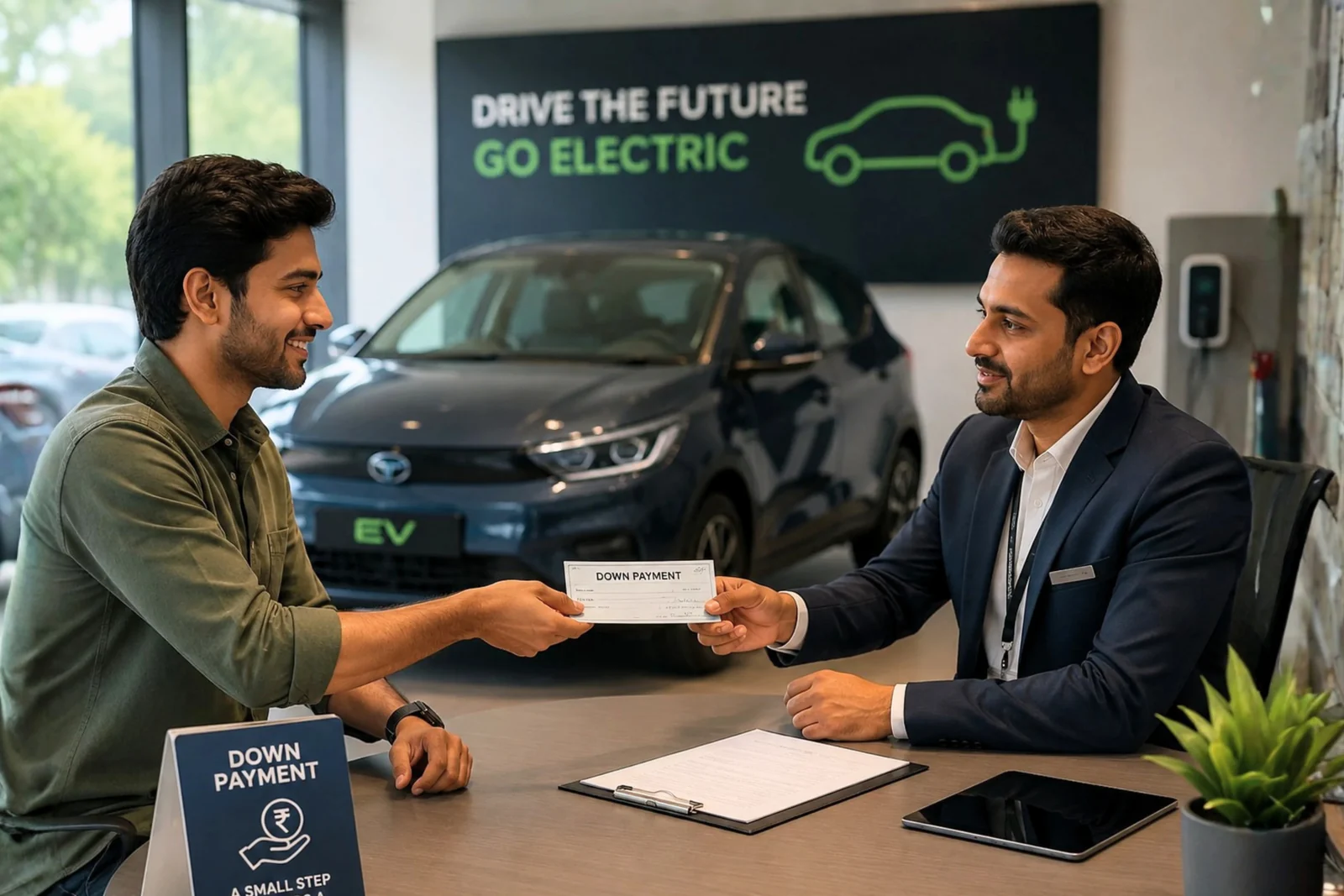
A cousin of mine walked into a showroom last month convinced he needed 3 lakh saved up before he could even think about an EV. He'd been postponing the whole thing for over a year, slowly saving, feeling like the down payment was this huge mountain.
Turned out he needed about 80,000. He'd delayed a year for nothing.
"Yaar mujhe laga poora ek-tihai paisa pehle dena padega. Kisi ne saaf bataya hi nahi."
This is the most misunderstood part of EV buying, easily. People either think they need way more than they do and delay forever, or they put down way too little and regret it when the EMI bites. Both are avoidable once you understand how down payment actually works.
So let me lay it out properly. How much you really need, what changes it, and when putting more or less is the smarter move.
What down payment actually is
Quick basics, because half the confusion starts here.
The down payment is the chunk you pay upfront from your own pocket. The rest is the loan. Lenders express the loan part as LTV, loan-to-value, which is just the percentage of the vehicle price they're willing to finance.
If a lender offers 90 percent LTV on a 1 lakh scooter, they lend 90,000 and you put down 10,000. That's it. The higher the LTV, the smaller your down payment.
And here's the bit my cousin missed entirely: the down payment is calculated on the post-subsidy price, not the sticker price. For EVs that difference is real money. The current PM e-DRIVE subsidy shaves Rs 2,500 per kWh off your bill, capped at Rs 5,000 per vehicle for two-wheelers.
How much you actually need, by vehicle
Rough down payment ranges after subsidies:
| Vehicle | Typical Price (post-subsidy) | Down Payment Range | What You Pay Upfront |
|---|---|---|---|
| EV Scooter | Rs 1.0 to 1.5 lakh | 5% to 15% | Rs 5,000 to 22,000 |
| E-Rickshaw | Rs 1.2 to 1.8 lakh | 10% to 20% | Rs 12,000 to 36,000 |
| Small EV Car (Comet, Tiago EV) | Rs 7 to 11 lakh | 10% to 20% | Rs 70,000 to 2.2 lakh |
| Mid EV Car (Nexon EV) | Rs 13 to 16 lakh | 10% to 20% | Rs 1.3 to 3.2 lakh |
My cousin was looking at a small EV car around 8 lakh. At 10 percent LTV that's 80,000 down, not the 3 lakh he'd convinced himself he needed. The mountain was imaginary.
What pushes your down payment up or down
The required down payment isn't fixed. It moves based on how the lender reads you.
Strong CIBIL and clean salaried profile pushes it down. Lenders happily finance 90, even 95 percent for a low-risk borrower. Smaller down payment.
Weak CIBIL, no credit history, or hard-to-verify income pushes it up. The lender offsets their risk by making you put more skin in. A first-time gig rider with thin CIBIL might be asked for 20 to 25 percent down.
A guarantor or co-borrower pushes it back down. Adding someone with solid income and CIBIL reassures the lender, and they'll often lower the down payment requirement.
The vehicle itself matters too. EVs with stronger resale hold their collateral value better, so lenders finance more of them. Models with weak resale, they finance less, asking for a bigger down payment.
| Borrower profile | Typical LTV offered | Down payment range | Why |
|---|---|---|---|
| Salaried, CIBIL 750+ | 90% to 95% | 5% to 10% | Lowest risk profile |
| Self-employed, clean ITR | 85% to 90% | 10% to 15% | Moderate, ITR readable |
| Gig rider, thin CIBIL | 75% to 85% | 15% to 25% | Higher perceived risk |
| First-time borrower, no credit history | 70% to 80% | 20% to 30% | No track record yet |
| Any profile + guarantor | 85% to 90% | 10% to 15% | Co-borrower reassures lender |
When you should put down MORE than the minimum
Just because you can put 5 percent doesn't always mean you should. Cases where paying more upfront is smart:
You want a lower EMI you're sure you can sustain. More down payment means smaller loan means smaller monthly. Simple.
You want to pay less total interest. Every rupee you don't borrow is a rupee you don't pay interest on. Over a 5-year car loan, a bigger down payment can save you a serious amount in interest — and on a longer tenure the effect is far larger, as our home loan down payment guide shows.
Your rate is on the higher side. If you're a profile getting quoted 17 percent, minimising the loan amount matters more, because that 17 percent compounds on everything you borrow. The full picture is in our EV loan India guide.
When you should put down LESS
And the reverse. Sometimes a smaller down payment is the smarter play:
Your loan rate is low and you have better uses for the cash. If you're getting 12 to 13 percent and you could invest or keep that money as an emergency buffer, there's an argument for borrowing more and keeping your cash working.
You'd be draining your entire savings to make a big down payment. Never empty your emergency fund for a down payment. A vehicle you own outright but with zero savings behind you is a fragile position. Keep a cushion.
You're a gig rider whose EV will immediately start earning. If the vehicle pays for its own EMI through fuel savings or income from day one, conserving your upfront cash and letting the asset carry the loan can make sense. The same logic comes up in our electric bike loan guide.
Back to my cousin
Once he realised he needed 80,000, not 3 lakh, the whole thing unlocked. He actually had 1.4 lakh saved by then from a year of over-saving.
We talked it through. He didn't dump all 1.4 lakh in. He put down about 1.1 lakh, kept 30,000 as a buffer, and financed the rest at a comfortable rate. Smaller loan, EMI he barely notices, and he still has emergency money. The year of delay was wasted, but at least the decision itself came out clean.
"Agar mujhe yeh pehle pata hota, main saal bhar pehle le leta." Probably true. He'd have had the car, the fuel savings, and a year of ownership behind him already.
The lesson is just: find out the real number before you start saving toward an imaginary one. Once you have it, the next step is registering the vehicle through your local RTO via the Parivahan portal, which is what the post-subsidy invoice is built around.
A quick rate note
Where EV loan rates currently sit, since your down payment decision interacts with your rate:
Salaried clean profiles, 12 to 14 percent. Self-employed, 13.5 to 16. Gig and cash income, 15 to 18. The working band is 12 to 19 percent overall. The higher your rate, the more a bigger down payment helps, because you're cutting down the balance that the high rate compounds on.
Where Credifin fits
We finance EVs across India, online. A couple of things relevant to down payment specifically.
We calculate everything on the post-subsidy price, so your down payment is based on the real cost, not the inflated sticker. And for strong profiles we go up to high LTV, meaning a smaller down payment if that's what you want.
For gig riders and self-employed with thinner profiles, we'll often work with a guarantor to bring the required down payment down rather than just demanding a big upfront chunk. Rates land 13 to 19 percent depending on profile, with a decision in 3 to 7 working days. Apply on the EV two-wheeler loan page if you're starting with a scooter.
Bottom line
You almost certainly need less down payment than you think. On most EVs it's 5 to 20 percent of the post-subsidy price, not some giant one-third figure. Strong profiles put down less, riskier ones put down more, and a guarantor brings it down either way.
Whether to pay more or less than the minimum depends on your rate and your savings cushion. Higher rate, pay more to shrink the loan. Low rate with a thin emergency fund, keep your cash and borrow a bit more. Just never find out the number a year too late, like my cousin did.
FAQs
How much down payment do I need for an EV scooter?
Usually 5 to 15 percent of the post-subsidy price, so roughly 5,000 to 22,000 on a typical scooter. Strong profiles pay less.
Is down payment on the sticker price or post-subsidy?
Post-subsidy. The subsidy and tax waiver come off first, and your down payment is a percentage of what's left.
Can I get zero down payment?
Some captive or dealer schemes offer it, but the interest rate is usually higher to compensate. Compare total cost before taking it.
Does a bigger down payment lower my rate?
Not always the rate itself, but it lowers the loan amount and therefore your total interest and EMI. With a high rate, that matters a lot.
Should I empty my savings for a bigger down payment?
No. Always keep an emergency buffer. A paid-up vehicle with zero savings behind it is a risky spot to be in.
Does a guarantor reduce the down payment?
Often yes. A guarantor or co-borrower with good income and CIBIL reassures the lender, who may then ask for less upfront.
Why am I being asked for a high down payment?
Usually weak or thin CIBIL, or hard-to-verify income. The lender offsets risk by asking you to put in more. A guarantor can fix this.
What rate should I expect today?
Roughly 12 to 19 percent across profiles. The higher your rate, the more a larger down payment works in your favour.
Ready to apply?
Want to know your real down payment before you start saving? Apply with Credifin online. We calculate it on the post-subsidy price and offer high LTV for strong profiles, plus guarantor options to bring it down. Decision in 3 to 7 days, pan-India.
This might catch your interest