First-Time EV Buyer? 9 Mistakes That Cost You Money
Lakshay Khanna·08 June 2026
My neighbour bought his first EV last year. A Nexon EV, proud as anything, washed it every morning for the first month. Lovely.
Two weeks in, he knocks on my door looking a bit sick. Turns out he'd financed the whole thing at 17.5 percent through the dealer's "convenient in-house finance" because it was faster, and he hadn't compared a single other lender. Salaried guy, CIBIL 780. He should've been paying 13.
On a 14 lakh loan over five years, that gap was costing him close to 3 lakh in extra interest over the life of the loan. For "convenient."
"Yaar dealer ne bola sabse aasaan yahi hai, maine soch liya theek hoga."
That's mistake number one, and honestly the most expensive one. But there are more, and first-time buyers hit them in a depressingly predictable order. Here they are, so you don't.
Before you sign at the dealership — get one straight quote.
Credifin sizes the loan on the real post-subsidy price and tells you if a dealer quote is high, even before you apply. Decision in 3-7 days, online.
Get a Straight Quote →The 9 mistakes at a glance
| # | The mistake | What it costs you | The fix |
|---|---|---|---|
| 1 | Dealer in-house finance "because it's easy" | Up to Rs 3 lakh extra interest | Get 1 bank + 1 NBFC quote first |
| 2 | Chasing the lowest EMI | A lakh in hidden total interest | Compare total cost, not EMI |
| 3 | Financing the sticker, not post-subsidy | Interest on money you didn't need | Subsidy as a line item |
| 4 | Buying on brochure range | Daily range anxiety | Plan for 75-85% real range |
| 5 | Ignoring home charging | Ownership becomes a chore | Sort charging before buying |
| 6 | Applying at five lenders at once | 30-50 CIBIL points gone | One bank, one NBFC, parallel |
| 7 | Taking the dealer's insurance bundle | 15-30% more, every year | Compare online before signing |
| 8 | Skipping prepayment / foreclosure terms | A surprise 2-5% charge later | Ask both questions before signing |
| 9 | Over-buying on "fuel savings" | A bigger loan than you needed | Buy for actual usage and budget |
1. Taking the dealer's in-house finance because it's "easy"
The dealer finance desk is convenient because it's designed to be. It's also usually the most expensive money in the room. Dealers earn a commission on the loan they sell you, so the "easy" option is rarely the cheap one.
Always get at least one outside quote before you sign anything at the dealership. One bank, one NBFC. Five minutes online. Our bank vs NBFC guide shows which to compare for your profile. My neighbour skipped this and it cost him a small car's worth of interest.
2. Obsessing over EMI instead of total interest
First-timers look at the monthly EMI and nothing else. "Can I afford 18,000 a month? Yes. Done."
But a longer tenure lowers your EMI and quietly inflates the total interest you pay. A 7-year loan feels comfortable monthly and bleeds you over time. Look at the total cost of the loan, not just the monthly number. Sometimes paying 2,000 more a month saves you a lakh overall.
3. Financing the on-road price instead of the post-subsidy price
This one's specific to EVs and it catches everybody. Your state subsidy and road tax waiver come off the price first, much of it via the PM e-DRIVE scheme. You should be financing the lower, post-subsidy number.
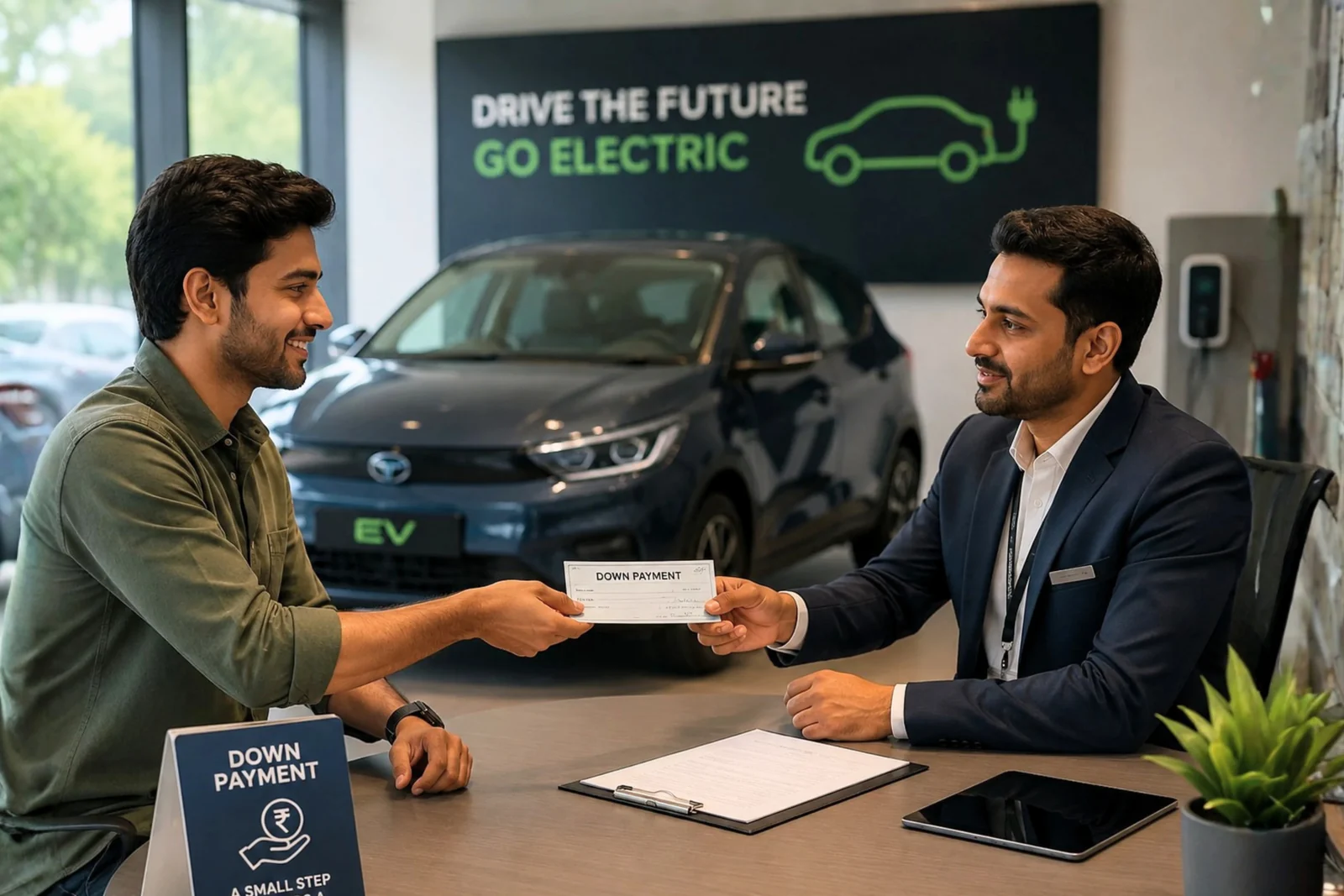
Some dealers quietly finance the full sticker price and let the subsidy disappear into their commission. You end up borrowing more than you needed to and paying interest on money that should never have been in the loan. Insist the subsidy shows as a line item, and that the loan is sized on what's left. Our EV down payment guide breaks down the post-subsidy maths.
4. Not checking real-world range before buying
Brochure range is a lab figure. Real-world you get about 75 to 85 percent of it. A scooter claiming 150 km gives you maybe 120 on a normal day, less with a pillion or AC.
First-timers buy on the brochure number, then panic two months later when the range "drops." It didn't drop. It was always that. Buy for your real daily distance plus a comfortable buffer, not the marketing claim.
5. Ignoring the charging situation at home
People buy the EV and then figure out charging. Wrong order.
If you live in a flat with no dedicated parking, or a building society that won't allow a charger point, your lovely new EV becomes a daily headache. Sort out where and how you'll charge before you buy, not after. This single thing decides whether EV ownership is a joy or a chore.
6. Applying at five lenders in one week
Classic. You get rejected or quoted high once, panic, and apply everywhere. Every application is a hard CIBIL inquiry. Stack four or five and your score drops 30 to 50 points, which gets you worse rates or rejections, which makes you apply more. A death spiral entirely of your own making.
One bank, one NBFC, parallel. That's the whole rule. There's more on getting it right the first time in our EV loan approved on the first try guide.
7. Skipping the insurance comparison too
You negotiated hard on the vehicle, then let the dealer bundle their insurance partner at whatever price, because you're tired and just want the keys. Dealer insurance is often 15 to 30 percent more than what you'd get going direct.
Five minutes comparing online before you sign saves a few thousand a year, every year. EVs have slightly different insurance considerations (the battery is the expensive bit), so check that battery damage is properly covered while you're at it.
8. Not reading the prepayment and foreclosure terms
Nobody reads these until they want to close the loan early. Then they discover a 2 to 5 percent foreclosure charge they never knew about.
Before signing, ask two questions. Can I prepay without penalty after some months? What's the foreclosure charge if I close it early? If you ever get a bonus or want to clear the loan ahead of time, these terms decide whether that's smart or pointless.
9. Forgetting the EV is cheaper to run, and over-buying because of it
Slightly different mistake, this one. People know EVs are cheap to run, so they stretch their budget for a bigger model than they need, telling themselves the fuel savings will cover it.
The fuel savings are real but they don't cover a two-lakh price jump. Buy the EV that fits your actual usage and budget, not the one you've justified with imaginary future savings. The running-cost benefit is a bonus, not a reason to overspend — the real numbers are in our electric vs petrol scooter cost breakdown.
What it should actually cost you
For reference, here's the rate band first-time buyers should aim for:
| Profile | Fair Rate | Watch out if quoted |
|---|---|---|
| Salaried, strong CIBIL | 12% to 14% | Above 15% |
| Self-employed, clean ITR | 13.5% to 16% | Above 17% |
| Gig / cash income | 15% to 18% | Above 19% |
Working band across profiles is 12 to 19 percent. If the dealer or lender is above your row, you have room to walk and find better. First-timers don't realise they have that power. You do.
Back to my neighbour
He couldn't undo the 17.5 percent loan easily. But about eight months in, his CIBIL still solid, he did a balance transfer to a bank at 13 percent. Took a bit of paperwork and a small transfer fee, but it knocked the effective rate way down and saved most of what he'd been about to lose.
"Kaash pehle hi compare kar leta," he said. Yeah. That's the entire lesson in four words.
The good news is most of these mistakes are avoidable with about an hour of effort before you buy. Compare lenders. Read the real range. Sort charging. Check the fine print. An hour now versus lakhs later is not a hard trade. If you're registering a new EV, the road-tax and subsidy details run through the Parivahan portal.
Where Credifin fits
We finance EVs across India, online. For first-time buyers specifically, two things help. We size the loan on the post-subsidy price, so you're not borrowing more than you should. And we'll tell you straight if a dealer quote you've been given is high, even before you apply.
Rates land 13 to 17 percent depending on profile. Decision in 3 to 7 working days. If you're comparing us against a dealer's in-house finance, just put the two quotes side by side. That comparison is the whole point.
FAQs
Is dealer finance ever the right choice?
Occasionally, if they're running a genuine subvented scheme. But always compare against one bank and one NBFC first. Convenience usually costs you.
Should I pick the lowest EMI?
No. Lowest EMI often means longest tenure and highest total interest. Look at total cost, not just monthly.
What range will I really get?
About 75 to 85 percent of the brochure figure. Buy for your real daily distance plus buffer.
Can I switch to a cheaper loan later?
Yes, via balance transfer, if your CIBIL holds up. There's a small fee but it can save a lot.
Do I finance the full price or post-subsidy?
Post-subsidy. Make sure the subsidy shows as a line item and the loan is sized on what remains.
How many lenders should I apply to?
One bank, one NBFC. No more. Extra applications just hurt your score.
Is EV insurance different?
Slightly. The battery is the costly component, so confirm battery damage is covered. And compare, don't just take the dealer's bundle.
What rate is fair today?
12 to 19 percent across profiles. Above your profile's band means shop around.
Ready to apply?
First EV and don't want to overpay? Apply with Credifin online. We size the loan on the real post-subsidy price and give you a straight quote to compare against any dealer offer. Decision in 3 to 7 days, pan-India.
Apply for an EV LoanThis might catch your interest