How Much Does an E-Rickshaw Earn Monthly in India? Profit, EMI & ROI Guide
Lakshay Khanna·18 June 2026
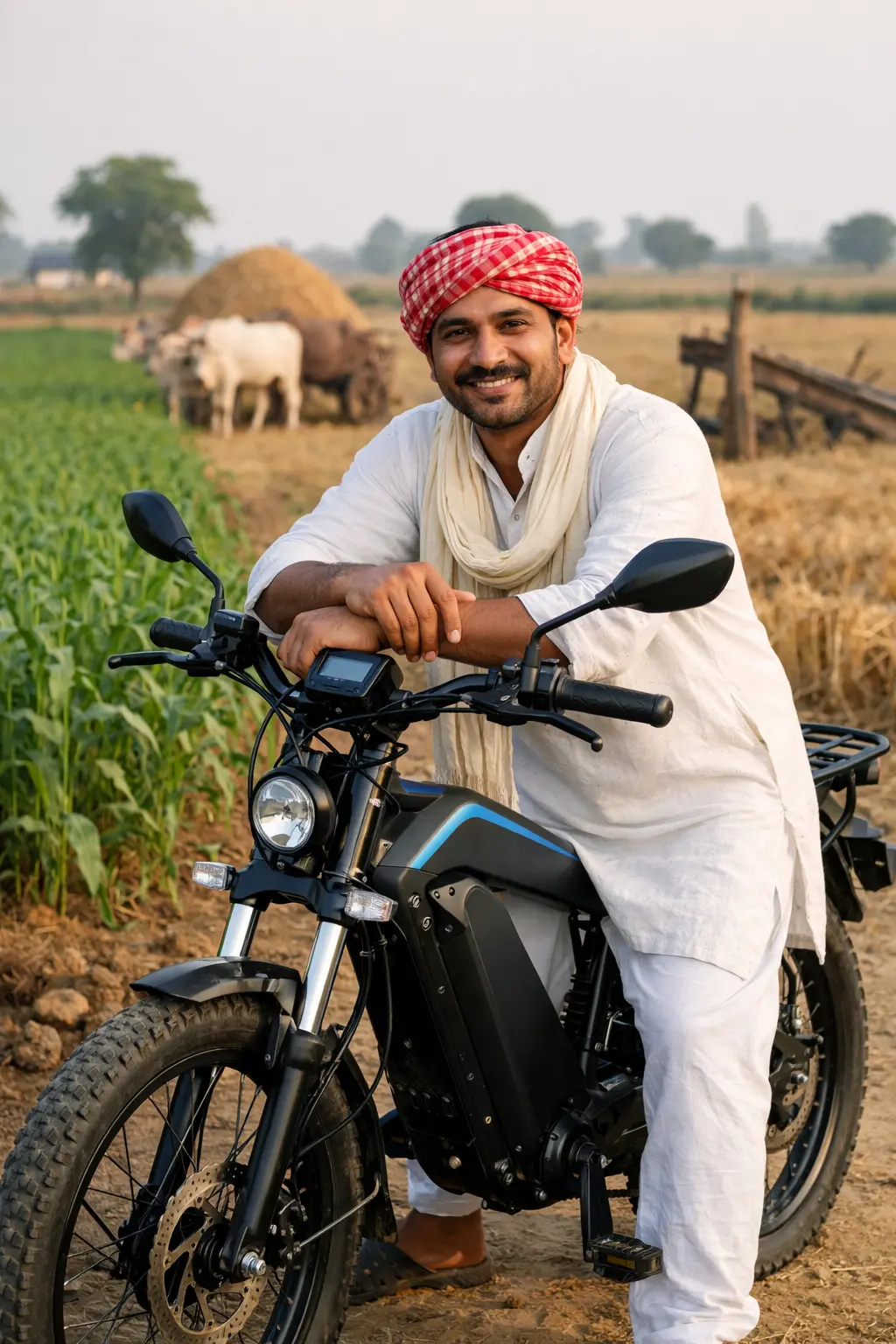
Bhola lives in Basti Sheikh, Jalandhar. Mid-thirties, two kids, wife works at some local school as a helper. Till about June last year he was loading grain sacks at a wholesale shop near Maqsudan for eleven thousand rupees a month. Twelve-hour days. Body absolutely wrecked by Friday. His brother in Ludhiana has been running an e-rickshaw for three years and kept telling him just do it bhai, switch already. Bhola kept saying no, where's the down payment going to come from yaar.
Anyway he did it. June 2025. Bought a passenger e-rickshaw on NBFC loan. EMI four thousand one hundred, three year tenure. Runs the route from Bus Stand to Basti Sheikh via Maqsudan which is one of the better passenger lanes in Jalandhar.
I called him last week. Asked how it's actually going. His exact words — "Pehle wali job se double kama raha hu bhai, lekin thakawat aadhi hai." Double the old income, half the exhaustion.
That story isn't unusual. It's basically every honest e-rickshaw operator's story in tier 2 India right now. The economics work. The only real question is how much exactly, and whether the EMI eats too much of the take-home for it to be worth the hassle. Most articles you'll find online either lowball it or massively overpromise. Let me try to be straight with you.
A passenger e-rickshaw in India grosses roughly Rs 800 to Rs 1,500 a day. After charging, a battery set-aside, permits, repairs and the EMI — about Rs 9,500 a month in running costs — a typical operator takes home Rs 16,500 to Rs 29,500 a month. That's usually 2 to 3 times an unskilled-labour wage, with the vehicle owned outright in 36 months.
Thinking of buying an e-rickshaw?
Credifin finances first-time operators on route potential and repayment capacity — not ITR or salary slips. Passenger or cargo, decision in days, not weeks.
Apply for an E-Rickshaw Loan →The daily revenue thing
Range I keep seeing across Jalandhar, Noida, Lucknow and Patna is somewhere between Rs 800 and Rs 1,500 a day in gross revenue for passenger work. Wide range because honestly it depends on so many things.
Bhola does roughly Rs 1,200-1,300 a day on his route. Bus Stand connection helps him a lot — there's always foot traffic. Guys running residential-only routes in say the Adampur side make less, sometimes Rs 700-900 because the passenger volume just isn't the same. A friend of his runs near Civil Hospital and BMC chowk, busier area, pulls in Rs 1,400 on weekdays and crosses Rs 1,600 on Saturday. Same vehicle, different route, almost double the difference on a good day.
| Location / Route Type | Approx. Daily Gross Revenue |
|---|---|
| Tier-1 metro (Delhi, Mumbai, Bangalore) | Rs 1,200 to Rs 2,000+ |
| Tier-2 city, busy route (bus stand, hospital, market) | Rs 1,200 to Rs 1,600 |
| Tier-2 city, residential-only route | Rs 700 to Rs 900 |
| Tier-3 small town | Rs 500 to Rs 800 |
| Cargo e-loader (contracted runs) | Rs 1,000 to Rs 1,800 |
Tier 1 cities pay better — Delhi, Bangalore, Mumbai routes I've seen operators report Rs 1,200-2,000 a day, sometimes more on the metro-station feeder routes. Tier 3 small towns are way lower, often Rs 500-800 because the fares per ride are also lower and there's more competition.
Hours obviously matter. The serious guys do 10-11 hours total but they split it — early morning 7 to 11, long charging and lunch break, then 4 PM to 9 PM peak hours. Trying to do continuous 11 hours kills both you and the battery. Bhola figured this out by month two when he was constantly running out of charge in the late afternoon.
Weather can wipe out earnings completely. Heavy rain in Punjab in July-August basically kills 30-40% of the working days because passengers don't want to sit in an open e-rickshaw in monsoon. December-January cold mornings cut the morning shift earnings because everyone prefers covered autos. Summer afternoons aren't bad surprisingly — open vehicle gives some breeze when you're moving.
If you're doing cargo instead of passenger that's a whole different game. E-loaders in Punjab right now pull in Rs 1,000-1,800 a day mostly through contracted runs with local kirana suppliers, courier outfits, small wholesalers. Fewer trips per day but higher per-trip value. Vehicle is more expensive, EMI is higher, but the income tends to be more stable because most of it is contracted not opportunistic.
Where the money actually goes
Gross revenue and take-home are two very different numbers. People forget this when they're getting excited about Rs 1,500 a day.
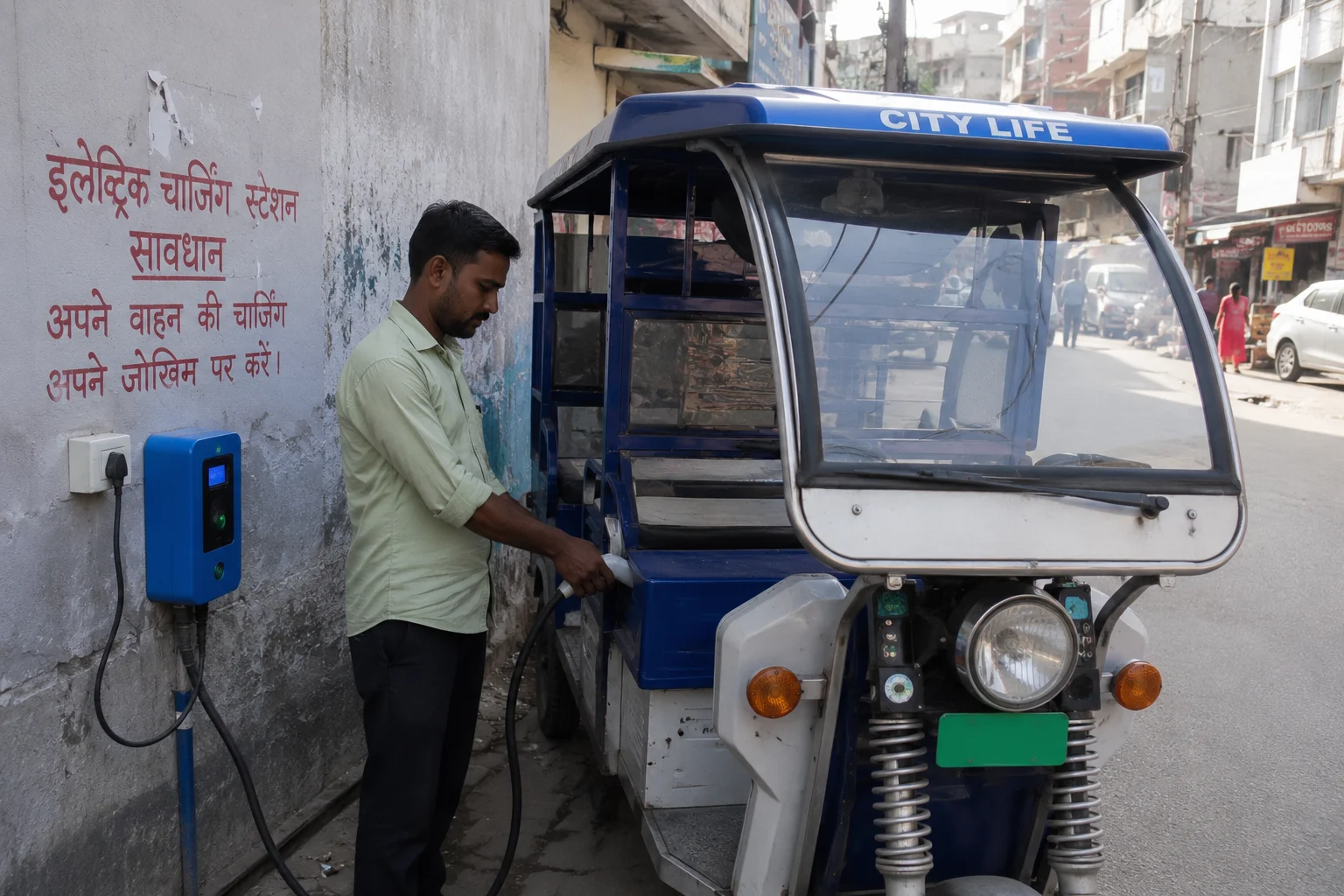
You're charging the vehicle daily, that's about 8-9 units for a full battery, electricity at home in Punjab is what, Rs 7-8 per unit on domestic, so maybe Rs 65-70 a day just on charging. If you charge at a paid station because you don't have home access, the commercial tariff is Rs 12-15 per unit and your charging cost doubles. Bhola charges at home so he's at the lower end.
Then there's the battery situation which is the thing nobody warns first-time buyers about properly. If you bought a lead-acid e-rickshaw (which most cheaper models still are), the batteries are going to need replacement in 14-18 months under daily heavy use. A full set is Rs 22,000 to Rs 30,000 depending on brand.
Spread that over the life of the batteries and you should mentally set aside about Rs 1,500-1,800 a month for the next replacement. People who don't do this run out of money when the batteries die and then they have to take an emergency loan at terrible terms. Don't be that guy — our EV battery replacement loan guide covers the smarter way to handle it.
Lithium is the alternative. Batteries last 3-4 years instead of 18 months, charge faster (4-5 hours vs 8-10), and the vehicle is lighter so slightly more efficient. Catch is the e-rickshaw with lithium costs Rs 25,000-30,000 more upfront and when those batteries eventually do need replacement, you're looking at Rs 60-90 thousand not Rs 25k. If you're going to operate the rickshaw for 5+ years and ride it hard, lithium pays back. If you're doing 3-4 hours a day part-time, lead acid is fine because the batteries last longer under lighter use anyway. Most first-time buyers should just start with lead-acid honestly, get into the business, learn the trade, then upgrade to lithium when the first vehicle gets replaced in year 3 or 4.
Permits, insurance, that whole government paperwork side is about Rs 3,500-4,500 a year. Less than four hundred rupees a month essentially.
Repairs are unpredictable. Some months it's literally nothing. Then you'll hit a month where a motor controller goes and that's Rs 4,500 in one shot. Tyres wear out, suspension bits go, the wiring needs a fix. Average it across a year, Rs 1,200-1,800 a month is realistic.
Add the EMI. For a Rs 1.5 lakh on-road passenger e-rickshaw with say 20% down payment, you're financing Rs 1.2 lakh over 36 months at around 14%. That's about Rs 4,100 a month. Cargo loaders that cost Rs 1.8 lakh on-road work out to roughly Rs 4,900 EMI. If down payment is the blocker, the EV down payment guide shows how to size it.
So if I put all that together — charging plus battery set-aside plus permits plus repairs plus EMI — your monthly outflow before take-home is around Rs 9,500. Roughly.
| Monthly Cost | Approx. Amount |
|---|---|
| Charging (home tariff) | Rs 1,800 to Rs 2,000 |
| Battery replacement set-aside | Rs 1,500 to Rs 1,800 |
| Permits & insurance | ~Rs 400 |
| Repairs (averaged over the year) | Rs 1,200 to Rs 1,800 |
| EMI (Rs 1.2 lakh / 36 months / ~14%) | ~Rs 4,100 |
| Total monthly outflow | ~Rs 9,500 |
The actual take-home
This is what people want to know.
Bhola's Rs 1,250 daily average across 26 working days a month gives him Rs 32,500 gross monthly. Take out the Rs 9,500 in operating costs and EMI, he's taking home around Rs 23,000. Which compared to the Rs 11,000 he was making at the grain shop is genuinely life-changing for his family.
| Operator Type | Gross / Month | Costs + EMI | Approx. Take-Home |
|---|---|---|---|
| Slow route (~Rs 1,000/day) | Rs 26,000 | ~Rs 9,500 | Rs 16,500 |
| Average route (~Rs 1,250/day) | Rs 32,500 | ~Rs 9,500 | Rs 23,000 |
| Premium route (~Rs 1,500/day) | Rs 39,000 | ~Rs 9,500 | Rs 29,500 |
| Cargo (single vehicle, contracted) | Rs 32,000 to Rs 36,000 | higher EMI | Rs 19,000 to Rs 25,000 |
Guys doing Rs 1,000 a day on slower routes are at Rs 26,000 gross, take-home around Rs 16,500 a month. Still better than most labour jobs in the same city but not the dramatic improvement Bhola got. Guys doing Rs 1,500 a day on premium routes — Rs 39,000 gross, take-home around Rs 29,500. These are the operators who picked their route carefully and run long disciplined hours.
Cargo work is slightly different because the contracted revenue is more predictable but the EMI is higher. Net take-home for a single-vehicle cargo operator with established client routes is somewhere between Rs 19,000 and Rs 25,000 a month. Less variance, more stress about client retention.
Akash in Sector 62 Noida runs a cargo e-loader serving small wholesalers in Sector 18 and Atta market. Bought the loader at Rs 1.78 lakh on-road. Down payment Rs 35,000 — Rs 27k from his savings, Rs 8k borrowed from his brother. NBFC loan for Rs 1.43 lakh at 14.5%, EMI Rs 4,920.
He has three regular wholesalers paying him Rs 8,000-10,000 a month each for daily deliveries inside a 6 km radius. That contracted revenue is Rs 26-30k and he picks up spot deliveries on top whenever he has free time. Monthly gross Rs 32,000-36,000. After operating costs and the EMI, he's clearing Rs 19,000-22,000 take-home. When I asked him about the business after 14 months his honest reply was "Bhaiya paisa theek hai, lekin tension batteries ki sabse zyada." Money is fine, biggest stress is batteries.
That stress is real and you should know about it before buying. It's the single most important operational worry for any e-rickshaw owner.
Like these take-home numbers? Credifin finances first-time operators in days — on your route potential, not ITR.
Check Your E-Rickshaw Loan →The loan question that scares people
Most first-time buyers panic at the idea of an EMI on a vehicle they don't own yet. I get it. But the alternative isn't usually "buy outright with cash" — almost nobody has Rs 1.5 lakh sitting in their account anyway. The real alternative is "stay in the job you're currently in."
So when you compare it that way, the math is straightforward. If your take-home after EMI is meaningfully more than what you're earning now, the loan is worth it. Bhola's Rs 23,000 take-home after EMI versus Rs 11,000 from loading work is obviously a yes. For someone making Rs 18,000 in a stable admin job the math is tighter — maybe Rs 23,000 e-rickshaw versus Rs 18,000 admin is only Rs 5,000 extra and you've taken on a vehicle, battery risk, daily exposure. For someone in a Rs 35,000 salaried role, switching to e-rickshaw operation usually doesn't make sense unless they want a complete lifestyle change.
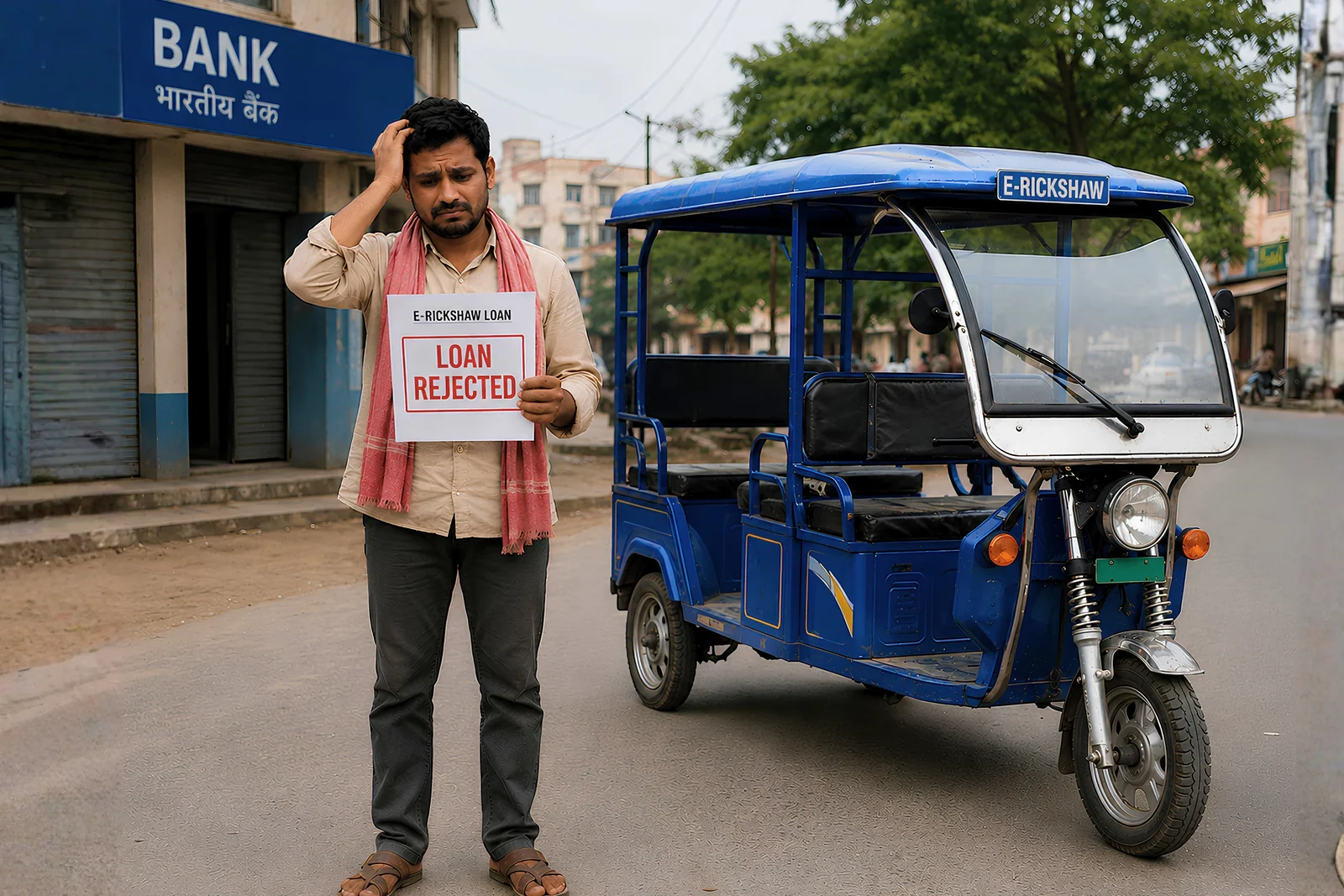
There's also a thing about who you borrow from that matters a lot. A bad lender will destroy what would otherwise be a profitable business. The informal lending guys who charge effective interest rates of 30%+ — avoid those completely no matter how easy they make it sound. Dealer financing that's bundled with overpriced insurance and unnecessary accessories — read everything carefully before signing. Banks usually won't fund e-rickshaws because the borrower profile doesn't match their checklists, which is fine, NBFCs are where this business lives anyway. If a lender has already turned you down, our guide on why e-rickshaw loans get rejected walks through the fix for each reason.
For first-time operators with no credit history, expect the lender to ask for a guarantor or a slightly higher down payment. That's standard. As you build a clean repayment record on the first vehicle, the second loan becomes easier and the terms get better. Bhola told me his next loan, whenever he decides to take it for a second rickshaw, will probably get him a slightly better rate just because he's now on lender records as a clean repayment file.
What happens at the end of the loan
Three-year loan, EMI Rs 4,100, by month 36 you've paid back Rs 1,47,600 for the Rs 1.2 lakh you borrowed. Total interest Rs 27,600 across three years. Not bad considering the lending risk on a first-time operator with no formal income proof.
After month 36 the loan is done. The vehicle is yours, no encumbrance, you can do whatever you want with it. The frame and motor will easily last another 2-4 years if you've maintained things properly. Batteries you've already replaced once in the loan period and will need to do again. But your monthly take-home jumps by Rs 4,100 the moment the EMI stops which is a serious step up.
Total earnings across those three years for a guy like Bhola — somewhere between Rs 8 lakh and Rs 10 lakh in take-home. From a Rs 30,000 down payment investment. Plus the asset itself at the end which has some residual value. There aren't many businesses at this capital level that produce these kinds of returns.
Rs 8 to 10 lakh over three years from a Rs 30,000 start. Ready to begin?
Apply for an E-Rickshaw Loan →The second-vehicle move
The really interesting income jump comes when you add the second rickshaw. There's a guy in Jalandhar I know of — Surinder, runs five rickshaws now. He started with just one in 2022. Bought the second in early 2024 when his first one had been profitable and stable for about 14 months. Then added roughly one per year. Drives one himself, rents the other four to drivers at Rs 400-450 daily rental. He pays for batteries and major repairs, drivers handle daily charging and minor stuff.
His personal vehicle nets him about Rs 23,000 a month. Each rental rickshaw gives him roughly Rs 11,000-12,000 after his share of costs. Four rentals is Rs 45,000-48,000. Total monthly take-home north of Rs 65,000 from a fleet that started with one vehicle and patience.
That's where small-capital owner-operator transitions into actual small business income. The path is just one vehicle at a time as the previous one becomes stable.
But this comes with real headaches I should mention. Drivers come and go. Some disappear after a week. Vehicles get damaged through careless driving. Some months a rental vehicle sits idle for ten days because the driver vanished and you're scrambling to find a replacement. You need 1-2 backup drivers on call and enough cash buffer to absorb a vehicle being non-operational for a couple of weeks at a time. If you don't have the patience for this kind of people-management, stay with one vehicle and run it well.
Subsidies that actually apply
PM E-DRIVE (Central)
Running for e-rickshaws till March 2028 — much longer than the two-wheeler window that closes in July 2026. The subsidy is Rs 2,500 per kWh of battery capacity, capped at Rs 12,500 per vehicle. Most passenger e-rickshaws qualify for the full Rs 12,500 deduction. It comes off the dealer invoice automatically; you don't apply for anything.
State Incentives (UP, Delhi & others)
UP gives 15% of purchase price capped at Rs 12,000, plus three years of road tax exemption. Delhi gives a Rs 30,000 scrapping incentive if you're swapping out an old fuel auto. Maharashtra, Karnataka and Telangana all have variants. Punjab's current state subsidy is modest, so in Jalandhar we mostly see only the central PM E-DRIVE benefit.
Always Verify the Model
Always ask your dealer for the exact PM E-DRIVE approval number for the model you're buying, then verify it on the Ministry of Heavy Industries portal. Some cheaper models from smaller manufacturers don't qualify even though dealers will claim they do. The Rs 12,500 difference matters when your margins are tight. UP buyers can check state incentives on the UP Government portal.
Stuff you actually need to start
Under 250 kg unladen weight, LMV gearless covers it. Heavier vehicles need a three-wheeler commercial endorsement. Sort this before applying for the loan because lenders verify at disbursement.
Even if you're earning Rs 12,000 from manual labour, lenders want to see it consistently in the account rather than as cash. If you've been getting paid cash, start receiving payments via UPI for at least three months before applying. This single thing improves your file more than anything else.
Aadhaar, PAN, address proof. Nothing exotic.
Don't buy the vehicle and then figure out where to operate. Spend two weeks observing the routes you're thinking of running. Count passengers during peak hours, talk to other operators, understand the local fare expectation. The most profitable operators picked their route first.
Rs 8,000-12,000 in reserve for the first month even after the down payment. Electricity, food, minor repairs, the EMI on the due date — the first month is when surprises happen and you don't want to be flat broke when something unexpected hits.
Final reality check
E-rickshaw operation in India is genuinely one of the better small-capital businesses available. The income is real, the asset accumulates value, the EMI is manageable for someone whose alternative is loading sacks or working as a security guard. But it's not effortless and it's not for everyone.
You're responsible for daily charging discipline, route management, battery longevity, the occasional drunk passenger, the cop at the chowk who wants chai paisa, the inevitable breakdown at the worst possible moment. None of this is glamorous. The reward is a take-home that's typically 2-3x what unskilled labour in the same city pays, and an asset you own outright in 36 months.
If you're committed and you've done the route research and you have the down payment, it works. If you're hesitant or you're hoping someone will manage the operation for you, it doesn't.
Bhola's the example I keep coming back to because his trajectory is realistic — not the inspirational Rs 60,000 a month fleet operator stories, just a regular guy who doubled his income with one disciplined vehicle. That's what's actually achievable for most first-time operators in the first year. When you're ready to buy, the EV loan in Jalandhar and EV loan in Noida guides cover local financing for exactly this.
Talk to Credifin
Credifin is an RBI-registered NBFC financing e-rickshaws for first-time operators across Punjab, Delhi NCR, Uttar Pradesh and beyond — underwriting on route potential and repayment capacity, not ITR.
079651-74500 | info@credif.in
Find your nearest branch →
FAQs
How much does an e-rickshaw earn per month in India?
After charging, battery set-aside, permits, repairs and EMI, a passenger e-rickshaw operator typically takes home Rs 16,500 to Rs 29,500 a month depending on route quality. A single-vehicle cargo operator with contracted clients nets roughly Rs 19,000 to Rs 25,000.
Is an e-rickshaw a profitable business?
Yes, for someone whose alternative is unskilled labour. Take-home is typically 2 to 3 times what manual labour pays in the same city, the EMI is manageable, and you own the vehicle outright in 36 months. It isn't effortless — it depends on route choice, disciplined hours and battery care.
Should I buy a lead-acid or lithium e-rickshaw?
Lead-acid is cheaper upfront but the battery set needs replacing every 14 to 18 months (Rs 22,000 to Rs 30,000). Lithium lasts 3 to 4 years and charges faster but costs Rs 25,000 to Rs 30,000 more upfront and Rs 60,000 to Rs 90,000 to replace. Most first-time buyers should start with lead-acid and upgrade to lithium when the first vehicle is replaced.
Can I get an e-rickshaw loan without ITR or a salary slip?
Yes. Banks usually won't fund e-rickshaws, but NBFCs underwrite first-time operators on route potential and six months of bank statements rather than ITR or salary slips. First-timers may need a guarantor or a slightly higher down payment.
How much down payment do I need for an e-rickshaw?
Around 20 percent is typical — about Rs 30,000 on a Rs 1.5 lakh on-road passenger e-rickshaw, financing the rest over 36 months. First-time operators with no credit history may need to bring more or arrange a guarantor.
Ready to start?
Looking to buy an e-rickshaw — passenger or cargo — anywhere in India? Credifin underwrites first-time operators based on route potential and repayment capacity, not ITR or salary slips you don't have. Get a quote online or find your nearest Credifin branch.
Apply for an E-Rickshaw LoanThis might catch your interest