EV Battery Replacement Loan in India: What Most Owners Don't Realise (2026 Guide)
Vansh Budhiraja·28 April 2026
So you're on your way to work, riding the same electric scooter you've had for years, and you notice the range bar dropping way quicker than it should. By the time you park in the evening, the battery is at 20% and you've barely done what used to be a normal day's running. Sounds familiar, right?
Next morning you take it to your usual mechanic. He plugs in his tester, looks at the reading for a few seconds, then gives you that quiet sigh. "Battery khatam ho chuki hai bhai. Ab toh replace hi karna padega."
Then comes the quote. And honestly, it's never the number you were hoping for. Anywhere from Rs. 45,000 for a basic scooter pack to over a lakh if you ride something premium. The annoying bit is that your EV is otherwise perfectly fine. Motor's running, the body looks new, brakes work, lights work. You just need one part replaced. And that one part happens to be the most expensive thing on the whole vehicle.
Which brings up the obvious question. Is there a loan that covers only the battery? Not a new EV, not a regular personal loan, just the pack itself.
Turns out, yes. NBFCs in India started offering this EV battery replacement loan in the last couple of years and it's quietly become one of the most useful loan products around. Whether you actually qualify, what kind of interest rate to expect, and the small things people miss before signing, all of that is what we're getting into below. No fluff, no hype. Just the stuff worth knowing before you spend.
Why So Many Batteries Are Dying Together Right Now
Bought your EV sometime between 2020 and 2022? You're definitely not alone in dealing with this. Those couple of years were when electric two-wheelers and e-rickshaws really took off here. Petrol had just gone past a hundred bucks a litre, the FAME-II subsidy was making EVs genuinely affordable, and showrooms couldn't keep stock for even a week. Folks who'd never seriously considered going electric ended up booking one after a single test ride.
Cut to four or five years later. The early excitement has faded, and now the long-term bills are starting to come in.
Quick technical detail, nothing complicated. A regular lithium-ion pack on most electric scooters is designed to give you 5 to 8 years of use, somewhere around 50,000 to 80,000 km of riding, whichever you hit first. That's the number assuming you treat it reasonably. Park it under direct afternoon sun every day, leave it plugged in all night, or let it die down to zero before charging, and you'll see the life shorten noticeably. The same rules apply to commercial EVs, except those packs deal with way more daily abuse.
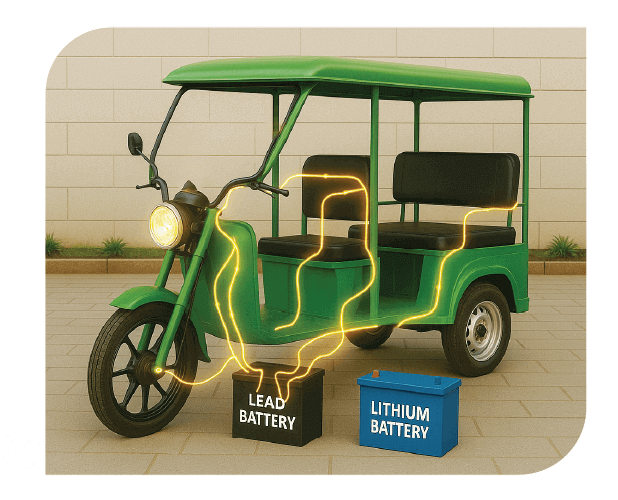
E-rickshaws are a whole separate game. A big chunk of them in India are still running lead-acid sets because they're cheap to buy. Problem is, they don't last. A driver clocking 80 to 100 km a day will usually be back at the battery shop every 12 to 18 months for a full replacement set. Some replace twice a year if the route is hilly or if the charging is irregular. Lithium upgrades last way longer, but they cost more upfront, which is exactly why most rickshaw owners stick with lead-acid until something forces a change.
Vehicles picked up in late 2020 or early 2021 are hitting their end-of-life mark sometime in 2026. There's nothing surprising or unfortunate about it. Lithium cells just lose capacity over time and over the number of charge cycles they go through, and both of those are quietly catching up with the first big wave of EV buyers in India.
You can see the pattern clearly. In Punjab, Haryana, Delhi NCR, and across the western UP belt, mechanics are hearing the exact same complaints. Range has halved. Charging takes way longer. Vehicle slows down on inclines. Lakhs of owners are getting the same diagnosis in the same financial year. Service centres in Ludhiana, Faridabad, Karnal, and Meerut have backlogs running into weeks for battery work alone.
Motor's running clean, the body still looks decent aside from a few scratches, wiring is fine, headlight and indicators all work. So replacing only the battery makes way more sense than dumping the whole EV and buying fresh. That bit is easy to figure out. The tough part is finding the lakh or so to actually pay for it, which is where most owners get stuck.
So How Much Does a New Battery Actually Cost?
Depends on what you ride and where you get it done. OEM service centres charge more but back it with a warranty. Third-party shops in metro cities cost less but you lose any warranty cover the rest of the EV still has. Here's what 2026 prices look like for the most common vehicles.
| Vehicle Type | Battery | What You'll Pay | Lasts For |
|---|---|---|---|
| Basic e-scooter (2 kWh) | Lithium-ion | Rs. 45,000 to 55,000 | 5 to 7 years |
| Mid scooter (3 to 4 kWh) | Lithium-ion | Rs. 65,000 to 90,000 | 5 to 8 years |
| Premium scooter (5 kWh+) | Lithium NMC | Rs. 1.1 to 1.2 lakh | 6 to 8 years |
| E-rickshaw (lead-acid) | 4 lead-acid units | Rs. 30,000 to 45,000 | 12 to 18 months |
| E-rickshaw (lithium) | Lithium LFP | Rs. 60,000 to 1.2 lakh | 4 to 6 years |
| Electric auto / cargo | Lithium LFP | Rs. 1.2 to 2 lakh | 5 to 7 years |
Few things to keep in mind before you start asking around for quotes.
- OEM is safer. Costs more, but you get 1 to 3 years of warranty on the new pack. Worth it for daily-use vehicles.
- Third-party can save 30 to 40%. Workshops in Delhi, Bengaluru, Pune and Hyderabad now do cell-level repairs. The catch is, going this route voids whatever OEM warranty was left.
- Battery-as-a-Service (BaaS) is something brands like Hero Vida offer. Pay a monthly subscription instead of one big amount. Useful if cash flow is the issue more than the cost itself.
- Check warranty FIRST. Sounds obvious, but many owners skip this. If your battery's State of Health is below 70% and you're still inside the warranty window, FAME-II rules say the manufacturer has to replace it cheap or free. Don't pay before you've checked.
Yes, There's a Loan for Just the Battery
This wasn't really a thing a few years back. Vehicle loans only worked for new purchases. That changed.
Today, several NBFCs offer loans built specifically for battery replacement. Some banks have started doing it too, mostly for premium EVs. The loans are kept small and short on purpose, since that's what fits the situation. You're not waiting two months or pledging your house to make this work.
What These Loans Cover
- Two-wheeler EV battery swap
- E-rickshaw battery, both lead-acid replacement and lithium upgrade. See our L5 e-rickshaw finance options
- Three-wheeler and cargo EV packs
- Battery plus charger or solar setup combined into one loan
- Retrofit kits, where the RTO allows it
Loan amounts run from about Rs. 30,000 to Rs. 2 lakh. Tenures sit between 12 and 36 months. Short tenure means a slightly bigger EMI, but you pay way less interest overall.
Where to Actually Apply
This is where it gets real. Salaried person in Gurgaon with a stable bank account and 730 CIBIL? Walk into HDFC, you'll be fine. E-rickshaw driver in Karnal who hasn't filed an ITR in three years? Same bank will probably reject you at the screening stage, before anyone even looks at your vehicle.
| Lender | How Fast | Interest | Papers Needed | Who It Works For |
|---|---|---|---|---|
| Private Bank | 2 to 4 weeks | 10% to 14% | ITR, salary slips, CIBIL 700+ | Salaried folks with clean records |
| NBFC like Credifin | 2 to 5 days | 12% to 18% | Bank statements, KYC, RC | Self-employed, drivers, traders |
| Local Sahukar | Same day | 30% to 60% | Mostly nothing | Honestly, nobody |
That last row exists, sure. People still borrow from local lenders because the cash arrives by evening. But please run the numbers before you do. A Rs. 60,000 battery on a 3% per month informal loan ends up costing Rs. 90,000 to Rs. 1 lakh by the time you finish paying. Same battery, same use, just a worse deal. If a regulated NBFC will work with you, go that route.
Who Qualifies and Who Doesn't
Banks still treat battery loans like regular vehicle loans. Same checklist, same rigid criteria. Which is why so many self-employed EV owners get a no without much explanation. NBFCs play this differently because they actually know who rides EVs in this country.
What an NBFC Will Look At
- Vehicle registered in your name with a valid RC and insurance
- Vehicle age, usually under 7 years for two-wheelers, under 5 for commercial EVs
- Some kind of income proof, where bank statements work in place of ITR
- Aadhaar and PAN for KYC
- Existing EMI commitments, if any, to figure out how much you can comfortably pay
Why This Matters If You Drive for a Living
Most e-rickshaw drivers don't have ITR. Most delivery riders earn partly in cash. Many small fleet owners run a real business but their books are basic. None of that means they can't pay back a loan.
A driver who runs the same e-rickshaw every day on a fixed route, deposits earnings into a bank account most weeks, and pays his rent on time has a clear ability to repay. NBFCs will work with that. Banks usually won't, no matter how steady the actual income is.
Real Numbers: What Your EMI Will Look Like
Here's how the math plays out at 15% per year, which is roughly where most NBFCs land. The actual number on your loan agreement will depend on your profile, processing fee, and any insurance bundled in.
| Loan | Tenure | Monthly EMI (15%) | Total Paid Back |
|---|---|---|---|
| Rs. 50,000 | 18 months | Rs. 3,140 | Rs. 56,520 |
| Rs. 75,000 | 24 months | Rs. 3,640 | Rs. 87,360 |
| Rs. 1,00,000 | 24 months | Rs. 4,850 | Rs. 1,16,400 |
| Rs. 1,50,000 | 36 months | Rs. 5,200 | Rs. 1,87,200 |
For most full-time EV users, paying Rs. 3,000 to Rs. 5,000 a month is doable. A delivery rider doing 800 to 1,200 rupees daily usually recovers the EMI from petrol savings alone, since electricity per kilometre is a fraction of what fuel costs. Once the loan ends, the vehicle goes back to being almost free to run.
Stuff People Get Wrong
A few mistakes show up over and over. Worth flagging before you make them yourself.
- Walking into the dealer first. Convenient, sure, but dealer-tied loans almost never have the best rate. Get one outside quote at minimum before signing anything.
- Skipping the warranty check. Already mentioned this once but it's worth saying again. If your battery's still covered, you may not need a loan at all.
- Going for the cheapest aftermarket pack. A 15,000-rupee saving on a low-quality battery becomes a 70,000-rupee headache when it dies in two years. Stick to OEM or BIS-certified replacements.
- Not asking about prepayment. If you have a strong month and want to close the loan early, will the lender let you? Some do, some charge a fee, some make you pay full interest. Ask before you sign.
- Treating it like an informal deal. Even a small loan needs proper paperwork. Verbal arrangements is where the trouble starts.
Why Credifin Makes Sense for North India
Credifin isn't trying to be a national giant. It's an NBFC built around how people actually earn and ride in Punjab, Haryana, and the surrounding states. That regional focus shows up in how their loans work.
On the government's Parivahan portal, they're registered as the financer on the highest number of EV registration certificates among NBFCs in Punjab. Bigger volume than the others by a clear margin. Which means they've already seen every kind of borrower. The auto driver in Patiala. The delivery partner in Mohali. The small fleet owner in Ludhiana running four e-rickshaws on rent.
Their underwriting reflects all that. Bank statements work in place of ITR. Cash income gets considered when there's a transaction trail. Approvals come through in 2 to 5 working days. And because they're RBI-registered, the whole thing is documented, the rate is fixed, and the legal protections are real. None of that informal-lender mess.
Quick Checklist Before You Apply
- Get the battery properly diagnosed. Sometimes a faulty BMS or controller gets blamed on the battery. Don't pay for a swap you didn't need.
- Confirm warranty status. Even partial warranty cover changes everything.
- Get 2 to 3 quotes. OEM, certified third-party, dealer. The same battery can vary by 25 to 40%.
- Add up the total cost. EMI plus processing fee plus insurance, not just the headline rate.
- Read the prepayment clause. It tells you how flexible the loan really is.
Bottom Line
A battery replacement isn't a disaster. It's a planned cost that hits at year five or six of ownership, and it gives you another five to seven years of running on what you already own. That's a far better deal than scrapping the vehicle and buying new.
If you're salaried with a strong CIBIL and weeks of patience, your bank will give you the cheapest rate. If you're self-employed or driving for a living, an NBFC like Credifin is built for exactly your situation. Slightly higher rate, but the loan actually goes through. And it goes through fast enough that you don't lose three weeks of earnings while waiting on paperwork.
One last thing. Don't wait until your EV refuses to start one morning. The minute range drops to half, start gathering quotes. Sort it out while the vehicle is still useful, not after it's been parked for a fortnight.
Frequently Asked Questions
-
Can I get a loan only for the battery, without buying a new vehicle?
Yes. NBFCs like Credifin have a specific product for this. It works on existing two-wheelers, e-rickshaws, and commercial three-wheelers. You don't have to buy a new EV.
-
How much loan can I expect?
Two-wheeler battery loans usually fall between Rs. 30,000 and Rs. 90,000. E-rickshaw lithium upgrades and commercial EV packs run higher, often Rs. 80,000 to Rs. 2 lakh. Loan amount mostly tracks battery cost.
-
Is high CIBIL mandatory?
Not for NBFCs. They look at bank statements, vehicle ownership, and consistent income alongside the score. Below 700 isn't an automatic no. Banks are stricter and usually want 700 or more before they'll talk.
-
How long does approval take?
Two to five working days at NBFCs like Credifin. Two to four weeks at private banks. Local lenders disburse the same day but the rates make the loan a worse deal than the original problem.
-
Will the EV be used as collateral?
For smaller loans, the vehicle's RC and ownership papers usually serve as security. No separate collateral needed. Larger loans may ask for more, but battery loans rarely cross that threshold.
-
I drive an e-rickshaw and don't have ITR. Can I still get this loan?
Yes. NBFCs accept bank statements and proof of regular income instead of ITR. This is exactly why drivers, delivery riders, and small fleet owners prefer them over banks for battery financing. See our used e-rickshaw loan options as well.
-
Should I upgrade my e-rickshaw to lithium or stay with lead-acid?
Lithium LFP costs more upfront, somewhere between Rs. 60,000 and Rs. 1.2 lakh. But it lasts 4 to 6 years and barely needs maintenance. Lead-acid is cheaper, Rs. 30,000 to Rs. 45,000, but you'll be replacing it every 12 to 18 months. Run it over four years and lithium almost always works out cheaper, especially if you're doing high mileage.
-
What is the EMI on an EV battery replacement loan?
At an indicative 15% per annum, a Rs. 50,000 loan over 18 months has an EMI of around Rs. 3,140. A Rs. 1,00,000 loan over 24 months works out to roughly Rs. 4,850 per month.
-
Can I claim tax benefit on the loan interest?
If your EV is used commercially, like for an e-rickshaw, delivery, or fleet work, the interest you pay and the depreciation on the battery may qualify as business expenses. Personal-use EVs don't get this benefit. Talk to your CA, or check our business loan options for fleet financing.
Ready to Apply?
If your EV battery has dropped to half range and you're tired of squeezing one more month out of it, get a quote from Credifin online. Most applications are decided within 2 to 5 working days, with bank statements accepted in place of ITR. Self-employed riders, e-rickshaw drivers, and small fleet owners across Punjab, Haryana, and Delhi NCR are explicitly served.
This might catch your interest