Why Are E-Rickshaws Suddenly Stopping on the Road? The BAT-BMS App Explained, and What Owners Should Do
Lakshay Khanna·11 July 2026
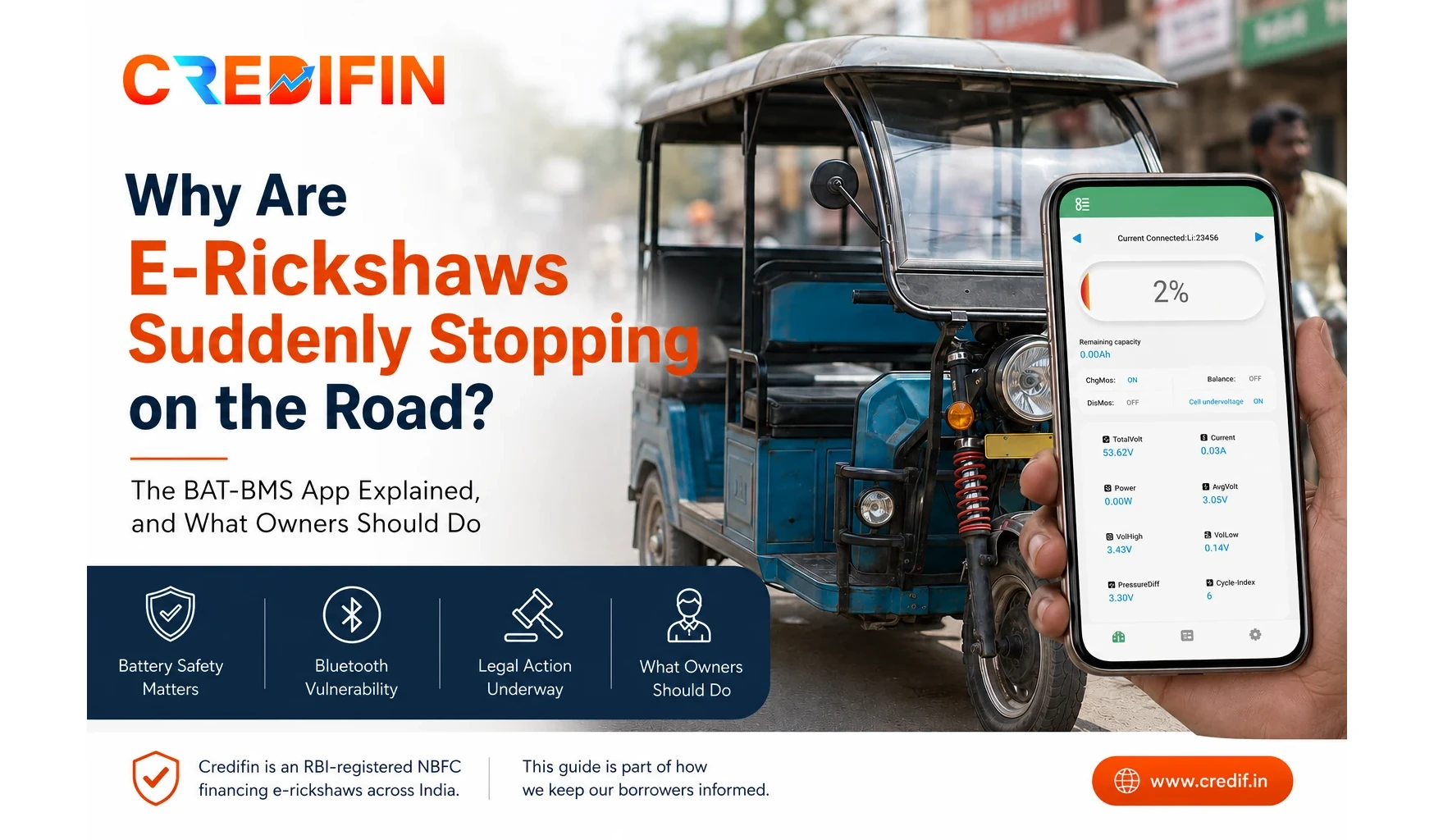
An e-rickshaw stopped at Loti Tiraha in Ujjain. Middle of the junction. No warning, no noise, nothing.
A young man appeared at the driver's side. Said he could fix it. Two hundred rupees. The driver paid. What else was he supposed to do? His vehicle was dead in traffic and this boy sounded like he knew something. Money changed hands. The rickshaw started.
Here's what the driver didn't know. Nothing had been fixed, because nothing was broken. The boy had switched the battery off from his phone a minute earlier. Then watched. Then switched it back on, for two hundred rupees.
Neel Ganga police picked up the thread. Other drivers in the city said the same thing had happened to them. An FIR was registered. The accused was arrested and produced in court.
Two hundred rupees is about a quarter of what an e-rickshaw driver clears on a good day — you can see the real numbers in our e-rickshaw income guide. Handed to the person who took it from him. That's where the "prank" ended up. Not a joke. Extortion, with an FIR attached.
Own an e-rickshaw and worried about this?
Credifin is an RBI-registered NBFC financing e-rickshaws across India. This guide is part of how we keep our borrowers informed.
Explore E-Rickshaw Loans →What is the BAT-BMS app
Every lithium battery has a BMS — a Battery Management System. Think of it as the battery's brain. It watches voltage, temperature and charge, and keeps the pack running safely.
Many of these BMS units are Bluetooth-enabled, so the owner or fleet operator can check battery health from a phone app instead of a wired display. That part is normal. That part is useful.
BAT-BMS is one such app, made by the Chinese company Shenzhen Grenergy Technology. It was built as a legitimate tool to monitor and control compatible lithium batteries. Charge, voltage, temperature, cell health, cycle count.
The problem is what else it could control. Alongside all that monitoring, the app could send a shutdown command to the battery — flip the discharge function off. A technician needs that during maintenance. Fine. But on a lot of the cheap imported BMS units fitted to Indian e-rickshaws, that command wasn't locked behind any real authentication. No password. No ownership check. Nothing.
Why the vehicles are stopping
Now put those two facts side by side. Bluetooth works over a short range, roughly 10 to 15 metres. On the vulnerable battery units, anyone standing inside that circle could connect and issue commands. Including switching the thing off.
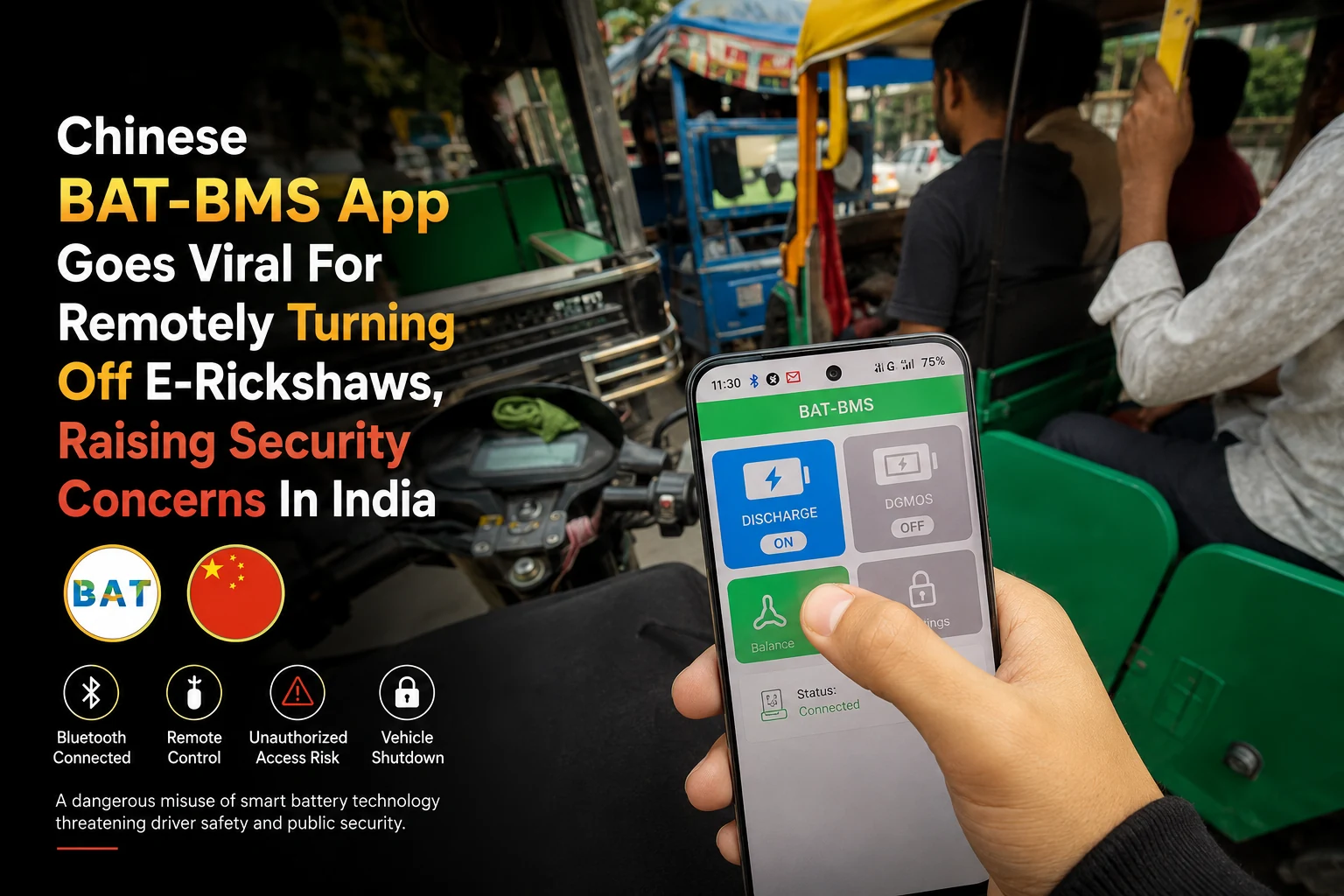
They didn't need to own your vehicle. They didn't need to know your name. They needed to be standing near you. So people started doing exactly that, for views. Walking up to strangers' e-rickshaws, connecting, killing the battery mid-road. The videos spread across Instagram, YouTube and X. Some clips show drivers breaking down in tears, because they couldn't understand why the vehicle kept dying and assumed their expensive battery had failed.
Then it curdled. The Ujjain case is what happens when somebody realises a stalled driver in a junction will pay to get moving again.
One thing worth being precise about: this is not a genius hack. It's a security hole in cheap connected hardware. The batteries were sold with a remote-shutdown feature and almost no protection around it, and that combination turned a safety tool into a public danger the moment somebody decided to misuse it.
| The key facts | Detail |
|---|---|
| Apps banned | BAT-BMS, Lossigy, Epoch-i-ion |
| Ordered by | The government — Google & Apple directed to remove them |
| Law it breaks | Section 66 read with Section 43, IT Act 2000 |
| Penalty reported | Up to ₹5 lakh and up to 3 years in jail |
| First arrest | Ujjain — ₹200 charged to restart drivers' own vehicles |
| Cannot be affected | Lead-acid batteries (no Bluetooth at all) |
What the government did
The response came fast. The Ministry of Electronics and IT directed Google and Apple to remove three apps — BAT-BMS, Lossigy, and Epoch-i-ion — and warned that any other app found with the same remote-kill capability will be pulled too. Apple took BAT-BMS down quickly. Reports through early July noted it was still floating around on Android in some form, which is exactly why awareness matters more than assuming the problem is finished.
The Delhi Transport Department opened its own investigation into the apps and the battery systems behind them. Delhi Police said anyone endangering public safety this way would face action.
And there are teeth to it. Cyber law experts have been blunt: an e-rickshaw with a digital battery system is a computer system in the eyes of the law. Interfering with it without the owner's consent falls under Section 66 read with Section 43 of the IT Act, 2000. Penalties reported run up to 5 lakh rupees and up to 3 years in jail. The man in Ujjain is finding that out. This isn't a grey area. Filming yourself switching off a stranger's vehicle is a criminal act, not a joke.
Wait, so lenders can shut off my battery too?
This question comes up immediately. You deserve a straight answer rather than a dodge. The same category of technology — remote immobilisation — does have a legitimate use. Financiers and fleet operators sometimes use secure telematics to locate a vehicle or immobilise it in cases of genuine loan default or theft. That's a real feature and it exists for real reasons, the same way a bank can repossess a financed car. The difference is everything about how it's done.
| App misuse (the viral clips) | Legitimate lender immobilisation | |
|---|---|---|
| Who can trigger it | Anyone within Bluetooth range | An RBI-registered lender or fleet operator |
| Authentication | None — no password, no ownership check | Authenticated, tied to verified ownership |
| When | Any time — for a reel or a shakedown | Only on genuine default or theft |
| Record | No audit trail | Documented system with an audit trail |
| Legality | Criminal (IT Act 66/43) | Lawful, only under the terms you signed |
That is not the same universe as a boy on the footpath with a free app and a Bluetooth connection, killing your vehicle for a reel or a two-hundred-rupee shakedown. The scandal here isn't that immobilisation exists. It's that cheap batteries shipped it with no security, so anybody at all could trigger it.
What owners and drivers should do
A few practical steps. None of them are expensive.
What this means if you're buying
If you're in the market for an e-rickshaw right now, this whole episode is a useful filter. Buy from a dealer who can tell you exactly which BMS and battery brand you're getting, and confirm it uses authenticated, secured control. Certified batteries meeting the current AIS-156 safety norms have largely pushed the worst of the uncertified grey-market units out. That grey market is precisely where these vulnerabilities cluster.
Financing through a regulated NBFC helps too. Not for anything dramatic. Simply because your vehicle, your battery and your paperwork all sit inside a documented system rather than an unknown backend. If you want the finance side in full, our e-rickshaw loan guide covers EMI, rates, and how to apply.
Bottom line
E-rickshaws are stopping because some cheap Bluetooth battery units shipped a remote-shutdown feature without real security, and people misused a free app to trigger it — first for views, then, in Ujjain, for money. The government has banned the apps. The penalties are real, and the first arrests have already happened. Legitimate lender immobilisation is a separate, secured, regulated thing.
If you own one: find out which BMS you have, lock down the Bluetooth, update the firmware. That's most of your risk handled. And don't let a viral clip scare you into a purchase you don't need. Your battery is almost certainly fine.
Talk to Credifin
Credifin is an RBI-registered NBFC financing e-rickshaws and electric three-wheelers across India, on bank-statement income, no ITR needed.
079651-74500 | info@credif.in
Find your nearest branch →
FAQs
What is the BAT-BMS app?
A Chinese-made app built to monitor and control compatible lithium batteries over Bluetooth. It became controversial because it could send a shutdown command to poorly-secured battery units.
Why are e-rickshaws stopping on the road?
People used the app to connect to vulnerable batteries within Bluetooth range, roughly 10 to 15 metres, and switch them off. First for viral videos, and then, in at least one case, to charge drivers to switch them back on.
Somebody offered to fix my rickshaw for money. Should I pay?
No. That is the Ujjain case exactly — a man was arrested for disabling e-rickshaws and charging ₹200 to restart them. Try a power cycle first, then call your supplier.
Is the app banned in India?
Yes. The government directed Google and Apple to remove BAT-BMS, Lossigy, and Epoch-i-ion, and warned that similar apps will be pulled too.
Is it illegal to use these apps on someone's vehicle?
Yes. It falls under Section 66 read with Section 43 of the IT Act, 2000. Penalties reported run up to 5 lakh rupees and up to 3 years in jail. An arrest has already been made in Ujjain.
Can my financier shut off my e-rickshaw?
Regulated lenders may use secure telematics to immobilise a vehicle only in cases of genuine default or theft, under authenticated, documented terms. That is separate from the app misuse in the viral clips.
Is my e-rickshaw affected?
Only certain Bluetooth-enabled BMS units with weak authentication are vulnerable. Lead-acid batteries have no Bluetooth and cannot be affected. Ask your dealer which BMS yours uses before assuming anything.
Source: aninews.in — "Ujjain Police arrest man for extorting e-rickshaw drivers using BAT-BMS mobile app".
Financing an e-rickshaw the safe way?
With Credifin, your vehicle, battery and paperwork sit inside a documented, regulated system. Online application, decision in 3 to 7 days, across India — on bank-statement income, no ITR.
Explore E-Rickshaw LoansThis might catch your interest