How to Make Your EV Battery Last Longer: Real Maintenance Tips for Indian Riders (2026)
Vansh Budhiraja·2 May 2026
Ride an electric scooter or e-rickshaw in India? Then you've definitely heard somebody say "EV waale toh battery jaldi kharab ho jaati hai bhai." And honestly, the people saying it usually fall into two groups. Either they've never owned an EV themselves and are just repeating something a friend said. Or they own one and have been treating the battery like it can take any kind of abuse.
The reality is somewhere in between. Your EV battery isn't fragile, but it definitely isn't bulletproof. Whether it gives you 4 years or 8 comes down to a handful of things. How you charge it. Where you park it. The way you ride. Two people can buy the same scooter on the same day from the same showroom, and five years later one of them will have a healthy battery while the other is shopping for a replacement. The vehicle isn't the difference. The owner is.
So this guide is meant to cover what genuinely works in Indian conditions. Not generic gyaan copied from American or European blogs that don't apply to our heat, our charging setups, or our roads. Real, doable habits that fit how we actually live.
Why Battery Care Hits Different in India
Worth understanding what your battery is up against here, because it's not the same as what manufacturers test for in cooler climates.
Take the heat for starters. Walk out at 2 PM in Delhi or Ludhiana sometime in May, touch any metal surface, and you'll know what your battery is dealing with. Road surfaces in Jaipur and Ahmedabad regularly cross 45 degrees during peak summer. And lithium-ion cells, which sit inside basically every EV out there today, just don't deal with heat well. The warmer they get, the quicker they wear out. Going by some research, batteries can age 15 to 20% faster in extreme heat than in places with milder weather.
Charging at home is its own problem. Most folks just plug into a regular 15A socket, often on the same line that's already powering a fridge, AC, geyser, you name it. Voltage isn't always steady in many neighbourhoods. Power cuts in the middle of a charge cycle? Happens way too often. Add it all up and the battery is taking small hits constantly.
Riding conditions are no help either. Bengaluru traffic that doesn't move for 20 minutes at a stretch. Speed breakers showing up every couple of hundred metres. Couple of adults, school bag, subzi thaila, all loaded onto a scooter that's officially rated for 150 kg max. Every one of these things chips away at the pack.
But here's the better news. None of this means you have to handle the EV like glass. Stick to a few small habits over time, and you can genuinely add years to your battery's life. The ones that follow are the ones that actually matter.
1. The 20 to 80 Rule Is Not Made-Up
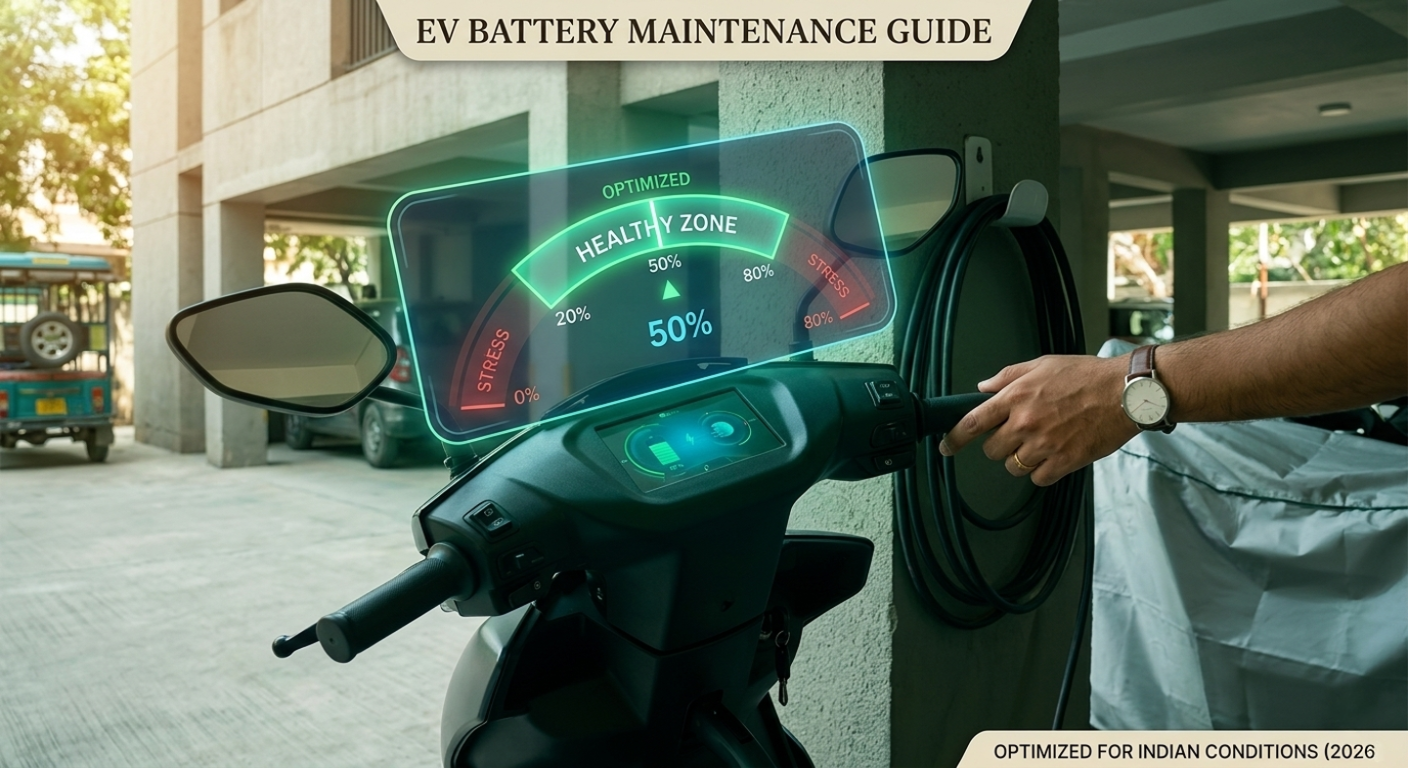
Of everything in this article, if just one habit sticks, please let it be this. Stop topping up your EV to 100% every night. And don't ride it till the meter says 0 before plugging it in.
Lithium cells like to sit somewhere in the middle, roughly between 20% and 80% charge. Pushing it to 100% every single day puts steady, slow pressure on the cells. Running them down to empty is honestly worse, since the chemistry near zero is already in a stressed state.
Save the full charges for days you actually need the full range. A weekend trip out of town, a long delivery shift, that sort of thing. For your regular 25 to 40 km daily ride, charging up to 80% is plenty. Owners who genuinely stick to this report something like 20 to 30% less degradation over three years, compared to people who blindly plug in at 100% every night.
Newer scooters from Ather, Ola, and Hero Vida have an "optimised charging" or "trip mode" toggle in the app. Turn it on. The vehicle then holds at 80% and only fills up to 100% if you specifically ask.
2. Park Smart, Especially in Summer
Indian afternoons are brutal on lithium cells. Parking in direct sun at 2 PM in Faridabad or Jaipur during May? Your battery casing can easily touch 50 plus degrees. Repeat that for a couple of months and you're knocking real life off the pack without even noticing.
A few easy moves go a long way here:
- Park under a tree, in a basement, or in some kind of building shade whenever you can
- If your office has covered parking, walk the extra 50 metres and use it
- E-rickshaw drivers especially, find a shaded spot for charging instead of one in direct noon sun
- A simple UV-resistant cover helps if open parking is your only option, particularly in May and June
In hilly areas or far north, the opposite problem shows up in winter. Sub-zero temperatures temporarily eat 20 to 30% off your range. The capacity does come back as the battery warms up, but storing the EV in extreme cold every night for months on end isn't ideal long term.
3. Cool the Battery Down Before Plugging In
This tip is one of the most ignored, and honestly, one of the most useful.
Picture this. You ride for half an hour through summer traffic, reach home, and the first thing you do is plug the scooter in. Sounds harmless, right? Except the battery pack is still hot from the ride, and now you're forcing it to take in fresh energy on top of that heat. The damage happens slowly. You probably won't see it in year one. Come year three though, and the lost range becomes obvious.
Simple fix really. Park the scooter, head inside, drink some pani, give it 15 to 20 minutes. Then come back and plug in. By that point the pack has cooled to room temperature and is ready to handle a charge properly. Works the other way around too. Right after a long fast charge, give it a few minutes before riding off if you can.
4. Stick With the Charger That Came With the Vehicle
Pretty obvious advice, no? But you'd be surprised how often this gets ignored. Owners lose the original charger, then walk into a local shop and pick up some no-name 800-rupee one because it "looks the same."
Problem is, the charger that came in your EV box was specifically tuned for your battery's voltage and current needs. Random ones from kabaadi shops or sketchy online listings can throw off voltage, push too much current, or run hot through the entire cycle. None of that does the battery any favours, even if everything seems fine on the surface.
If you genuinely need a new one, get the original from your manufacturer's service centre. Yes it's pricier, maybe 1,500 rupees more. But that's nothing next to a 70,000 rupee battery replacement two years from now because you cheaped out on a charger.
5. Go Easy on Fast Charging
Public DC fast chargers like Ather Grid, Tata Power EZ, and Statiq are seriously useful. Take you from 20 to 80 in under an hour. Great when you're caught short on a long ride.
But fast charging produces noticeably more heat than regular slow charging at home. Used as your daily routine, it slowly chips away at battery life. Used now and then for emergencies or trips, totally fine.
Simple rule of thumb. Slow charge at home for daily use, fast charge only when you really need it. Hitting a DC fast charger more than twice a week? Your battery isn't thanking you.
6. Don't Overload the Vehicle
Two-wheeler EVs in India are built for two adults and maybe a small bag. Squeeze on three people plus a stack of luggage plus a few kilos of groceries, and the motor has to draw way more current than it was designed for. That extra current pulls from the battery, which heats up quicker, drains quicker, and ages quicker.
Same applies to e-rickshaws. They're rated for four passengers, not seven plus a baraat band's worth of equipment. Overloading is honestly one of the biggest hidden killers of commercial EV batteries that nobody talks about.
If you regularly haul heavy stuff, get a vehicle actually built for it. A passenger e-rickshaw isn't a cargo vehicle, no matter what your jugaad mind thinks.
7. Smooth Riding Saves the Battery
Hammering the throttle, slamming on brakes, and keeping it in turbo or sport mode all the time? All of that spikes the current draw. The battery is forced to deliver short bursts of heavy power, which generates heat and stresses the cells.
Ride smoother. Read the traffic ahead. Use regen braking when your scooter has it. The pack will thank you. And honestly, you'll see noticeably better range too. Even slightly easing off the throttle often gets riders 8 to 12% more kilometres on the same charge.
This isn't a call to ride like an aunty doing first gear in third gear. Just don't treat your EV like a track bike on the way to buy bhindi.
8. Check Tyre Pressure Every Two Weeks
Soft tyres mean more rolling resistance. More rolling resistance means the motor has to pull more current. Which means the battery is working harder than it should be for the exact same distance.
Spend five minutes every fortnight at the nearest petrol pump and check tyre pressure. Or buy a small pressure gauge for 200 bucks and do it at home. Most EVs work best at the pressure printed on the tyre sidewall or in the manual. Keep it there and you get better range plus less battery stress, both at no extra cost.
9. Don't Leave the Battery Empty for Weeks
Heading out of town and parking the EV for a while? Don't leave it sitting near empty.
Lithium cells age noticeably faster when left at very low or very high charge for long stretches. Sweet spot for storage is around 50 to 60%. Charge it up to that level, unplug, and forget about it.
If the EV is going to sit unused for more than a couple of weeks, also helpful to turn it on for a few minutes every fortnight. Keeps the BMS awake and stops the pack from going into deep discharge.
10. Take Software Updates Seriously
Companies like Ather, Ola, TVS, they keep rolling out OTA updates every few weeks. And a good chunk of those aren't cosmetic. They tweak how your battery actually behaves day to day. The way the BMS handles a charge cycle, how it manages discharge, how it deals with thermal load when things get hot.
Problem is most riders just swipe the notification off without thinking. Looks like a minor app refresh, must be skippable, right? Wrong most of the time. That same update you ignored could be the reason your scooter handles a 45-degree afternoon better, or pulls less hard going up a flyover. Skipping it means missing out on stuff the company is literally giving you for free.
Bottom line, if your dashboard or app pings about an update, just block 20 minutes that evening and let it run. Done.
Quick Maintenance Checklist by Season
Different times of year stress the battery in different ways. Here's a season-wise cheat sheet for Indian conditions.
| Season | What to Watch For | What to Do |
|---|---|---|
| Summer (Apr to Jun) | Heat damage, quicker degradation | Park in shade, skip noon charging, let battery cool 20 mins before plugging in |
| Monsoon (Jul to Sep) | Water entering charging port | Wipe socket dry before plugging in, avoid waterlogged routes, check for rust monthly |
| Winter (Dec to Feb) | Range drop in north India | Don't stress about it, capacity comes back when temperature rises |
| All year | Tyre pressure, software updates | Check pressure every 2 weeks, install updates as they come |
Habits to Drop Completely
Some things are bad enough that they need their own list. Doing any of the below? Stop.
- Plugging in overnight every single day. Even with BMS protection, hours of trickle topping at 100% slowly hurts cells.
- Letting the battery sit at 0% for hours or days. Recharge as soon as you can after a full drain.
- Aftermarket "performance" mods on the controller. Messes with how the BMS talks to the cells and usually voids warranty too.
- Ignoring warning lights or weird behaviour. A small problem caught early is fixable. Ignored long enough, it ends in a battery replacement.
- Charging in a closed, badly ventilated room. Especially in summer. A small bedroom or bathroom is honestly a terrible place to charge a scooter battery.
Service the Whole Vehicle, Not Just the Battery
Plenty of owners get this part wrong. They focus all their energy on battery care and completely skip regular service. Those two things are way more connected than they realise.
Brake pads dragging slightly? That's extra resistance. Wheel out of alignment? More resistance. Controller starting to fail? It might be pulling more current than it should from the battery without you knowing. Each of these problems, big or small, finds its way back to the battery sooner or later. The pack itself could be perfectly fine, but it ends up taking the hit anyway.
So go by what your manufacturer's manual says about servicing. For most electric scooters in India, you're looking at one service every six months, or whenever you cross 5,000 km, depending on which one shows up first. Service centres do a basic State of Health check on the battery during these visits, which catches problems early while they're still small.
For e-rickshaws and other commercial EVs, monthly checkups make a lot more sense given how hard they're worked.
When Should You Actually Worry?
Some signs mean it's time to do something, not panic.
- Range has dropped more than 25 to 30% from when the EV was new
- Charging takes way longer than it used to, even with the original charger
- Battery feels noticeably hot during or right after charging
- Vehicle struggles on slopes that it used to climb without breaking a sweat
- Sudden range drops day to day with no real explanation
Two or more of these together? Get the battery checked at a service centre. Most issues can be sorted if caught early. By the time the EV refuses to start one morning, the pack is usually past the point of saving.
Bottom Line
Looking after your EV battery isn't some complicated science. You don't need to obsess over every charge cycle or treat the scooter like it's about to break. Most of it really comes down to skipping a few common mistakes and putting in place some boring everyday habits.
Keep the charge somewhere between 20 and 80 on a normal day. Find shade when you park. Give the pack a few minutes to cool off before plugging in. Don't switch to some random charger. Get the vehicle serviced when it's due. Stay consistent with this stuff and you can squeeze out 2 to 3 extra years of battery life pretty easily. That's real money you save when replacement day eventually shows up.
And when that day does come, it's not the end of the world either. There are loan products built specifically for battery swaps, so you don't have to ditch the whole EV and shell out for a new one. Take care of the pack from today onward, and honestly that whole replacement headache gets pushed years further out compared to where most owners land.
Frequently Asked Questions
-
How often should I be charging my EV scooter?
Best to plug in once it's around the 20% mark, and pull the plug at roughly 80% for everyday riding. Push to 100% only on those days when you actually need the full range, like a long ride somewhere.
-
Is it okay to charge my EV in the rain?
For the most part, yes. Modern EV scooters are usually IP67 rated, so light rain isn't a concern. But always dry off the charging socket before you connect it, and avoid plugging in during a heavy thunderstorm because the voltage can swing badly.
-
Does fast charging actually wreck the battery?
Once a week or for a long ride, no big deal. Doing it every day at home? Yeah, that adds up. Fast chargers heat the pack up more, and over time that heat eats into the cells. Use your home charger for daily use and save the fast option for when you actually need it.
-
My range dropped suddenly. Is the battery dying?
Maybe, but don't jump to conclusions. Check tyre pressure first, since flat-ish tyres can chew up 10 to 15% of your range on their own. Still bad after that? Take it in for a State of Health diagnostic at a service centre.
-
Should I unplug right after the battery hits 100%?
Yes, that's the better habit. BMS protection is there, but sitting at full charge for hours still puts slow stress on the cells. Either set a timer, or just use the optimised charging toggle if your scooter app has one.
-
How long should an EV battery realistically last with good care?
For two-wheelers, somewhere around 6 to 8 years, or 60,000 to 80,000 km. E-rickshaws running on lithium, about 4 to 6 years. Lead-acid e-rickshaw sets only last 12 to 18 months on average, mostly because of how heavily they're used every day.
-
Can I ride right after the scooter finishes charging?
Better to give it 5 to 10 minutes after a full charge so the pack cools off a bit. For partial top-ups, no waiting needed, just go.
-
Can I leave my EV plugged in if I'm not using it for a few days?
Don't keep it plugged in non-stop. Charge it to about 50 to 60%, unplug, and park it like that if you're not riding for over a week.
Ready to Apply?
Even with the best maintenance habits, every EV battery eventually wears out. When that day arrives, you don't have to scrap the whole vehicle. Credifin offers a dedicated EV battery replacement loan from Rs. 30,000 to Rs. 2 lakh, decided in 2 to 5 working days, with bank statements accepted in place of ITR. Self-employed riders, e-rickshaw drivers, and small fleet owners across Punjab, Haryana, and Delhi NCR are explicitly served.
This might catch your interest