Used Car Finance in India: Best 2nd Hand Car Loan Options
Lakshay Khanna·26 June 2026
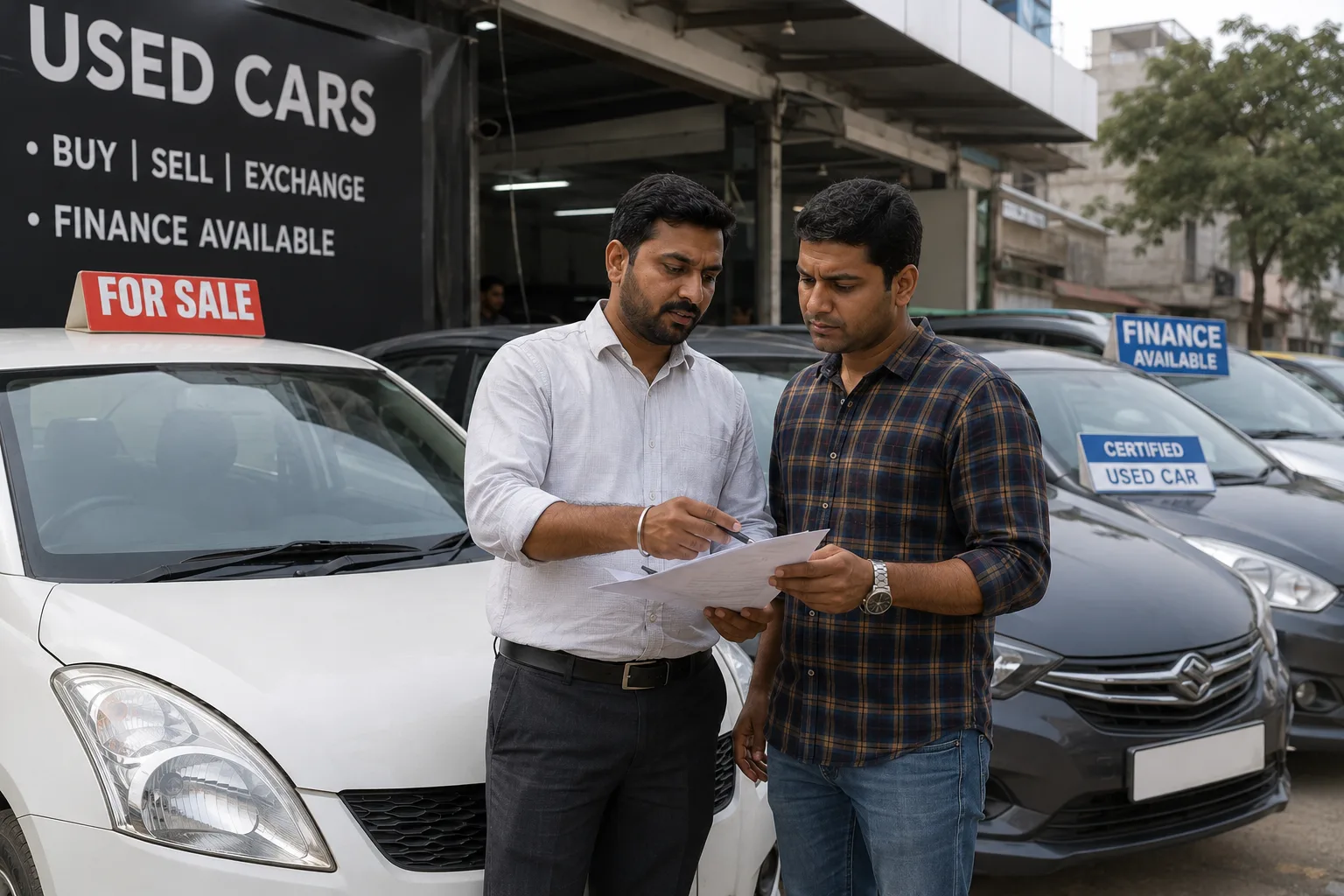
Walk into any used car dealership in Ludhiana on a Sunday. Same scene every time. Buyer in his thirties, wife scrolling Insta in the corner, dealer pushing some 2020 Creta with that "single owner, only driven by uncle" energy. And nobody, literally nobody, is talking about the loan yet. Everyone assumes the finance thing will sort itself out at the end of the conversation.
That's where you end up overpaying. Sometimes by 40, 50 thousand you could've kept in your pocket.
Used car finance in India is its own thing. Way fewer lenders actually do it. The ones who do build in margins you won't see unless you know where to look. And the rate you walk out with depends on a bunch of stuff most buyers never bother to learn before signing.
So. This guide. Written for someone who hates being talked down to by a bank guy in a fake-polite voice.
Bank statement says more than your ITR?
Credifin finances used cars on real bank-statement income — self-employed, cash income, CIBIL under 720, cars up to 8-10 years. Decision in 4 to 7 days.
Apply for a Used Car Loan →Why used car loans are harder than new ones
Bank looks at a new car, easy. Exact model. Exact on-road price. Exact depreciation curve they've already mapped out. No guesswork.
Now hand them a six-year-old Swift Dzire. 81,000 km. Second owner. One service stamp missing from 2022. What's it worth today? What's it worth in three years if you stop paying and they need to auction it? Nobody knows for sure. So the bank has to guess and then price the risk on top of the guess. Three things happen because of this:
- Interest rates run higher — 1 to 3 percent above new car rates, usually.
- They fund less — 70 to 85 percent of their valuation, not the asking price (and that gap, more on it below, is where people get hit).
- Tenure is shorter — 3 to 5 years, almost never 7.
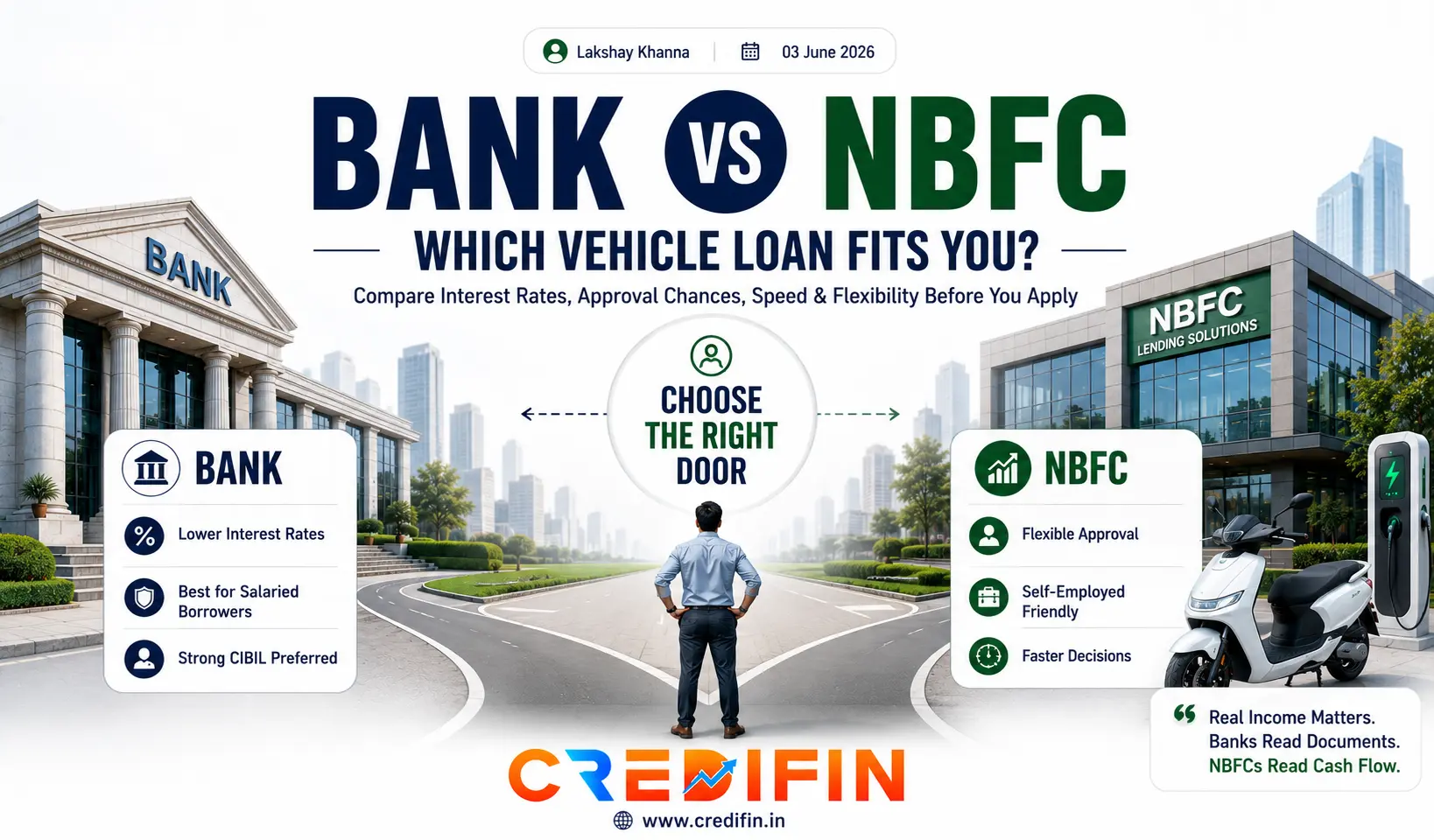
It's not a scam, it's just risk pricing. Knowing all this up front means you walk in not getting surprised when the numbers come out. For the broader bank-versus-NBFC trade-off, see our bank vs NBFC vehicle loan guide.
What you'll actually pay in interest
Forget the "starting at 9.99%" banner on the bank homepage. That rate exists for one customer profile and that customer is mostly imaginary. Here's the real picture.
| Borrower Profile | Vehicle Age | Interest Rate | Typical Tenure |
|---|---|---|---|
| Salaried, CIBIL 750+ | 0 to 3 years | 12% to 13.5% | Up to 5 years |
| Salaried, CIBIL 700 to 750 | 3 to 5 years | 13% to 15% | Up to 4 years |
| Self-employed, clean ITR | 0 to 5 years | 13.5% to 16% | Up to 4 years |
| Self-employed, cash income | 5 to 8 years | 15% to 17% | Up to 3 years |
| First-time buyer / low CIBIL | 3 to 7 years | 16% to 18% | 2 to 3 years |
Working band is 12 to 18 percent. Quote above that? Just walk. Someone else will price your profile cheaper. Even small-ticket borrowers shouldn't be paying 20+ percent. If your CIBIL is the thing holding you back, our CIBIL improvement guide covers the fixes.
Know your rate band but the bank still said no? Credifin prices used-car loans on your real bank-statement income, not just ITR or CIBIL.
Check Your Used Car Loan →Which lender suits which person
There are basically four kinds of lenders doing used car finance in India right now. They all want your EMI. They all weigh you differently.
Private banks (HDFC, ICICI, Axis, Kotak)
Cheapest rates if you fit — and the "if you fit" part is huge. Salaried, CIBIL above 750, car under 5 years, clean ITR, no recent defaults. Tick everything and they'll do 12.5 percent. Miss one box, the executive smiles, says "we'll get back to you," and never does.
PSU banks (SBI, BOB, PNB, Canara)
Slower, more paper. But for government employees, retirees, anyone with squeaky-clean documentation, sometimes the cheapest in the room. SBI's used car loan can start around 12 percent for the right person.
NBFCs (Credifin, Bajaj, Mahindra, Tata Capital)
Rates run 1 to 2 percent higher than banks. The trade-off is they actually open your bank statement and read it — not just CIBIL-check, ITR-check, reject. This is where shopkeepers, traders and the whole self-employed bucket end up after the bank visit goes nowhere.
Dealer finance
The guy who can "arrange it in 30 minutes." Convenient, yes. Cheapest, no. Dealers typically bake 1 to 1.5 percent commission into the rate. On a Rs 5 lakh loan over 4 years that's about Rs 22,000 extra. Sometimes more.
| Lender Type | Strength | Weakness | Best For |
|---|---|---|---|
| Private banks | Lowest rates, fast if existing customer | Strict CIBIL, age caps at 5 years | Salaried, CIBIL 750+, recent model |
| PSU banks | Can be cheapest for the right profile | Slow, more documents | Govt employees, retirees, clean paperwork |
| NBFCs | Read bank statements, accept older cars | 1 to 2 percent higher than banks | Self-employed, cash income, CIBIL under 720 |
| Dealer finance | On-the-spot, no running around | Hidden commission, highest rates | Buyers in genuine hurry only |
I'm not saying dealer finance is straight-up bad. If the seller's leaving town tomorrow and you have to close fast, fine. But you should at least check one outside option before signing. Even one phone call helps.
The valuation gap nobody warns you about
This is the part that gets every first-time used car buyer.
You and the seller agree on 8 lakh for a 2020 i20. Cool. You go to the bank for the loan. Bank values the car at 7.4 lakh from their internal book value tool. Maybe they send a guy out to look at it. Either way, they fund 80 percent of their number. Not yours. So you get 5.92 lakh, not 6.4 lakh.
That's Rs 48,000 short. Out of your pocket. Unplanned. Realistic out-of-pocket on a used car is 25 to 30 percent of the asking price by the time you add down payment, the valuation gap, RC transfer, insurance and processing fees — not the 10 to 15 percent the dealer keeps quoting because it makes the sale easier.
EMI tables, for the people who actually do the math
| Loan Amount | 3 Years | 4 Years | 5 Years |
|---|---|---|---|
| Rs 3,00,000 | Rs 10,257 | Rs 8,200 | Rs 6,980 |
| Rs 5,00,000 | Rs 17,095 | Rs 13,667 | Rs 11,634 |
| Rs 7,00,000 | Rs 23,933 | Rs 19,134 | Rs 16,287 |
| Rs 10,00,000 | Rs 34,190 | Rs 27,334 | Rs 23,268 |
(Numbers at 14 percent indicative.) The 5-year row looks easy on monthly cash flow. Look at total interest paid though. On a Rs 5 lakh loan, the 5-year tenure costs you roughly Rs 1.98 lakh in total interest. The 3-year tenure costs about Rs 1.15 lakh. Almost double for slightly easier EMIs. Most buyers I talk to end up at 4 years. That's the sweet spot, usually.
A buyer from Phagwara
Sukhwinder. 34. Runs a kirana shop near the bus stand in Phagwara. Found a 2021 Brezza on OLX, owner asking 8.5 lakh. He had about 2 lakh saved up. Needed roughly 6.5 lakh loan.
Two private banks rejected him in five minutes. ITR showed 3.1 lakh annual. His actual income, going by bank deposits, was closer to 6 lakh, but the CA had been "conservative" at filing time. (Translation: trying to save tax. Half of small-town India has this same problem.) One PSU bank asked for a guarantor he didn't have lined up.
The NBFC route worked. They pulled 14 months of bank statement. Saw 45 to 55k a month coming in consistently. Valued the car at 8 lakh. Sanctioned 6.4 lakh at 14.5 percent over 4 years. EMI 17,496. Six working days, application to disbursal.
He could've gone to two more banks first, gotten rejected at both, lost two weeks. Saved himself the time by knowing where his profile actually fit.
Bank said no on a conservative ITR? That's exactly the file Credifin approves — we read 12 to 14 months of bank statement, decision in 4 to 7 days.
Apply with Credifin →Documents you need to keep ready
Salaried
- PAN, Aadhaar
- 3 latest salary slips
- 6 months bank statement (salary account)
- Form 16 — helps but not always mandatory
- Address proof (rent agreement is fine if you don't own)
Self-employed
- PAN, Aadhaar
- 2 years ITR with computation (filed on the Income Tax portal)
- 12 months bank statement (business account)
- GST cert / Udyam reg / shop license
- Address proof
Vehicle side
Original RC plus copies, current insurance, PUC certificate, and the NOC from the previous lender if the car was financed before. People forget the NOC: the prior loan must be cleared and the hypothecation removed from the RC (check on the Parivahan portal) before your new loan goes on — it can add 7 to 10 days if you don't catch it before agreeing to buy. Some lenders also ask for photos of you with the car.
Stuff I'd warn a first-time used car buyer about
Rs 1,500 to 2,500, take it to an independent mechanic, half an hour check. The number of Indian buyers who skip this is honestly criminal. My own cousin, last March, paid 9.4 lakh for a 2019 Honda City. Day 3 the AC was blowing warm. Compressor on its last legs, Rs 32,000 to fix. A Rs 2,000 inspection would've caught it.
Each application is a hard CIBIL pull. Stack four-five in a month, your score drops 30 to 50 points. Pick one bank, one NBFC. Run them parallel. Done.
Run the car through Spinny, Cars24, OLX valuation tools yourself. Take the average. That's your reference price. Don't pay above it without a strong reason.
The chassis number on the RC has to match the stamped number on the actual car. Mismatch means stolen vehicle — walk away the same second. People running that market are getting better at faking RCs these days.
Used car sticker prices have 10 to 15 percent margin built in. Dealers expect pushback. Whoever pays full asking is subsidising the next ten buyers.
Where Credifin fits
Used car finance is one of those products that banks treat as an afterthought and NBFCs treat as core business. Credifin is an NBFC, RBI registered, working this segment specifically across India.
The buyer Credifin actually approves: shopkeeper whose ITR doesn't show what his account does. First-time buyer whose CIBIL is 690, not 750. Salaried guy at a small private firm where the bank wants three more documents than the payslip provides. We've got our name on enough vehicle RCs that RTOs recognise the paperwork without asking twice. Buying in a specific city? See our local guides for used car loans in Jalandhar and used car loans in Noida.
Rates land between 13 and 16 percent for most used car profiles. Our branches handle RC transfer, hypothecation and insurance routing all under one roof. You're not running to three desks to close one deal.
Wrapping up
A 2nd hand car loan in India is more accessible than it's been in a while. A rate range of 12 to 18 percent is doable for most income brackets. The trick is matching your profile to the right lender, not just walking into whichever bank is closest to your house.
Get the car inspected. Check the hypothecation status before paying. Compare two lenders, not five. Negotiate the price. Budget for the actual out-of-pocket cost, which is higher than the dealer is telling you.
Talk to Credifin
Credifin is an RBI-registered NBFC financing used cars for salaried, self-employed and cash-income buyers across India — underwriting on real bank-statement income, not just ITR or CIBIL.
079651-74500 | info@credif.in
Find your nearest branch →
FAQs
Maximum age of a car for a 2nd hand car loan in India?
Banks usually cap at 5 years from manufacture. NBFCs go up to 8, sometimes 10 years if the car's condition is decent and your repayment looks solid.
Can I get a used car loan with low CIBIL?
Yes if you go NBFC. Below 700 is workable as long as the bank statement shows steady income. Just expect to pay 2 to 3 percent above what someone with 750+ would pay.
How much down payment do I actually need?
25 to 30 percent of the asking price, realistically. Banks fund 70 to 85 percent of their valuation, which usually lands below the asking price. So the out-of-pocket adds up to more than the "15 percent down" figure the dealership will throw at you.
Are used car rates higher than new car rates?
Yes, by 1 to 3 percent typically, for the same borrower.
Can I get 100 percent finance on a used car?
Basically no. Anyone telling you this is hiding something else in the structure. There's always money to put down upfront.
Does the bank inspect the car before approving?
Yes, either book-value tool or a valuer who actually looks at the vehicle. This is one of the reasons used car loans disburse slower than new car loans.
Can I prepay or foreclose?
After 6 to 12 months usually. Some lenders charge 2 to 5 percent prepayment fee, some are zero. Read the loan agreement before signing, not after.
How fast does approval happen?
Banks: 7 to 14 working days. NBFCs like Credifin: 4 to 7 days if your documents are standard.
Ready to apply?
Buying a used car anywhere in India? Want a lender who'll actually read your bank statement instead of running you through a template? Get a quote from Credifin online or find your nearest branch. 2nd hand car finance across age ranges and CIBIL profiles, real assessment, none of the template rejection most banks default to.
Apply for a Used Car LoanThis might catch your interest