Two Wheeler Maintenance Cost in India: The Real Yearly Bill
Lakshay Khanna·29 August 2026
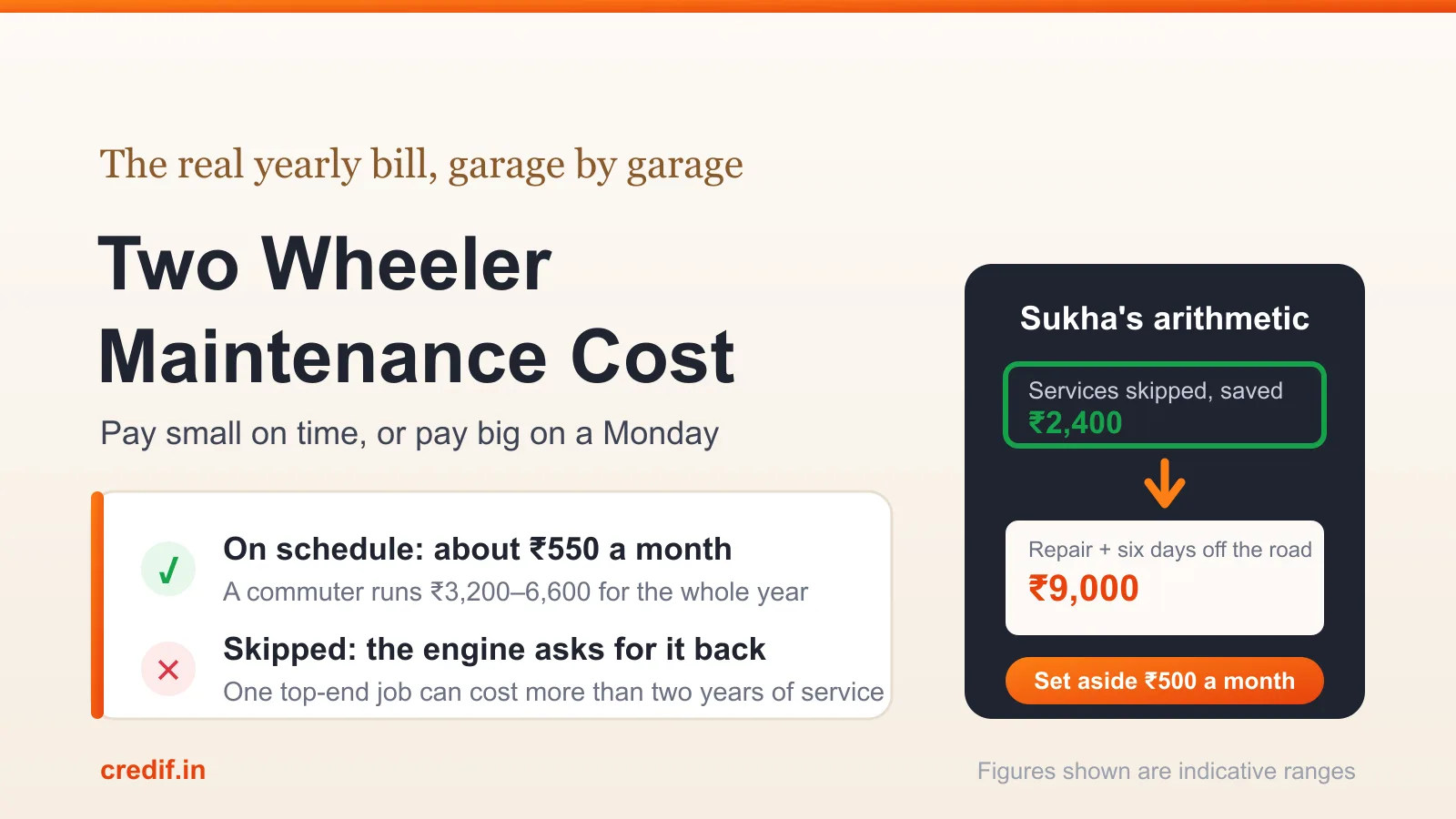
Sukha runs tiffins in Ludhiana. Forty boxes a day, two trips, one Splendor that I am fairly sure has never been washed.
He bought it second hand in 2023 and cleared the loan in about eighteen months. Then he did what most people do the month their EMI stops.
He stopped spending on it.
Fourteen months without a service. Oil topped up whenever the mechanic in his gali said it was looking low. Twenty two thousand kilometres in that stretch, almost all of it crawling through the mess near Ghumar Mandi, which is about the worst thing you can do to an engine short of filling it with water.
Then it started drinking oil.
Top end job, four thousand eight hundred. Bike stuck in the garage six days. Six days at roughly seven hundred rupees of tiffin money is another four thousand two hundred he simply never earned.
Total saved by skipping services: about two thousand four hundred.
"Maine service ke paise bachaye, engine ne wapas maang liye."
I saved the money on service, and the engine asked for it back.
I have heard this story so many times now, in so many versions, that I have stopped thinking of two wheeler maintenance as a mechanical subject. It is a money subject. Either you pay small amounts on time, or you pay a large amount at the worst possible moment, usually a Monday.
Before the two wheeler maintenance numbers, one fair warning. Everything here is a range, because labour in Mumbai is not labour in Bathinda and a Hero does not cost what a Royal Enfield costs. Plan with these, then ask your own mechanic what he charges.
Buying instead of repairing?
Credifin finances new and used two wheelers on bank statements and real income, not just a salary slip. Decision on a clean file in 3 to 7 working days.
Check your eligibility →What two wheeler maintenance costs you in a year
Most owners have no figure in their head for two wheeler maintenance at all. They pay the bill, grumble at the mechanic, forget about it by dinner.
So here is a year, assuming ordinary city riding of eight to twelve thousand kilometres.
The yearly bill, by vehicle type
| Vehicle type | Service spend | Wear parts | Total for the year |
|---|---|---|---|
| 100cc to 110cc commuter (Splendor, HF Deluxe, Shine 100) | Rs 1,400 to 2,600 | Rs 1,800 to 4,000 | Rs 3,200 to 6,600 |
| 110cc to 125cc scooter (Activa, Jupiter, Access) | Rs 1,800 to 3,200 | Rs 2,000 to 4,500 | Rs 3,800 to 7,700 |
| 150cc to 200cc (Pulsar, Apache, FZ) | Rs 2,600 to 4,600 | Rs 3,000 to 6,500 | Rs 5,600 to 11,100 |
| 250cc to 350cc (Classic 350, Hunter, Dominar) | Rs 3,500 to 6,500 | Rs 4,500 to 9,000 | Rs 8,000 to 15,500 |
| Electric scooter | Rs 1,000 to 2,200 | Rs 800 to 2,500 | Rs 1,800 to 4,700 |
Indicative, at 8,000 to 12,000 km a year. Delivery riders should read the top of every range, because the kilometres stack up three times faster.
A commuter is cheap to keep. Genuinely cheap. The top of that range is under seven thousand for the year, which works out around five hundred and fifty a month, which is less than a lot of people spend on recharge and chai. So when somebody tells me two wheeler maintenance is expensive, they are usually comparing it to nothing at all rather than to the alternative.
The bottom two rows are what I would actually warn you about.
That jump past 250cc catches buyers badly. A Classic 350 is not double a Splendor to run. It is closer to triple. More oil in it, pricier grade of oil, dearer parts, and the service interval does not stretch by a single kilometre to compensate. Nobody brings this up while you are sitting on the bike in the showroom feeling pleased with yourself.
The two wheeler maintenance schedule, and which bits you can bend
Here is the thing about service intervals. They are not friendly advice from the manufacturer. They are the condition your warranty survives on.
The service schedule
| When | What happens | Cost | Do people skip it? |
|---|---|---|---|
| 1,000 km or 1 month | First free service, break-in oil drained out | Free | Rarely |
| 3,000 km or 3 months | Second free service, checks and adjustments | Free | Sometimes |
| 5,000 to 6,000 km or 6 months | First paid service, oil and filter | Rs 700 to 2,000 | Often |
| Every 5,000 to 6,000 km after that | Periodic service | Rs 700 to 2,000 | Very often |
| 12,000 to 20,000 km | Major service: valve clearance, fork oil, brake fluid | Rs 1,500 to 4,000 | Almost always |
| 24,000 km, scooters only | CVT service, belt and roller weights | Rs 1,200 to 3,000 | Almost always |
Whichever comes first, the kilometres or the months. Your manual has the final word since brands differ. A general service at an authorised centre broadly runs Rs 800 to 2,500, while doorstep and multi brand options come in at Rs 450 to 1,500.
Two of those rows matter far more than the other four.
The thousand kilometre one I would never let slide. That first fill of oil is busy collecting metal shavings off surfaces that were machined a month ago. Ride past roughly fifteen hundred kilometres on it and you have put wear into that engine which no amount of looking after later will undo.
The other is the CVT service at twenty four thousand. If your Activa or Jupiter feels sluggish off the line these days and you have quietly decided it is just getting old, it probably is not old. Worn belt, tired roller weights. That inspection is the thing that stops the belt letting go suddenly, which is the very expensive version of the same problem. Hardly any scooter owner does it. Then they blame the scooter.
And if you ride in Delhi dust, Ludhiana dust, or through a proper monsoon, take twenty or thirty percent off every interval above. Air filters here fill up much faster than whoever wrote the manual ever pictured.
Dealer or the gali mechanic
Every family in India has had this argument. Both sides have a point, which is why it never gets settled.
| Authorised service centre | Local or multi brand garage | |
|---|---|---|
| General service | Rs 1,000 to 2,000 | Rs 450 to 1,200 |
| Parts | Genuine OEM | Depends completely on the mechanic |
| Warranty on a new bike | Safe | Can be affected |
| Service record for resale | Digital and verifiable | Usually nothing at all |
| Time it takes | 2 to 6 hours once you count the queue | 45 to 90 minutes |
Local labour normally lands thirty to fifty percent under dealer rates. A service billed at Rs 1,500 at a dealership is often Rs 800 to 1,000 down the road.
My own rule on two wheeler maintenance, for whatever it is worth: dealer while the warranty runs, and keep every single receipt. After that, if it is a commuter, a mechanic who recognises your bike by the sound of it beats a service advisor who has never ridden one.
Brand shifts this as well. Honda, Yamaha and Suzuki cost more to service than Hero, Bajaj and TVS. Royal Enfield and KTM cost more again. It comes down to OEM part pricing and oil specification. Hero is the cheapest brand in the country to keep going. A Splendor Plus general service is seven hundred to a thousand at an authorised centre, and you can find spares in towns with one traffic light.
The strongest case for staying with the dealer even after warranty is resale, and it is better than people assume. A stamped book brings back more at sale than the premium ever cost. Used buyers ask for it now. So do lenders, which is a point I will come back to.
While we are on two wheeler maintenance bills, spare parts carry eighteen percent GST and it is already inside the printed price. If a workshop tries adding tax on top of a printed part price, they are having you on.
The year everything breaks at once
Services you can plan for. It is the wear parts that wreck a month, and they are the half of two wheeler maintenance nobody budgets for.
| Part | Replace around | Commuter | 150cc plus |
|---|---|---|---|
| Engine oil | 3,000 to 5,000 km | Rs 250 to 700 | Rs 600 to 1,400 |
| Air filter | 10,000 to 15,000 km | Rs 200 to 450 | Rs 350 to 800 |
| Brake shoes or pads | 12,000 to 20,000 km | Rs 300 to 800 | Rs 700 to 2,000 |
| Chain and sprocket kit | 20,000 to 30,000 km | Rs 1,200 to 2,500 | Rs 2,200 to 5,000 |
| Tyres, pair, fitted | 20,000 to 30,000 km | Rs 3,000 to 5,000 | Rs 5,500 to 12,000 |
| Battery | 3 to 4 years | Rs 1,200 to 2,500 | Rs 1,800 to 3,500 |
| Clutch plates | 30,000 to 50,000 km | Rs 700 to 1,500 | Rs 1,500 to 3,500 |
| Drive belt, scooter | 20,000 to 25,000 km | Rs 900 to 2,000 | Not applicable |
Fitted prices, indicative, before your local labour rate does whatever it does. For reference, oil for a 100cc to 125cc runs Rs 250 to 500 for mineral and Rs 400 to 700 for semi synthetic.
Now look at those intervals again. Tyres, chain, battery. They all come due inside roughly the same twelve months, somewhere around year three.
Which happens to be exactly when customers tell me their bike has started giving trouble. It has not started anything. It has reached the age where the consumables run out together, the way they were always going to.
Set aside five hundred a month from the day you buy and that year turns into a non event. Nobody does it. Which is why a four thousand rupee tyre bill shows up feeling like a family emergency instead of an ordinary Tuesday. Make it six hundred if you are on a 150 or above.
Scooter people, this bit is for you
The advice really does differ, so it is worth splitting properly.
Scooters have no chain. Since the chain is the single most neglected item on any motorcycle in this country, you are already ahead. What you get instead is a CVT, a belt, roller weights, and small wheels that chew through tyres quicker on broken roads. Scooter two wheeler maintenance is easier day to day with one fat bill sitting in wait at twenty four thousand kilometres.
Motorcycles are the reverse. Constant small attention. Chain cleaned and oiled every five hundred kilometres or thereabouts, tension checked, sprocket teeth watched for that hooked shape they get. Do it and your chain kit sees thirty thousand kilometres. Skip it and you are buying a new one at fifteen.
Then there is how you ride, which nobody wants to hear about. Hard braking eats pads. Sitting on the clutch through traffic eats plates. Winding it to eight thousand rpm between two red lights eats the whole lot. Same model, same service record, two different owners, and I have seen one two wheeler maintenance bill at three thousand a year and the other at seven.
Papers ready and want a straight answer?
The eligibility check takes a few minutes and needs no documents. Decision in 3 to 7 working days on bank statements or platform earnings.
Check your eligibility →If it is electric
An electric scooter deletes most of that list. No engine oil, no oil filter, no air filter, no spark plug, no clutch, and on most models no chain either. Regenerative braking goes easier on the pads too. Two wheeler maintenance drops to somewhere near a thousand to two thousand two hundred a year, and a fair bit of that is tyres and brakes.
Replacing all of it is the battery, which is one big number sitting a few years out instead of a small one every six months.
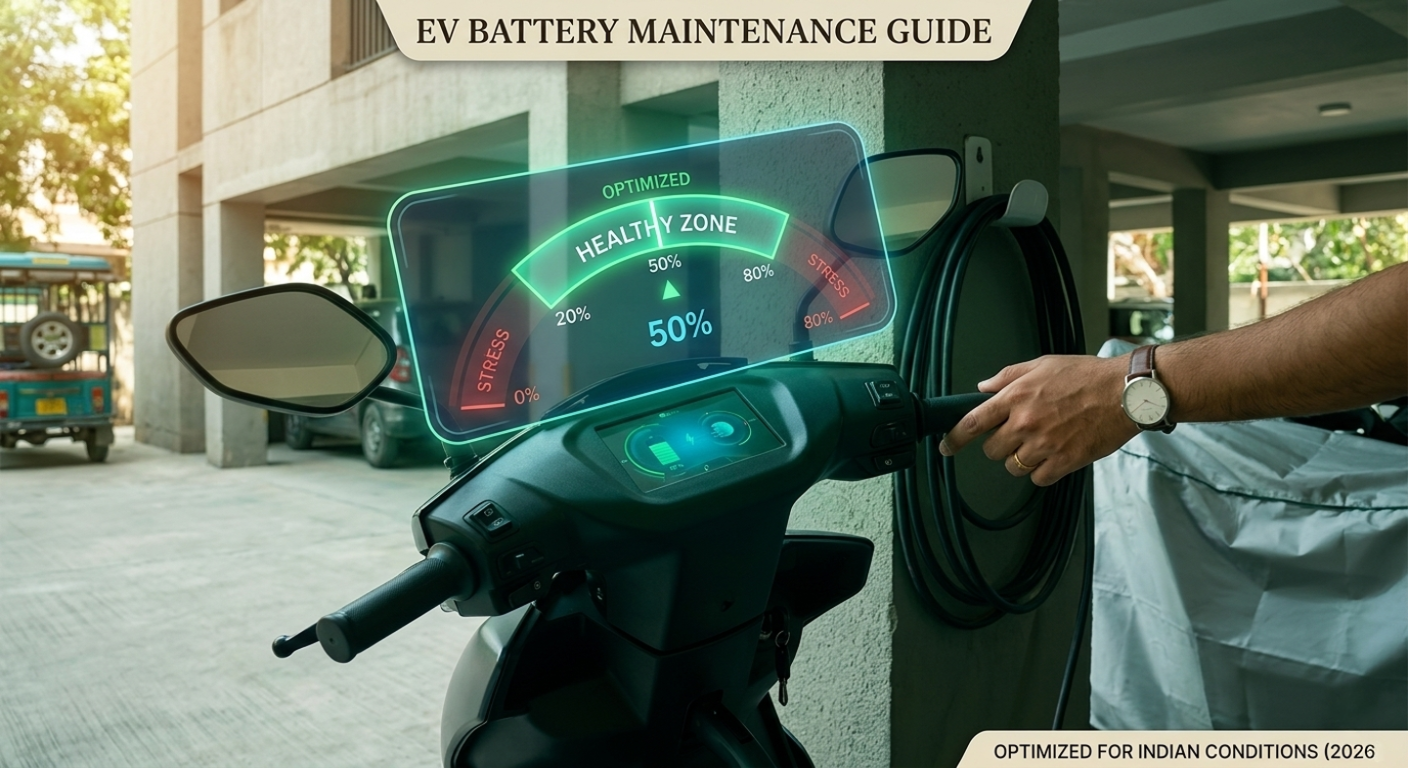
Battery care has its own rules and its own bad habits, and our guide on making an EV battery last longer goes through the charging routine properly. Read it before you buy rather than after.
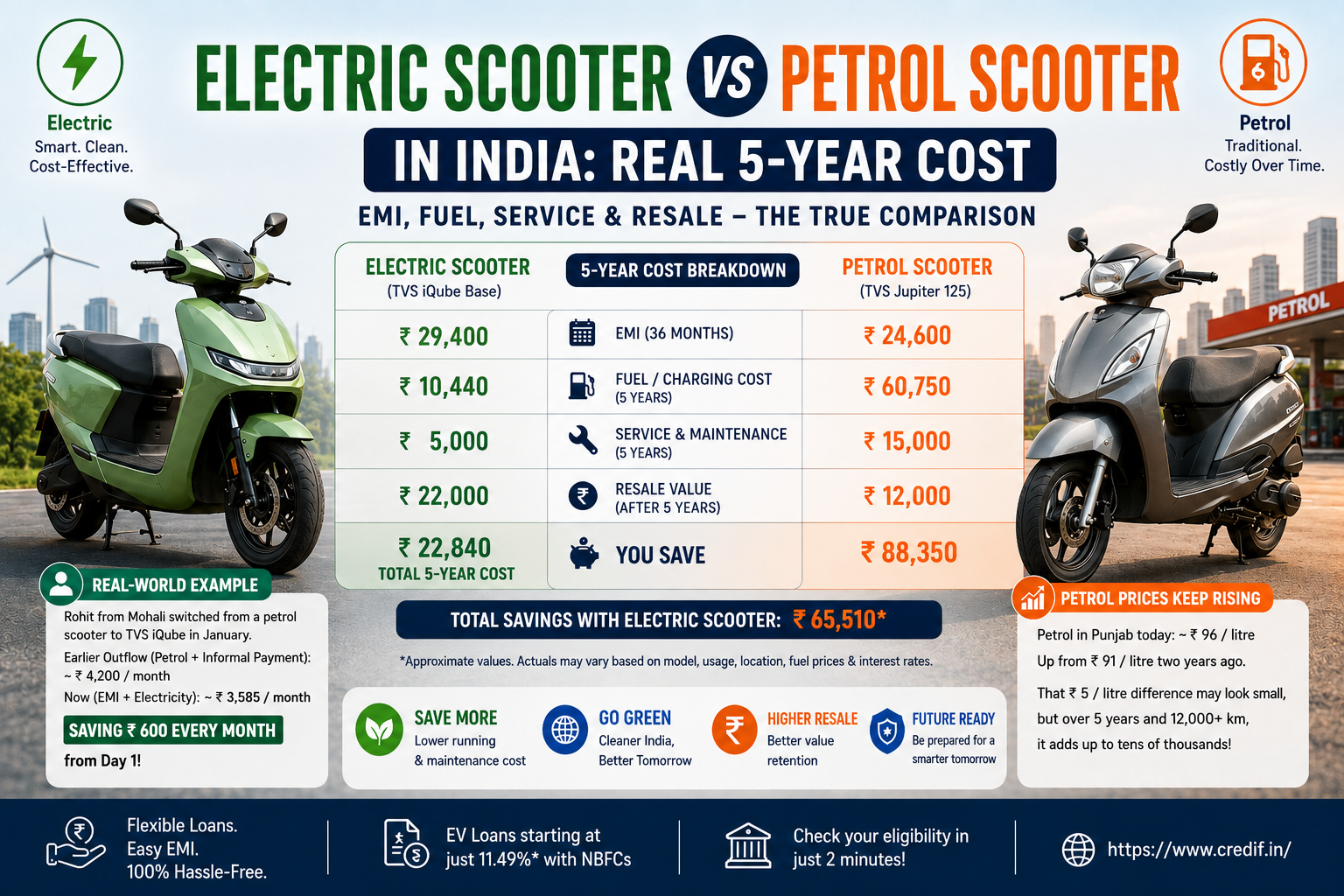
Still deciding between petrol and electric on total cost? Our five year comparison of electric and petrol scooters does the full sum using real models.
Two wheeler maintenance habits that cost nothing
Back to Sukha
He services it every five months now. Before the season turns, not after. Local mechanic in his own market, genuine oil, nine hundred a time.
His two wheeler maintenance spend last year was five thousand six hundred, and that included a rear tyre and a chain kit. He read the figures to me off the back pages of his tiffin register, where everything gets written down in pencil. The year of the top end job cost him nearer eleven thousand once the lost days went in.
"Ab ek hi cheez dekhta hoon. Gaadi chal rahi hai ya nahi. Baaki sab uske baad."
Now I watch one thing. Whether the bike is running. Everything else comes after that.
When your income arrives forty tiffins at a time, that is not sentimentality about a machine. It is knowing which asset the whole business is standing on.
Bottom line
Two wheeler maintenance is one of those rare expenses where doing it on schedule genuinely costs less than doing it when forced. Three hundred to six hundred a month for a commuter. Double above 250cc. It climbs with kilometres, not with the age printed on the RC.
Follow whichever comes first, the kilometres or the months. Dealer under warranty, trusted mechanic after. Put five hundred aside monthly for the year the consumables gang up on you. Keep the paper.
A commuter treated like that will do ten years without ever handing you a frightening bill.
Where Credifin fits
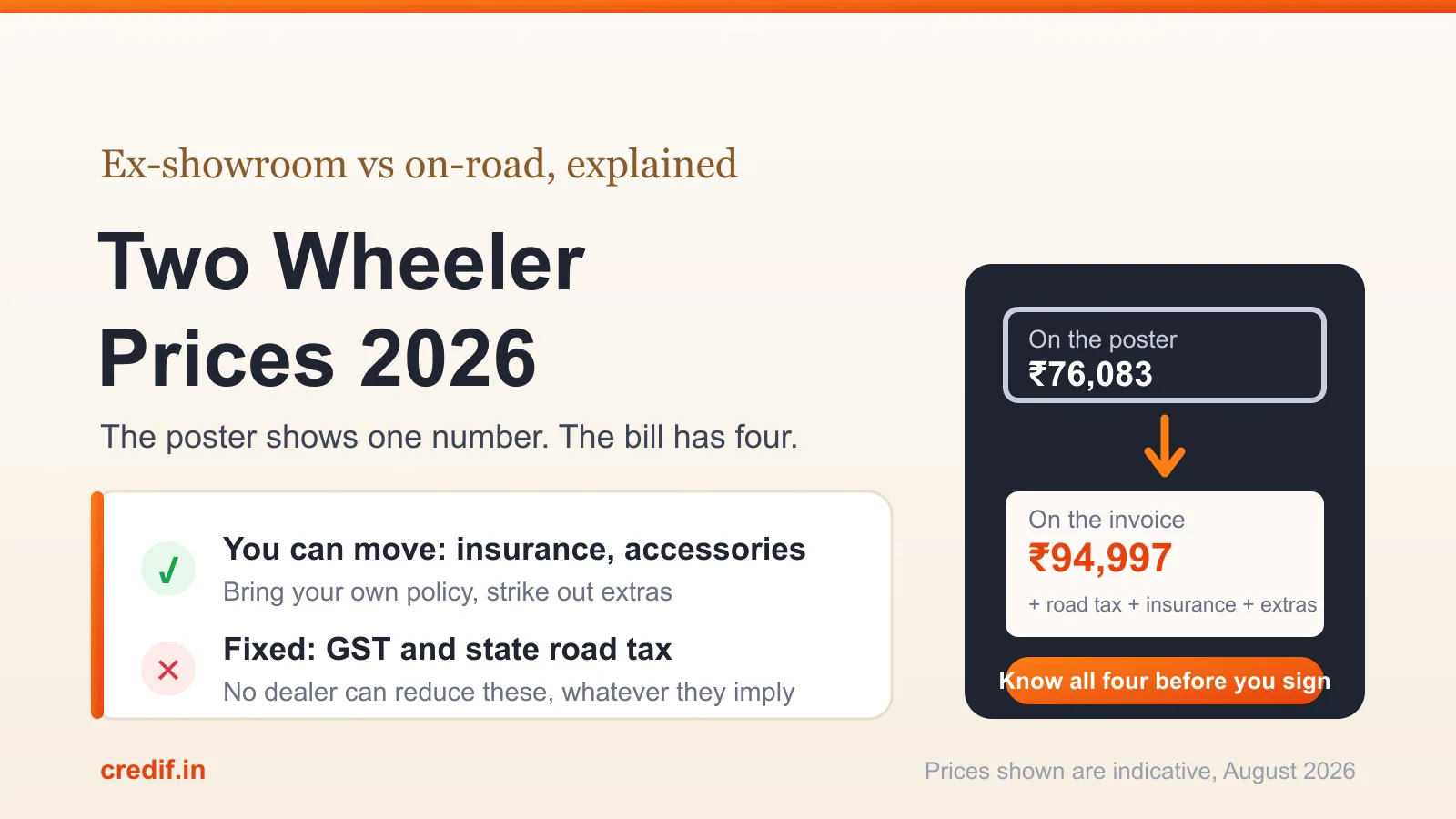
Two wheeler maintenance is the cheap part of owning a bike. Buying one is the part that needs money — our breakdown of two wheeler prices in 2026 covers that half.
We finance new two wheelers and used two wheelers across 14 states and more than 200 locations, plus electric two wheelers, used cars and e-rickshaws.
We read bank statements and real income, delivery platform earnings included. That is why shopkeepers, tiffin suppliers, riders and first time borrowers get through with us when a salary slip process cannot see them at all.
Apply online and a clean file gets a decision in 3 to 7 working days. If something is missing we will tell you what, rather than leaving you to guess at it. Would rather do this across a desk with an actual person? Walk into your nearest branch.
Ready when you are
Two wheeler finance on bank statements or platform earnings, across 14 states.
Apply now →Talk to Credifin
Credifin is an RBI registered NBFC financing new and used two wheelers, cars, e-rickshaws and EVs across India.
079651-74500 | info@credif.in
Find your nearest branch →
FAQs
How much does two wheeler maintenance cost per year in India?
For a 100cc to 125cc commuter doing eight to twelve thousand kilometres, budget Rs 3,200 to 7,700 covering services and wear parts. A 150cc to 200cc runs Rs 5,600 to 11,100. Above 250cc it can pass Rs 15,000.
How often should I service my two wheeler?
Every 5,000 to 6,000 km or six months, whichever arrives first. Drop that to 4,000 or 5,000 km if you ride in heavy dust or flooding. Major service at 12,000 to 20,000 km.
Is a local mechanic cheaper than the dealer?
Usually by thirty to fifty percent. What you give up is genuine parts, warranty cover and a service record that helps you at resale. Stay with the dealer while the warranty runs, then decide.
What actually happens if I skip two wheeler maintenance?
Small problems grow into large ones. Old oil wears the engine faster, a dry chain eats the sprocket, a blocked air filter drops your mileage. The repair costs several times the service you avoided, plus whatever the days off the road cost you.
Does two wheeler maintenance affect resale value?
Yes, and more than owners expect. The service record is one of the first things a used buyer or a lender asks to see. Our guide to used bike loan documents covers how a vehicle gets checked during finance.
Do electric scooters need less two wheeler maintenance than petrol?
A lot less. No oil, filters, plug or clutch, so routine two wheeler maintenance drops to roughly Rs 1,000 to 2,200 a year. The battery replaces all of it as one bigger cost further out.
Is GST charged on bike spare parts?
Eighteen percent, already included in the printed price. Anybody adding it on top is overcharging you.
Can I finance a used bike that needs work?
Lenders fund a share of their own valuation, and condition affects that valuation. A bike needing immediate repairs values lower, so the gap comes out of your pocket. Ask for an indicative valuation before you agree a price with the seller.
This might catch your interest