Used Bike Loan Documents Required: The Full Checklist
Lakshay Khanna·15 August 2026
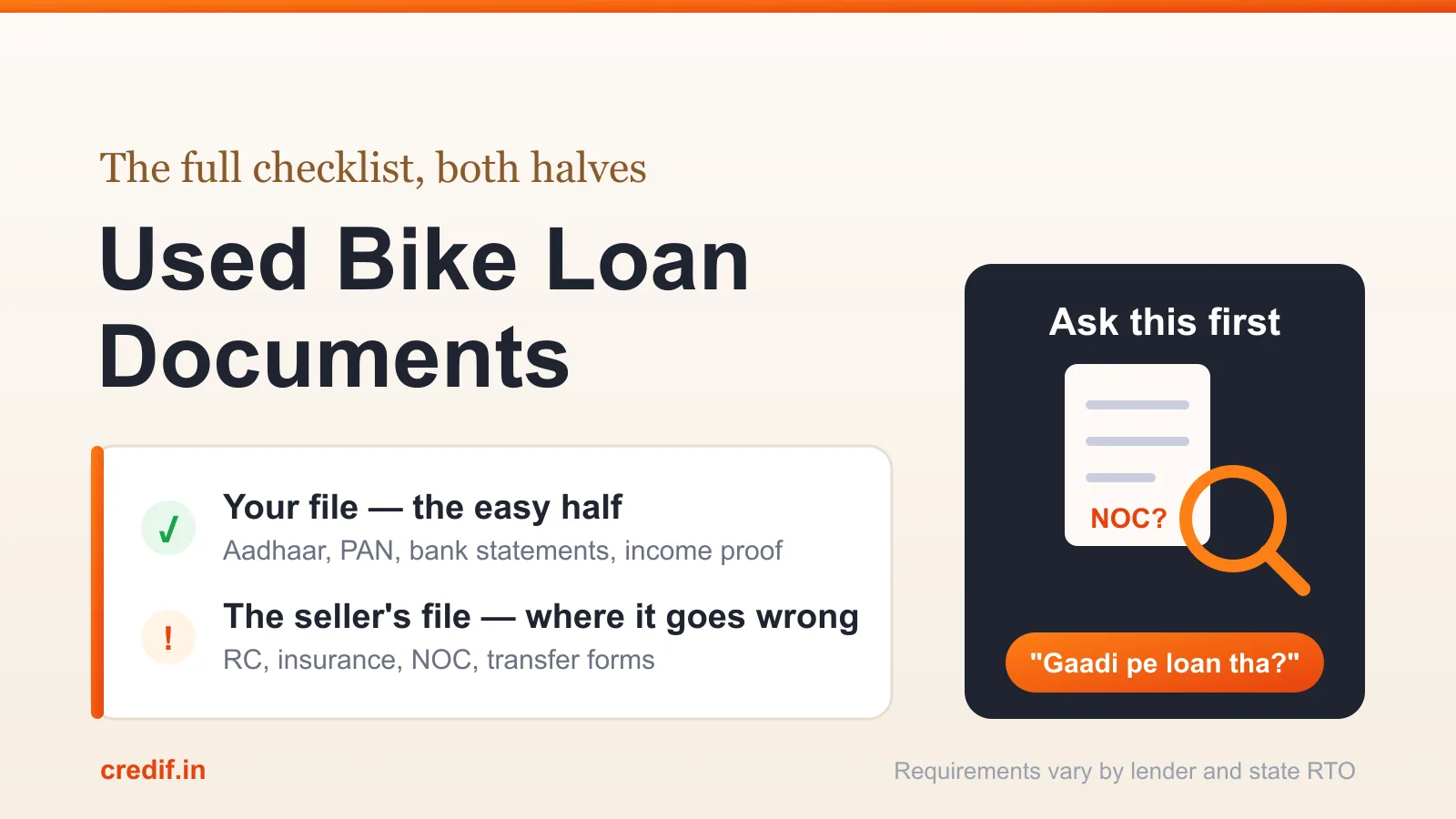
Faizan works at a mobile repair counter in Kanpur, the kind with three phones open on the desk at any moment. He is twenty-four and he had finally saved enough for a second-hand bike, a five-year-old commuter from a man in the next mohalla.
He came to ask about the loan, and he had done his homework. Aadhaar, PAN, bank statements, salary proof from his employer. All of it in a folder, all of it correct.
He got stuck anyway. Not on his papers. On the seller's.
"Meri saari file poori thi. Atka toh uski gaadi pe."
My whole file was complete. It got stuck on his vehicle.
That is what almost nobody tells you about a used two-wheeler loan. Your documents are the easy half. The vehicle comes with its own paperwork, and if that side is not clean, the best-prepared borrower in Kanpur still cannot get disbursed.
So this is both lists. Yours and the vehicle's. Get both right and this is a fast, simple loan.
One note before the lists: exact requirements vary between lenders, and between states on the RTO side. Everything here is the standard set that covers most cases. Confirm the specific list with your lender and your RTO before you start running around.
Bike picked out and want to know if you qualify?
Credifin finances used two-wheelers on bank statements and real income, not only a salary slip. Decision in 3 to 7 working days.
Check your eligibility →Your documents, by profile
The core set is short and the same for everyone. What changes is how you prove income.
Everyone needs these
Primary KYC. Watch the name spelling and current address.
Identity and credit check. Name must match Aadhaar.
Where you actually live. An old Aadhaar address is the classic trap.
Standard file requirement. Recent ones, two or three.
For the EMI auto-debit. Account active, mobile number live.
The application itself. Signature should match bank records.
Standard set. Individual lenders may ask for slightly more or less.
Then income proof, depending on who you are
| If you are | What proves your income | Typical period |
|---|---|---|
| Salaried | Salary slips plus bank statements | 3 months slips, 3 to 6 months statements |
| Self-employed, registered | Bank statements, GST returns, registration | 6 to 12 months statements |
| Self-employed, unregistered | Bank statements as the main document | 6 to 12 months |
| Gig or delivery rider | Platform earnings report plus bank credits | 3 to 6 months of both |
| First-time borrower, thin file | Whatever income proof exists, plus a co-applicant | As available |
| Student or dependent | Co-applicant income carries the file | Co-applicant full set |
Indicative. Lenders differ on what they will accept, particularly for gig income.
Two things worth flagging here.
If you drive for a delivery platform, your in-app earnings report now works as income proof at most NBFCs. Pair it with bank credits that match, and you have a real application. That was not standard a couple of years ago.
If you have no credit history at all, that is not a rejection. It usually means a co-applicant, a bigger down payment, or a slightly smaller loan. Thin files are common at this ticket size and lenders are used to them.
The seller documents, which is where it goes wrong
This is the half Faizan tripped over, and it is the half almost no article covers.
You are borrowing against a vehicle. The lender needs that vehicle to be legally transferable and free of anyone else's claim. So the seller has to produce a set of papers, and you should ask for all of them before you pay a single rupee as token.
The seller's file — check it before you pay anything
| Document | What it does | The problem if it is missing |
|---|---|---|
| Original RC | Proves ownership | No transfer is possible without it |
| Valid insurance | Required by law and by the lender | Loan cannot disburse |
| NOC from the seller's financier | Proves the old loan is cleared | This is the number one killer |
| Form 29 and Form 30 | The transfer application itself | RTO will not process the transfer |
| Form 28, if the state changes | NOC for interstate transfer | Blocks a cross-state sale |
| Valid PUC certificate | Emissions compliance | Usually needed at transfer |
| Chassis pencil print | Physical verification of the vehicle | Lender or RTO will ask for it |
| Seller ID proof | Confirms the seller is the owner | Verification stalls |
| Original purchase invoice | Supports the ownership chain | Helpful, not always essential |
Requirements vary by state. Check with your RTO, since forms and processes differ.
The NOC line is the one to burn into memory. If the bike was ever financed and the loan was cleared, the financier must have issued a No Objection Certificate and the hypothecation must be removed from the RC — the RTO does that removal against the NOC and Form 35. Sellers routinely say "loan toh khatam ho gaya" and genuinely believe it, without ever having collected the NOC or updated the RC. The loan being paid off and the paperwork being done are two different events.
Faizan's seller had cleared his loan two years earlier. Never collected the NOC. Never updated the RC. It took a few weeks of chasing the old financier to sort out, and Faizan spent that time not owning a bike he had already agreed to buy.
Ask this question early: "Gaadi pe loan tha? Agar tha, toh NOC aur RC update dikhaao." Was there a loan on this vehicle? If yes, show me the NOC and the updated RC.
How the transfer and the loan fit together
People get confused about the order, so here is the sequence.
The loan is secured against the vehicle. The lender's name goes onto the RC as the hypothecating party. That cannot happen while somebody else's name is still sitting there.
So the chain runs: old financier's hypothecation removed, then ownership transferred to you, then your lender's hypothecation added.
Seller · Can take weeks if not already done
Seller · A few days to a couple of weeks
You · An hour, if the papers are ready
Lender · 2 to 5 working days
Both · Follows verification
Lender · On completion
Lender and RTO · After transfer
Typical sequence. Timelines vary by state and by how ready the seller paperwork is.
Notice that the first two steps are entirely the seller's responsibility and entirely outside your control. Which is exactly why you ask about them before you commit to anything.
Papers ready and want a straight answer fast?
The eligibility check takes a few minutes and no documents. Decision on a clean file in 3 to 7 working days, on bank statements or platform earnings.
Check your eligibility →What the lender checks about the bike itself
Your documents can be perfect and the vehicle can still cap what you get.
Ask the lender for an indicative valuation before you agree a price with the seller. Doing it the other way round is how people end up needing to find an extra twenty thousand rupees at the last minute.
The five mistakes that actually cause delays
1. The Aadhaar address is old
You moved three years ago and never updated it. Now your address proof contradicts everything else in the file. Update it on the UIDAI portal before you apply, not during.
2. The name is spelled differently across documents
One letter between your PAN and your bank record is enough to stall a file. Line them up first.
3. A dead mobile number at the bank
Verification messages go nowhere and everyone assumes you are ignoring them. Update it.
4. Paying the seller before the papers are checked
Token money handed over on trust, then the NOC problem surfaces. Now you are negotiating from a weak position with your own money already gone.
5. Applying at four lenders at once
Every application is a hard enquiry. On a small-ticket loan where your score is already doing heavy lifting, that is self-sabotage. Pick one.
There is more on this pattern in our piece on why loan rejections are usually not about your credit score, because a surprising share come down to exactly these five.
Back to Faizan
The NOC came through eventually. The seller's old financier had merged into another company, which is why it took as long as it did, and neither of them had any idea that was the holdup until they went looking.
Once that was cleared, the rest moved quickly. Faizan's own file was clean, his employer gave him the salary letter the same day he asked, and his bank statements showed a small but steady salary landing on the same date each month. Sanctioned in under a week.
He has been riding it since June. The thing he tells people now is not about documents at all.
"Agli baar sabse pehle poochhunga, gaadi pe loan tha kya."
Next time, the first thing I will ask is whether there was ever a loan on the vehicle.
That is the whole lesson in one line. Your paperwork is the part you control and it is the easy part. The seller paperwork is the part that delays you, and the only defence is asking early, before money changes hands.
Bottom line
A used two-wheeler loan is one of the simpler products in lending. Small amount, secured, short tenure, and lenders are comfortable with borrowers who would struggle to get an unsecured loan.
What slows it down is almost never the borrower file. It is the vehicle history.
So work through it in this order. Check the seller's RC, insurance and NOC before you agree a price. Line up your own Aadhaar, PAN and bank records so the name and address match everywhere. Get an indicative valuation before you commit. Then apply once, with both sets of papers ready.
Do that and this is a week, not a month.
Where Credifin fits
We finance used two-wheelers across 14 states and more than 200 locations, alongside used cars, e-rickshaws and electric two-wheelers.
We assess on bank statements and actual income, including delivery-platform earnings, which is why gig workers, shopkeepers and first-time borrowers get through with us where a salary-slip process cannot read them. We are comfortable with thin credit files and moderate scores at this ticket size, because the vehicle is the security.
The application is online and the decision on a clean file comes in 3 to 7 working days. If the seller papers have a problem, we will tell you what is missing rather than leaving you to guess. And if you would rather sit across a desk and go through the folder with someone, walk into your nearest branch.
Ready to apply?
Used two-wheeler finance on bank statements or platform earnings, across 14 states. Bring both sets of papers and we will tell you where you stand in 3 to 7 working days.
Apply now →Talk to Credifin
Credifin is an RBI-registered NBFC financing used and new two-wheelers, cars, e-rickshaws and EVs across India.
079651-74500 | info@credif.in
Find your nearest branch →
FAQs
What documents are required for a used bike loan?
From you: Aadhaar, PAN, address proof, photographs, bank statements and income proof. From the seller: original RC, valid insurance, NOC from any previous financier, Forms 29 and 30, PUC and a chassis pencil print. Both sets are needed.
Can I get a used bike loan without a salary slip?
Yes, at most NBFCs. Bank statements showing consistent income work as the main proof, and delivery-platform earnings reports are accepted for gig workers.
What is an NOC and why does it matter so much?
A No Objection Certificate from the seller's previous financier, proving the earlier loan is cleared. Without it the hypothecation stays on the RC, ownership cannot transfer, and your loan cannot disburse. Ask for it before you pay anything.
How old can the bike be?
Lenders set their own limits, and many also cap the vehicle age at the end of the tenure rather than at purchase. An older bike usually means a shorter tenure and a higher EMI.
How long does the whole process take?
For a clean file with the seller papers in order, often a week. When an NOC is missing it can stretch to several weeks, and that part is outside both your control and the lender's control.
Who receives the loan money?
Usually the seller, or the dealer, rather than you. The amount is disbursed against the vehicle once verification and transfer arrangements are complete.
Will the loan cover the full price of the bike?
Rarely. The lender funds a share of its own valuation, which may be below the asking price, so plan for a down payment plus any gap between valuation and price.
Can I get a used bike loan with a low credit score?
Often yes, because the loan is secured and the amount is small. Expect a higher rate, and expect a larger down payment or a co-applicant to strengthen the file. Our guide to getting a loan at a 600 CIBIL score covers exactly this ground.
This might catch your interest