CIBIL Score 600: Which Loans Can You Actually Get?
Vansh Budhiraja·11 August 2026
Balbir has a small shop selling cycle parts off Gill Road in Ludhiana. Two shelves, a fan that only works on speed three, and a son who wanted to start driving a cargo e-rickshaw.
Last winter he got his credit report printed at a cyber cafe because his nephew told him to. It said 604. He folded the paper, put it in the drawer under the cash box, and did nothing about it for five months.
When I asked him why, he gave me the answer half the country gives.
"Score kam hai. Koi nahi dega. Kyun beizzati karwani hai?"
Score is low, nobody will give, why go get insulted.
Here is what those five months cost him. Not the loan. The five months. A cargo e-rickshaw on a decent route earns something every single day it runs, and his did not run, because it did not exist, because a number on a printout felt like a locked door.
It was not a locked door. When he finally applied, the file cleared in under a week.
I want to explain why, because the gap between what people think 600 means and what it actually means is costing a lot of families real money.
A note on the numbers below: every rate in this article is a range, not a quote. What you are offered depends on the lender, the loan type, the tenure, the vehicle or property behind it, and how the rest of your file reads. The figures here show you the shape of the thing. Your sanction letter is the only number that counts.
Sitting on a low score and not applying?
Credifin reads bank statements and real income, not just a three-digit number. E-rickshaw, EV two-wheeler, used vehicle, business and property loans across 14 states. Decision in 3 to 7 working days.
Check your eligibility →What 600 is actually telling a lender
The scale runs 300 to 900. Six hundred sits low, and it usually means one of three things happened.
You missed payments somewhere. Or you have barely any credit history at all, so the system has almost nothing to score you on. Or there is a mistake on your report that nobody has bothered to fix.
That third one is more common than it should be. Loans you closed years ago still showing as running. A name spelled one way on your PAN and another way at the bank. An account marked "settled" that should read "closed."
Before you accept 604 as your number, find out whether it is your number.
Here is roughly how the bands get read on the other side of the desk.
| Band | How a lender reads it | What it opens |
|---|---|---|
| 750 and above | Low risk, easy file | Almost everything, at the best pricing going |
| 700 to 749 | Comfortable | Most products, pricing a notch above the best |
| 650 to 699 | Borderline | Secured lending fine, unsecured gets tight |
| 600 to 649 | Higher risk | Secured lending works, unsecured is hard |
| Below 600 | High risk | Needs collateral or a co-applicant |
Indicative. Every lender writes its own credit policy and they differ more than people assume.
Read that table again and notice what is missing from it. The word "rejected" does not appear anywhere. What changes is the terms, not the answer.
The one distinction that decides everything
There are two kinds of borrowing and at 600 they behave like completely different products.
A secured loan has an asset sitting behind it. A vehicle, a property, something the lender can recover if it all goes wrong. A personal loan or a credit card has nothing behind it except your word.
At 600, your word is the weak part of the file. So a lender who cannot lean on the promise leans on the asset instead.
This is why the same man, on the same morning, gets turned down for a personal loan and approved for a vehicle loan. Nothing about him changed between the two applications. The structure of the loan changed.
Once that clicks, none of it feels arbitrary anymore.
Product by product, at 600
| Loan type | Realistic at 600? | What carries it |
|---|---|---|
| E-rickshaw loan | Yes, at NBFCs | Vehicle is collateral and earns daily |
| Used two-wheeler loan | Yes | Small ticket, secured, short tenure |
| Electric two-wheeler loan | Yes, mostly NBFCs | Secured, modest amount |
| Used car loan | Usually | Depends on vehicle age and down payment |
| Loan against property | Usually | Collateral outweighs a weak score |
| Home loan | Case by case | Clean title, bigger margin, often a co-applicant |
| Secured business loan | Often | Collateral plus banking history |
| Personal loan | Difficult | Nothing to fall back on |
| Credit card | Unlikely | A card against a fixed deposit is the workaround |
Directional. Availability varies by lender and by how the rest of your file looks.
The pattern is not subtle. Anything with an asset attached stays open. Anything without one becomes a fight.
And for an e-rickshaw or a used two-wheeler there is a second thing working in your favour. The asset is also a tool. It earns while it repays. Lenders who actually operate in this segment understand that, and they price accordingly.
Why two men with the same score get different answers
Because the score is one input, and it is rarely the one doing the deciding.
Sit on the other side of the desk for a minute. Two files in front of you. Both scored 600. Both want roughly the same amount.
The first has twelve months of bank statements with money arriving most weeks, roughly the same sort of figure each time. He is putting down a third of the vehicle cost himself. One small EMI already running, comfortably covered.
The second has an account with almost nothing moving through it, wants the maximum amount available, and has applied at four other lenders in the last three weeks.
Same score. Not remotely the same file.
The first one gets sanctioned. The second probably does not, and his score has very little to do with why.
Here is what is actually being read alongside the number.
Your bank statements. Six to twelve months of them. Nobody is looking for perfection. Seasonal gaps in a trading business are normal and explainable. What they want is a pattern they can recognise.
Your EMI-to-income ratio. Everything you owe monthly, added up, against what you earn. Push past roughly half your income and the file gets uncomfortable no matter what the score says.
Recent enquiries. Every application creates a hard enquiry on your report. Four of them in a month reads as somebody in trouble, and lenders react to that faster than they react to a mediocre score.
How much you are putting in. A bigger down payment shrinks the lender exposure. At a weak score it does more for you than almost anything else available.
Whether you have a co-applicant. A wife, a brother, a son with a cleaner profile can carry a file that would otherwise tip over.
There is more on this in our piece on why loan rejections usually are not about your score, because a surprising share of them turn out to be paperwork rather than credit.
What 600 costs you in rupees
It costs something. No point pretending otherwise.
| Score band | Rough range at banks | Rough range at NBFCs |
|---|---|---|
| 750 and above | About 10 to 14% | About 12 to 16% |
| 700 to 749 | About 12 to 16% | About 14 to 18% |
| 650 to 699 | About 14 to 18% | About 15 to 20% |
| 600 to 649 | Often declined | About 16 to 22% |
| Below 600 | Rarely approved | 18 to 24%, with conditions |
Illustrative bands only, to show the shape. Actual pricing depends on lender, product, tenure and profile. If it is specifically an electric vehicle you are financing, the band-by-band numbers are in our CIBIL score for EV loans guide.
On a used two-wheeler or an e-rickshaw, the difference between borrowing at 600 and borrowing at 750 might come to a few hundred rupees a month. Real money across three years. Not the difference between yes and no.
Now hold that against what the vehicle earns.
If the e-rickshaw brings in more per month than the rate difference costs you, waiting a year for a better score is the more expensive choice. Balbir's five months of waiting cost him far more than the extra interest ever would have. Run that sum for your own situation before you decide to sit on it.
There is a genuine version of the opposite argument. If you are upgrading something that already works fine, and there is no income riding on it, waiting a year and borrowing cheaper is sensible. The test is whether the thing you are borrowing for makes money or spends it.
Want to know where your file actually stands?
The eligibility check takes a few minutes and no documents. We will tell you what is realistic before you formally apply, so you are not collecting hard enquiries finding out.
Check your eligibility →Getting off 600
Better news here than there used to be. Since January 2025, lenders report to the credit bureaus twice a month rather than once, with data pulled as of the 15th and the last day. Something you fix in the first week of a month can show up inside three to four weeks.
Cuts both ways, obviously. Miss an EMI and that lands just as fast. That is also why a missed pay later bill hurts as much as a missed loan EMI.
| What you do | Roughly when it shows | How much it tends to move |
|---|---|---|
| Get a wrong entry corrected | Within 30 days, by rule | Sometimes a lot, if the error was big |
| Bring card usage under 30% | 3 to 6 weeks | Meaningful |
| Six months of EMIs paid on time | 6 months | Steady and dependable |
| Stop applying everywhere | 3 to 6 months | Enquiries fade off |
| Clear a small overdue account | 3 to 4 weeks | Depends how old it is |
| Twelve clean months | A year | This is the one that genuinely works |
Timelines are typical, not guaranteed. Movement depends on what else is on your report.
One thing on errors that almost nobody uses. If you file a dispute with a bureau and it is not sorted within 30 calendar days, you are owed Rs 100 for every extra day. Nobody at the bureau will volunteer this. The obligation exists whether you ask or not.
Our guide to improving a CIBIL score walks through the mechanics properly.
Four things not to do at 600
1. Do not apply everywhere at once
This is the most common self-inflicted wound we see. Six applications in a fortnight turns 604 into something in the 570s, and now the lenders who would have said yes are saying no. Pick one. If it fails, find out exactly why, fix that, then approach the next one three weeks later.
2. Do not settle a loan if you can close it
Settling means the lender accepted less than the full amount. It sits on your report as "settled" and reads as a partial default for years afterwards. Closing means you paid what you owed. If somebody offers you a settlement, understand you are trading a discount today for a mark that outlives it. Sometimes that trade is worth making. Make it knowing what it is.
3. Do not put the report in a drawer
Scores do not drift upward on their own. They move when your behaviour changes. Balbir's five months produced exactly the same number and five months of nothing earned.
4. Do not pay anyone who promises to fix your score
Nobody can edit a credit report except by correcting genuine errors, and you can do that yourself, free, at the bureau.
Bank or NBFC at this score
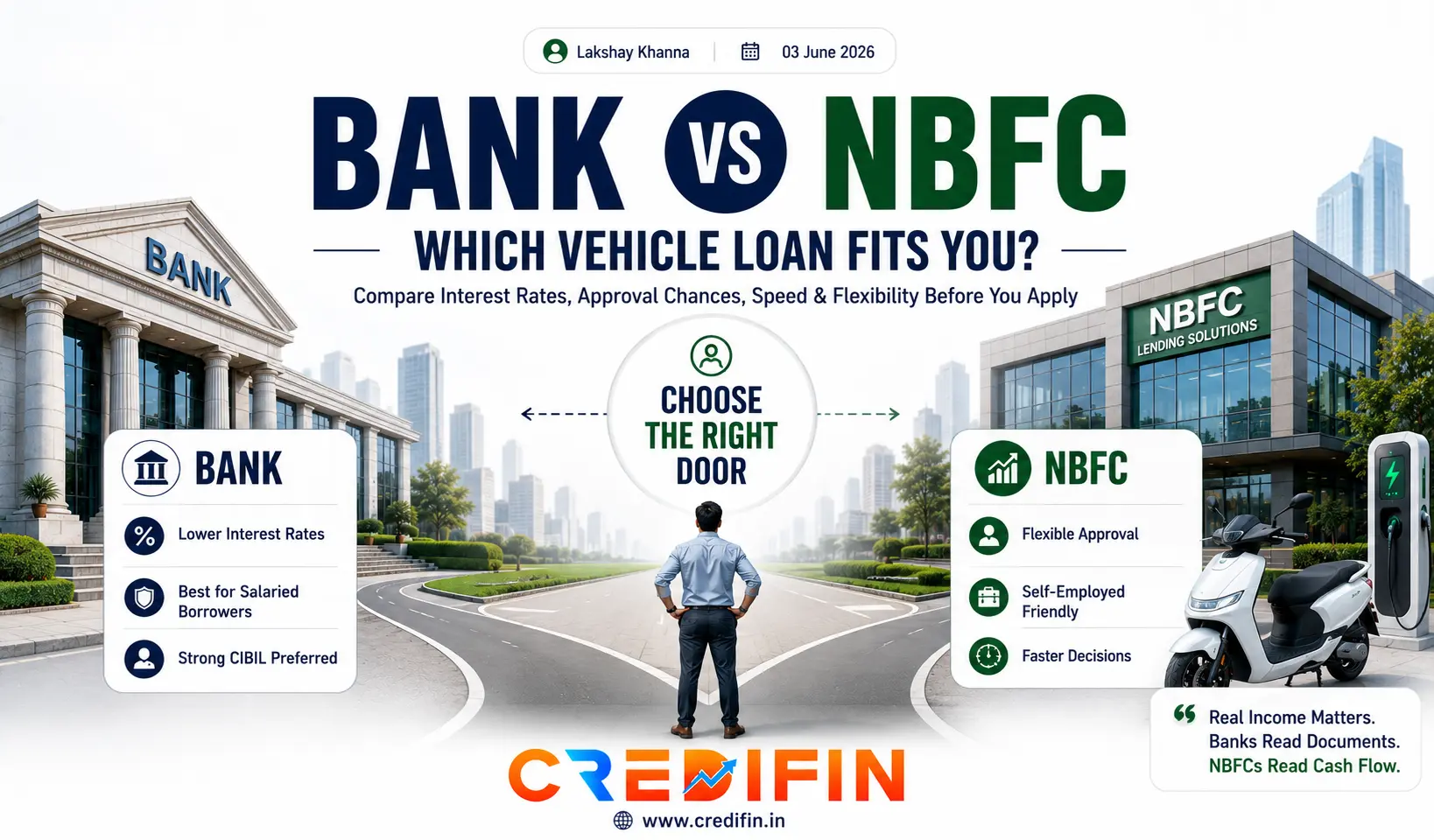
Banks and NBFCs are not chasing the same file, and treating them as interchangeable is the mistake sitting underneath most rejections.
A bank underwrites off documented income. Salary slips, ITR, a score sitting comfortably above 700. If you have all of that, go to a bank, because the rate will be better and you should take it.
An NBFC underwrites off the whole picture. Bank statements, the asset, how the business actually runs day to day, who else is signing.
That difference is the entire reason a shopkeeper earning sixty or seventy thousand a month gets declined at a bank whose file shows an ITR filed at a fraction of that. The bank is not being unreasonable. It is doing precisely what its system tells it to do with the information in front of it.
We look at the money moving through the account. There is more in our comparison of banks and NBFCs for vehicle loans.
Back to Balbir
He came round in March, mostly because his son had started asking questions he could not answer.
First thing we did was pull his report properly rather than relying on the cyber cafe printout. Two closed accounts were still showing as running. He had cleared both, years ago, and nobody had updated anything. He raised the dispute himself on his phone while sitting in the shop. It took him about fifteen minutes and cost nothing.
Then he did the sensible thing and applied at one place instead of five. Bank statements from the shop, his son as co-applicant, a slightly bigger down payment than he had originally planned because his brother chipped in.
Sanctioned inside a week. The e-rickshaw has been running since April.
His score, last I heard, had moved into the mid 640s, mostly on the strength of the corrections plus a few months of clean EMIs. He was quietly pleased about that, but it was not the part he wanted to talk about.
"Number chhota tha. Darr bada tha."
The number was small. The fear was bigger.
That is the whole thing, really. A weak score costs you some money on the rate. Believing a weak score means "no" costs you the earnings of every month you do not apply. Those two costs are not in the same league.
Bottom line
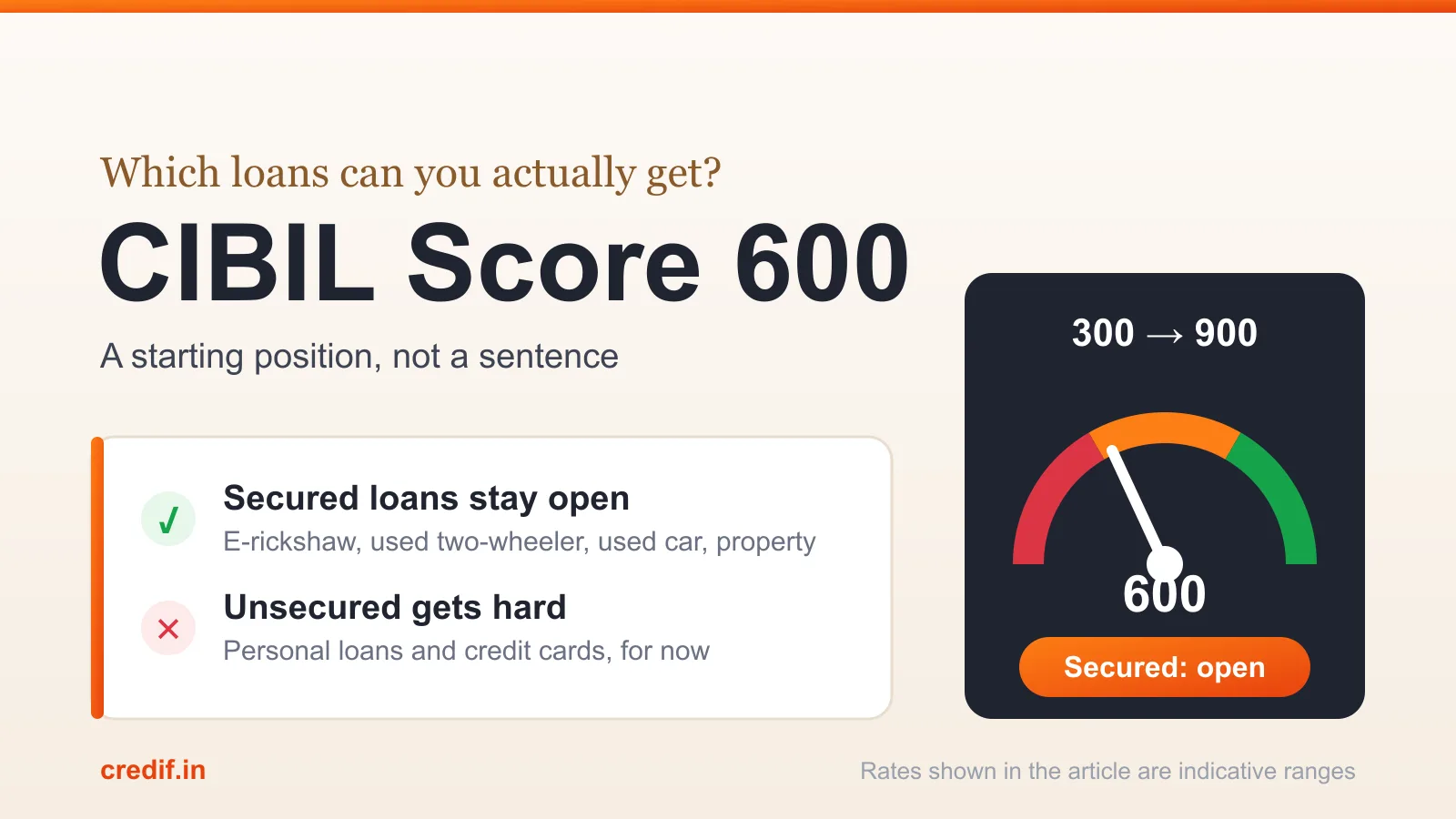
Six hundred is a starting position, not a sentence.
It costs you something on the rate, usually a few percentage points. It closes off unsecured borrowing for now, which is a real limitation. It leaves secured lending wide open, and secured lending happens to be where most people at this score actually need to borrow.
So do three things. Pull your reports from all four bureaus and check whether the number is even correct. Fix whatever is wrong, and claim your Rs 100 a day if they sit on it. Then apply once, to a lender who works with profiles like yours, with your documents in order and your down payment as large as you can sensibly make it.
After that, spend twelve months making the number irrelevant.
Where Credifin fits
If that sounds roughly like your situation, here is how we work.
We assess on bank statements and actual cash flow, which is why shopkeepers, traders, drivers and other self-employed borrowers get through with us when a salary-slip process cannot read them. We finance e-rickshaws, electric and petrol two-wheelers, used vehicles, business needs and property across 14 states and more than 200 locations. The application is online, the decision on a clean file comes in 3 to 7 working days, and if you would rather sit across a desk and ask questions in person, walk into your nearest branch.
We will also tell you when a bank is the better door for you. If your documentation is clean and your score is above 700, it usually is. Knowing which door to knock on is most of this decision.
Report says 600 and you have been avoiding it?
Find out what is actually available before you collect any more hard enquiries. Bank-statement assessed, so self-employed and cash-income borrowers qualify. Decision in 3 to 7 working days.
Apply now →Talk to Credifin
Credifin is an RBI-registered NBFC lending across 14 states and 200+ locations. CRISIL BBB- / Stable. Lending since 1992.
079651-74500 | info@credif.in
Find your nearest branch →
FAQs
Can I get a loan with a CIBIL score of 600?
Yes, for secured loans. E-rickshaw, used two-wheeler, used car, loan against property and secured business loans are all realistic at 600, particularly at NBFCs. Unsecured personal loans and new credit cards are much harder, because there is no asset behind them.
What interest rate will I get at 600?
Higher than someone at 750, usually by a few percentage points. The range varies a lot by lender and product, so ask for the rate on your specific file rather than working off a published figure.
How long does it take to go from 600 to 700?
With on-time payments and no new applications, most borrowers see real movement over six to twelve months. Correcting a genuine error on your report can move it considerably faster than that.
Does checking my own CIBIL score reduce it?
No. Checking your own report is a soft enquiry and has no effect at all. Only a lender hard enquiry, generated when you apply, gets recorded.
Is 600 enough for a home loan?
Possible, but harder. Expect a larger margin, a co-applicant, and closer scrutiny of the property title. A loan against property is often the more practical route at this score.
Will a co-applicant help?
Usually yes. Someone with a stronger score and documented income improves both your odds and your pricing, because the lender now has two people on the hook.
My report has a mistake on it. What do I do?
Raise a dispute directly with the bureau, online, free. If it is not resolved within 30 calendar days you are entitled to Rs 100 per day of delay. Note the date you filed.
Should I wait until my score improves before applying?
Depends what you are borrowing for. If the asset earns money, waiting usually costs more than the higher rate does. If it does not, waiting a year and borrowing cheaper is reasonable.
This might catch your interest