EV Price Hike: Why Electric Vehicles Suddenly Cost More in India
Lakshay Khanna·04 August 2026
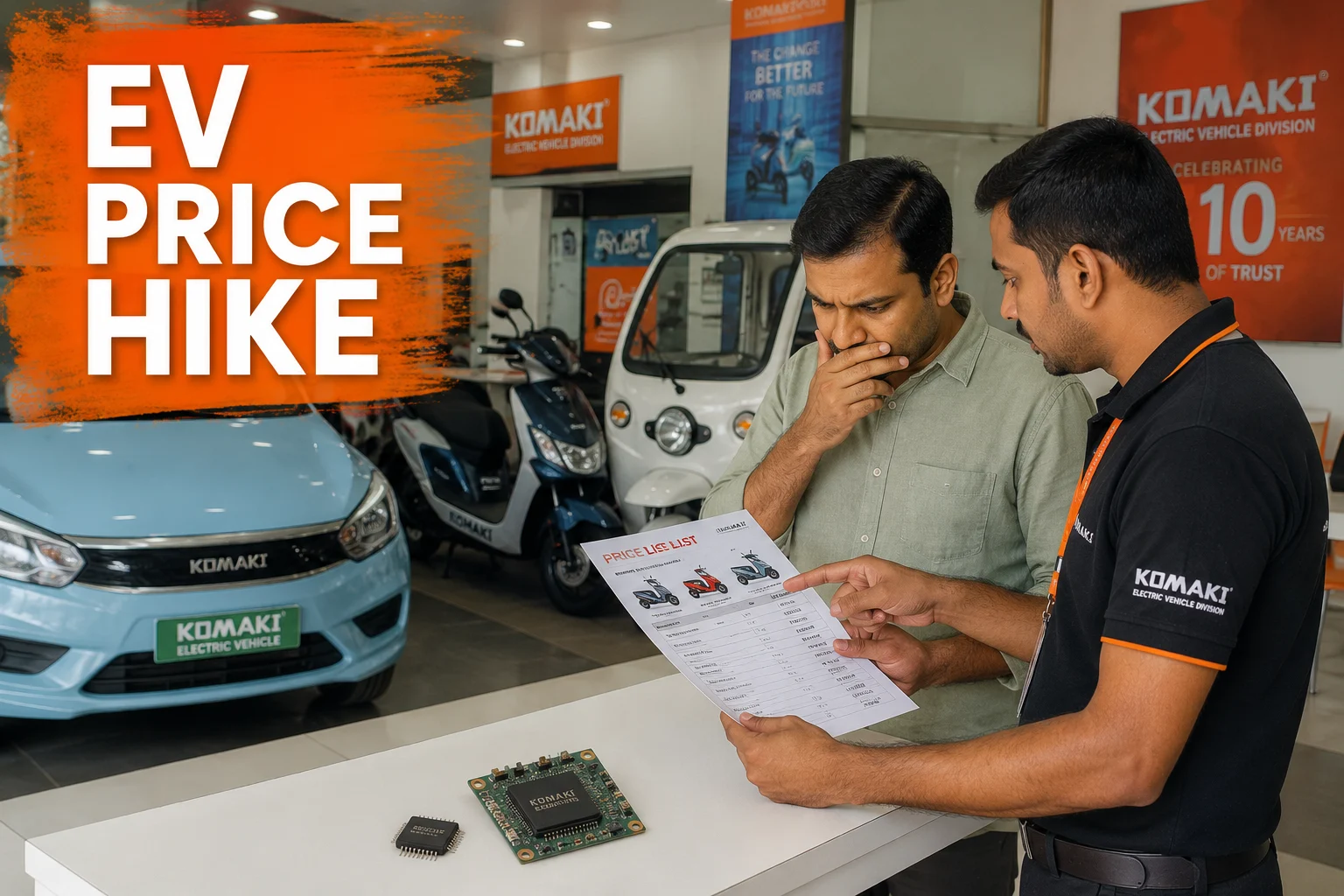
There's a dealer in Ludhiana I speak to fairly often. Sells electric scooters, mostly to college kids and small shop owners. In March he called me, properly irritated.
A customer had booked a scooter in December. Paid the token amount, all sorted. When the delivery finally came through, the company had revised the price. Not a huge amount. Enough to matter to a man who had budgeted down to the last rupee.
The customer thought the dealer was cheating him. Shouted for twenty minutes in front of other buyers. Walked out.
"Sir, maine kuch nahi kiya. Company ne rate badha diya, mujhe bhi ek din pehle pata chala."
He was telling the truth. And the reason the company raised the rate has almost nothing to do with scooters, batteries, steel, or anything you'd expect. It has to do with computers. Very large rooms full of them, in countries most of us will never visit. Bear with me. It sounds ridiculous and it's completely real.
Worried a quoted EV price will change before delivery?
Credifin sizes your loan on the current, post-subsidy price and flags a dealer quote that looks inflated. Apply online, decision in 3 to 7 working days.
Get a Straight Quote →The whole thing in one table
Every figure below is an estimate for explanation. Not a published price, not a quote.
| The link in the chain | What it means for you |
|---|---|
| AI companies started buying memory chips in bulk | Chip factories found a richer customer |
| Factories shifted production toward those orders | Less supply left for cars, phones, EVs |
| Memory chip prices roughly doubled (est.) | Anything with a chip inside got dearer |
| EVs carry a lot of chips | EVs took a harder hit than petrol vehicles |
| Manufacturers absorbed it, then stopped | Ex-showroom prices were revised |
| Loans get sized on the revised price | Your EMI moved without you doing anything |
What is actually short here
When people hear "chip shortage" they think of 2021. Cars sitting half-built in factory yards. Nine-month waiting lists. Everyone blaming Covid. This one runs on completely different logic.
Back then, the world genuinely could not make enough chips. Plants were shut. Ports were jammed. Supply collapsed. Right now the plants are running beautifully. That's not the problem.
The problem is memory chips specifically. Memory is the rough notebook a machine scribbles on while it works. Your phone has it. Your laptop has it. Your EV's display, its battery management unit and its instrument cluster all have it.
Artificial intelligence eats memory at a scale that's hard to picture. One AI facility can consume more of it than an entire city's worth of smartphones. And the companies building these facilities pay whatever is asked, because against what they're earning, the chip cost barely registers.
So chip makers did what any business would do. They pointed more of their factory at the customer holding the fatter wallet. Automotive didn't get thrown out of the queue. It just got moved to the back of it. That's the entire crisis. No villain, no conspiracy, just money going where money goes. India is building its own answer to this through the India Semiconductor Mission, but fabs take years, not quarters.
Why EVs got hit harder than petrol vehicles
This is the bit that surprises people. A basic petrol scooter is a machine with a few wires attached. An electric scooter is closer to a tablet that happens to have two wheels and a seat.
Battery management software. Regen braking logic. Colour screen. Bluetooth pairing. Ride modes. On some models, navigation, a phone app, over-the-air updates, an anti-theft ping. All of that sits on chips. A good chunk of it sits on memory chips.
Rough electronic content by vehicle type (illustrative only):
| Vehicle | Memory content | Rough cost impact | Visible on price tag? |
|---|---|---|---|
| Basic petrol scooter | Very low | Few hundred rupees | Almost never |
| Entry petrol car | Low to moderate | Low thousands | Rarely |
| Basic e-rickshaw | Low | Low thousands | Slightly |
| Connected e-rickshaw | Moderate | Mid thousands | Yes |
| Electric scooter | Moderate | Mid thousands | Yes |
| Mid-range electric car | High | Tens of thousands | Clearly |
| Premium EV with driver-assist | Very high | Higher still | Very clearly |
Directional estimates to show the shape of the problem.
Look at the pattern. The smarter the vehicle, the bigger the squeeze. Which is a little unfair, honestly, because "smart features" is exactly what EV brands have been selling us for the last five years. The thing they taught us to want is the thing that got expensive.
How it travels from a factory abroad to a showroom in Punjab
Seven steps. Each one adds a bit.
An AI firm places a giant order and agrees to pay well above the going rate.
The chip maker converts more capacity to serve it. Total output holds steady, but the slice left over for vehicles shrinks.
Suppliers who build parts for EV makers find their usual chips cost more and take longer. Some are forced to buy at spot prices, which is basically the tatkal window of the electronics world.
That supplier raises the price of the control unit or display module it sells to the vehicle manufacturer.
The manufacturer swallows it for a quarter or two. Quietly. Hoping it settles.
It doesn't settle. So the manufacturer revises the ex-showroom price, or cuts the discount that was running, or removes a feature from the base variant and doesn't announce it loudly.
And then you walk in with a printout from three months ago and get an unpleasant surprise.
Nobody along that line is doing anything wrong. Everyone is making a perfectly sensible decision about their own business. The cost just rolls downhill until it stops at the person standing at the bottom. Which is you, at a counter, holding an old quotation.
The delay hurts more than the price, sometimes
Price rises annoy people. Delivery delays wreck their plans. When parts are tight, manufacturers make choices about what to build. Fast-selling variants get priority. Popular colours get priority. The slower stuff waits.
So the base model might be available in a fortnight, while the top variant, the one with the screen you actually wanted, is sitting at eight weeks with no firm commitment. Dealers won't always volunteer this. Ask them straight: is this delivery date confirmed, or estimated? You're entitled to a clear answer, and their face usually tells you before their mouth does.
Now the part that actually costs you money
Almost nobody in India buys an EV with cash on the table. Most of us finance it. Which means a price rise doesn't hit you once. It follows you around every month for the next three to five years. Three things shift quietly.
Effect of a price rise on a financed EV (illustrative):
| Situation | Vehicle price | Down payment | Loan size | EMI direction |
|---|---|---|---|---|
| Original quote | Base | Unchanged | Lower | Baseline |
| Mild revision | Slightly up | Unchanged | Slightly up | Up a little |
| Sharp revision | Noticeably up | Unchanged | Noticeably up | Up clearly |
| Sharp revision, bigger down payment | Noticeably up | Increased | Near original | Roughly flat |
Directional only. Real EMI depends on rate, tenure and your profile.
Read that last row again. You cannot negotiate with a chip factory in Korea. You can absolutely change your down payment. That's the lever sitting right there in your hand, and most people forget it exists. Our EV down payment guide covers how much is genuinely worth putting in, and when putting in more is actually a mistake.
Six things worth doing
None of these are clever. All of them work.
1. Get the quote validity in writing
In a calm market a quotation holds for weeks. Right now it might hold for days. Ask the dealer to write the validity date on the paper. If he hesitates, that hesitation is your answer.2. Don't let the subsidy quietly disappear
State subsidy and road tax waiver should come off the price before the loan is calculated. Some dealers finance the full sticker and let the benefit vanish into their own margin. Insist it shows as a separate line. You can check what you're entitled to on the PM e-DRIVE scheme page.3. Sort the loan before you finalise the vehicle
If you know your sanctioned amount, you shop inside it. If you don't, you find out about the shortfall on delivery day, in front of your family.4. Look hard at the variant one step down
The premium variant costs more largely because of the electronics that got expensive this year. Dropping a trim level saves more now than it did two years ago — and our first-time EV buyer mistakes guide covers the other traps at the counter.5. Take used seriously
A two-year-old EV already has its chips inside it. Nobody's charging you today's component prices for a machine built before all this started. Used vehicle finance is genuinely more attractive right now than it was two years ago.6. Don't panic-apply to six lenders
Rising prices make people anxious, and anxious people fire off applications everywhere. Every one is a hard credit enquiry. Stack four or five and your CIBIL score can drop by thirty to fifty points, which gets you a worse rate, which makes you apply more. One bank, one NBFC, in parallel. That's the entire rule and people still break it every week.So should you buy now, or wait?
Everyone asks. Here's my honest read, and you're free to disagree.
Waiting makes sense when a shortage is temporary. This one doesn't look temporary. Demand for AI computing isn't a seasonal trend that fades after Diwali, and building new chip factories takes years. Not months. Years. So "wait for prices to fall" isn't a plan. It's a bet, and the odds aren't obviously in your favour.
| Your situation | Sensible move | Why |
|---|---|---|
| Vehicle earns your daily income | Buy now | Every idle month costs you actual money |
| Old petrol vehicle on its last legs | Buy now | Running-cost savings start day one |
| Upgrading something that works fine | Wait | No urgency, nothing lost by waiting |
| Already stretching your budget | Step down a variant | Don't let a price rise push you into a bigger loan |
| Want the fully loaded connected model | Consider waiting | Highest-electronics models are hit hardest |
If the vehicle makes you money, delay is the expensive choice. An e-rickshaw driver sitting at home waiting for a price correction that may never come isn't saving anything. He's just losing fares quietly. The arithmetic on that is in our piece on what an e-rickshaw actually earns monthly. If it's a want and not a need, waiting costs you nothing except patience.
Back to the man who shouted
The dealer called me again a few weeks later. The customer had come back. Sheepish, apparently. Someone had explained to him that the dealer genuinely had no say in it.
He ended up doing something sensible. Took the variant below the one he'd booked, added a bit more to his down payment from the money he'd set aside for a helmet and accessories, and financed the rest. His EMI landed almost exactly where he'd planned back in December. He lost the bigger display. He kept his monthly budget intact.
"Screen se ghar nahi chalta," he said, which is difficult to argue with.
That's the real lesson buried in all of this. You can't do a thing about global chip demand. You can control four things: your variant, your down payment, your lender, and your timing. All four are more useful than being angry at a dealer who didn't set the price.
Where Credifin fits
We finance electric two-wheelers, e-rickshaws, EV cars and battery replacements across India, and we've watched these revised prices land in actual loan applications through this year.
Two things we do that matter in this exact situation. We size the loan on the current post-subsidy price, so you're not borrowing against a number that's already stale. And if a dealer quote looks high for that vehicle and your profile, we'll tell you before you apply, not after.
Rates depend on profile and paperwork. Decision usually in 3 to 7 working days. No ITR needed for many self-employed and gig-income applicants, which matters if you drive for a living. If you're weighing us against a dealer's in-house finance, just lay the two offers side by side — our bank vs NBFC guide shows what to compare. That comparison tends to settle itself.
Ready to apply?
Prices moved. Your plan doesn't have to fall apart because of it. Apply with Credifin online, get sized on the real post-subsidy price, and get a straight quote you can hold up against any dealer offer.
Apply for an EV Loan →Talk to Credifin
Credifin is an RBI-registered NBFC financing electric two-wheelers, e-rickshaws, EV cars and battery replacements across India.
079651-74500 | info@credif.in
Find your nearest branch →
FAQs
Is this the same as the 2021 chip shortage?
No. In 2021 the world couldn't produce enough chips. Now production is fine, but AI data centres are buying a very large share of memory supply at higher prices.
Will EV prices come back down?
Not quickly. New chip capacity takes years to build. Don't plan your purchase around a fall that might not arrive this year.
Why are EVs affected more than petrol vehicles?
They carry far more electronics. Battery management, displays, connectivity and driver-assist all run on chips, so the cost lands harder.
My loan was sanctioned before the price changed. What now?
Talk to your lender before delivery day. Either raise your down payment to cover the gap or get the sanction revised. Don't leave it till you're standing at the counter.
Are e-rickshaws affected too?
Yes, but usually less. Basic models use simpler electronics. Connected or smart variants feel it more.
Is a used EV smarter right now?
For a lot of buyers, yes. A used EV was built with older, cheaper components. You're not paying today's chip prices for it.
Should I stretch the tenure to keep my EMI flat?
Careful with that. A longer tenure lowers the monthly figure and raises what you pay overall. Compare total cost, not just the EMI.
Do I still get the subsidy?
Yes. Subsidy schemes are separate from component pricing. Just make sure it appears as its own line and the loan is sized on what's left after it.
Prices moved. Your plan doesn't have to.
Get sized on the real post-subsidy price, with a quote you can hold up against any dealer offer. Online application, decision in 3 to 7 working days, across India.
Apply for an EV Loan