School Fee Finance vs Personal Loan vs Credit Card: The Cheapest Way to Pay Big School Fees
Lakshay Khanna·21 July 2026
My cousin Vineet called me in March. Panicked. His son's school had sent the annual fee demand and it was Rs 1.1 lakh, due in ten days. He runs a small printing press in Ludhiana. Good months and slow months, like most people who work for themselves. That particular month was slow.
"Bhai, card se pay kar doon? Ya personal loan le loon?"
He'd already half-decided. Swipe the credit card, deal with it later. I asked him to wait one evening and actually sit with the numbers before he did anything. Because the way you pay a big school fee decides how much that fee finally costs you. Same Rs 1.1 lakh. Three different ways to fund it. Three very different amounts leaving his pocket over the next year.
Most parents never do this comparison. The fee lands, the panic starts, and they grab whatever's closest to hand. Usually the card, because it's already in the wallet. That reflex is the expensive one. Let me walk you through what I showed Vineet.
Big fee due and the month is tight?
Credifin finances school fees the sensible way — the money goes to the school, you repay in easy EMIs. Online application, decision in 3 to 7 days.
Explore School Fee Finance →The three ways people actually pay
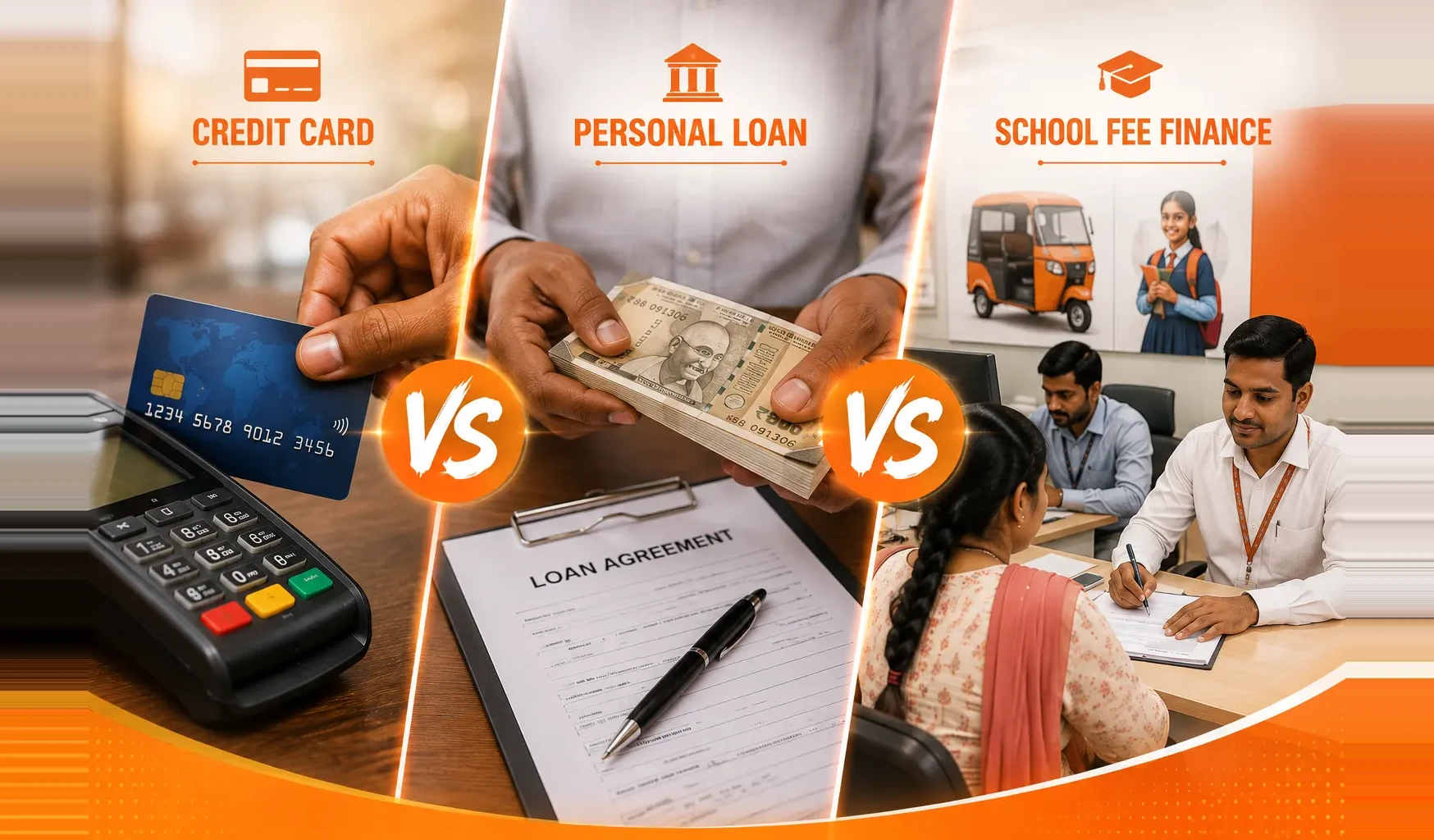
When a fee is too big to pay in one shot, almost everyone reaches for one of these three. A credit card. A personal loan. Or purpose-built school fee finance. They feel similar from the outside. You get the fee paid now, you repay over time. Under the hood they behave very differently, and the difference is money.
Here's the shape of each one before we get into the maths.
| How you pay | What it really is | Who it suits |
|---|---|---|
| Credit card | Short, expensive borrowing on a revolving balance | People who can clear the full bill next month |
| Personal loan | A lump-sum loan for anything, no fixed purpose | People who want cash in hand and a fixed EMI |
| School fee finance | A loan built only for education fees, paid to the school | Parents who want the fee handled and a clean monthly EMI |
The card looks free until you can't clear it in full. The personal loan looks tidy but you're paying for its flexibility. The fee finance is the narrow tool built for exactly this job. Narrow tools are usually cheaper for the job they're built for. That's the whole point.
Why the credit card is the trap
Let me be fair to the card first. If you can clear the entire bill on the due date, a credit card is genuinely the cheapest option going. Free credit for up to fifty days. No interest at all. If Vineet had the Rs 1.1 lakh sitting in his account and just wanted the reward points, swipe away.
But that's not why people reach for the card in a fee crunch. They reach for it because they don't have the money this month. And that's where it turns.
The moment you don't clear the full statement, the card stops being free and becomes the most expensive borrowing a normal person can access. Card interest runs around 3 to 3.5 percent a month. Work that out over a year and you're looking at roughly 36 to 42 percent. Not a typo. Per year.
And there's a second trap most people miss. If you pay only the "minimum due" the card kindly offers you, the interest doesn't just apply to the leftover balance. On most cards it applies to fresh purchases too, and it keeps compounding month on month. The balance barely moves while the interest quietly eats you. People carry a fee on their card for two years without realising they've paid nearly half of it again in interest alone. The Reserve Bank of India requires issuers to spell this out on your statement — it is worth actually reading that box once.
The card is brilliant if you're disciplined and liquid. It's brutal if you're using it because you're short. In a fee crunch, you're short. That's the tell. And if a card balance has already dented your score, our guide to improving your CIBIL score covers the way back.
Where a personal loan lands
A personal loan is the grown-up version of the same idea, and it's a real step up from the card. You borrow a fixed sum, you get a fixed EMI, you know the end date. No revolving trap. For a lot of parents this is a perfectly fine choice, and I won't pretend otherwise.
The catch is what you pay for that convenience. A personal loan is unsecured and has no fixed purpose, so the lender prices in that risk. Rates usually sit somewhere around 11 to 18 percent depending on your profile, plus a processing fee of 1 to 3 percent taken off the top. You also get the full amount dumped into your account, which sounds good until you realise loose cash in a tight month has a way of getting spent on things that aren't school fees. Our guide to the benefits of a personal loan covers where it genuinely is the right tool.
For Vineet, a personal loan would have worked. It just wasn't the cheapest tool on the table, and it handed him a pile of cash he'd have to be disciplined about. Fine. Not optimal.
What school fee finance actually does differently
This is the tool built for the exact job. And it does three things the other two don't.
That last point alone keeps people out of the debt spiral the card pulls them into. If you want the mechanics rather than the comparison, our guide to how school fee financing actually works walks the whole journey from application to the school being paid. The same logic runs across the rest of the education range — college fee finance for older children, annual fee finance for the once-a-year demand, and uniform and book finance for the smaller costs that stack up in the same month.
The three side by side
Here's the comparison I actually drew for Vineet on the back of an invoice. Same Rs 1.1 lakh fee. Rough, indicative numbers, but the shape is what matters.
| Credit card (min due) | Personal loan | School fee finance | |
|---|---|---|---|
| Interest level | Very high (36%+ a year) | Moderate (11–18%) | Built for purpose, moderate |
| Money goes to | Your card balance | Your bank account | Directly to the school |
| Repayment | Revolving, no fixed end | Fixed EMI, fixed end | Fixed EMI, short tenure |
| Risk of spiral | High | Low | Low |
| Loose cash to misspend | None, balance lingers | Yes, full amount in hand | None |
| Best when | You clear it in full next month | You want cash + a fixed plan | You just want the fee sorted |
Read the top row and the bottom row together. The card wins only if you can clear it next month, in which case you weren't really in a fee crunch at all. The fee finance wins for the exact situation most parents are actually in — the fee is big, the month is tight, and you want it handled cleanly without a pile of cash tempting you and without a balance that follows you around for years.
One thing worth claiming back: tuition fees paid for your children are eligible for a deduction under Section 80C, within the overall limit. It doesn't change which funding tool is cheapest, but it does reduce what the year costs you. Check the current position on the Income Tax Department portal before you file.
So which one should you pick?
Simple way to decide, no jargon.
Can you clear the whole fee on your card next month, in full?
Then use the card and take the points. You're not really borrowing.
Do you need the money as cash?
Maybe the fee is only part of a bigger crunch, or you've got other bills to cover in the same stretch, or the real cost is a multi-year degree rather than one fee cycle — in which case our B.Tech education loan cost breakdown is the better starting point. A personal loan gives you that flexibility, and a fixed EMI is far better than a card balance.
Do you just want the school fee paid, cleanly?
Money going where it should, and a monthly EMI you can plan around. That's what school fee finance is for. It's the boring, correct answer for most parents, and boring is exactly what you want when it's your child's education.
My honest rule: never fund a school fee on a credit card unless you can clear it in full next month. The month you can't is the month it starts costing you 40 percent a year.
Back to Vineet
He didn't swipe the card. We sat with the numbers and it took about fifteen minutes for him to see it himself. On the card, paying minimums through his slow-season months, that Rs 1.1 lakh would've cost him a frightening amount by the time his son's next fee came round. On fee finance, the school got paid upfront, and he repaid in EMIs sized to a printing press's real cash flow.
He called me after it went through. "Yaar, main toh card hi maarne wala tha. Ab samajh aaya kitna bach gaya." He was about to swipe the card. Now he understood how much he'd saved.
That's the whole lesson. The fee is the fee — you can't change that. But how you fund it changes what it finally costs you, sometimes by tens of thousands. Fifteen minutes with the numbers before you reach for the wallet is the cheapest fifteen minutes you'll ever spend.
Where Credifin fits
We finance school fees as a proper product, not an afterthought. The money goes to the school directly, you repay in EMIs built around your real income, and the application is online. We read your bank statement and your actual cash flow to understand what you can comfortably manage — the same way we work with self-employed parents, shopkeepers, and people whose money doesn't arrive on a fixed date each month.
If you're staring at a fee demand and wondering whether to swipe the card, talk to us first. The decision lands in 3 to 7 working days, and you'll know exactly what your monthly EMI looks like before you commit to anything. Sending a child abroad instead? Our international education funding roadmap and abroad education loan cover that side.
Bottom line
Three ways to pay a big school fee, three very different costs. The credit card is the cheapest if you can clear it in full next month and the most expensive if you can't — and in a fee crunch, you usually can't. A personal loan is a solid, fixed-EMI option, but you pay for its flexibility and it hands you loose cash. School fee finance is the tool built for the job: the money goes to the school, the EMI is clean, the tenure is short, and there's no spiral waiting for you.
Pick the tool that fits the job. For a school fee, that's usually the one built for school fees.
Talk to Credifin
Credifin is an RBI-registered NBFC financing school fees, vehicles, homes and more across India.
079651-74500 | info@credif.in
Find your nearest branch →
FAQs
Is it a bad idea to pay school fees with a credit card?
Only if you can't clear the full bill next month. Clear it in full and the card is free. Carry the balance and you're paying around 36 to 42 percent a year, which makes it the most expensive way to fund a fee.
How is school fee finance different from a personal loan?
A personal loan puts cash in your account for any use. School fee finance pays the school directly for a specific purpose, usually over a shorter tenure, so there's no loose cash and no long-running balance.
Does the money come to me or go to the school?
With school fee finance the lender pays the school directly. You never handle the money — you just repay the monthly EMI.
Which is cheapest overall?
For most parents in a genuine fee crunch, school fee finance. The card only wins if you can clear it in full immediately, and a personal loan costs you extra for flexibility you may not need.
What if I miss an EMI?
Talk to your lender early rather than going silent. A fixed-EMI product is far easier to manage than a revolving card balance, but any missed payment can affect your credit record, so plan the EMI around your real monthly income.
Fee demand on the table?
Get a straight read on your EMI before you reach for the card. Credifin pays the school directly and sizes the EMI to your real income. Online application, decision in 3 to 7 days, across India.
Apply for School Fee FinanceThis might catch your interest