How School Fee Financing Works: Pay School Fees in Easy Monthly EMIs
Lakshay Khanna·25 July 2026
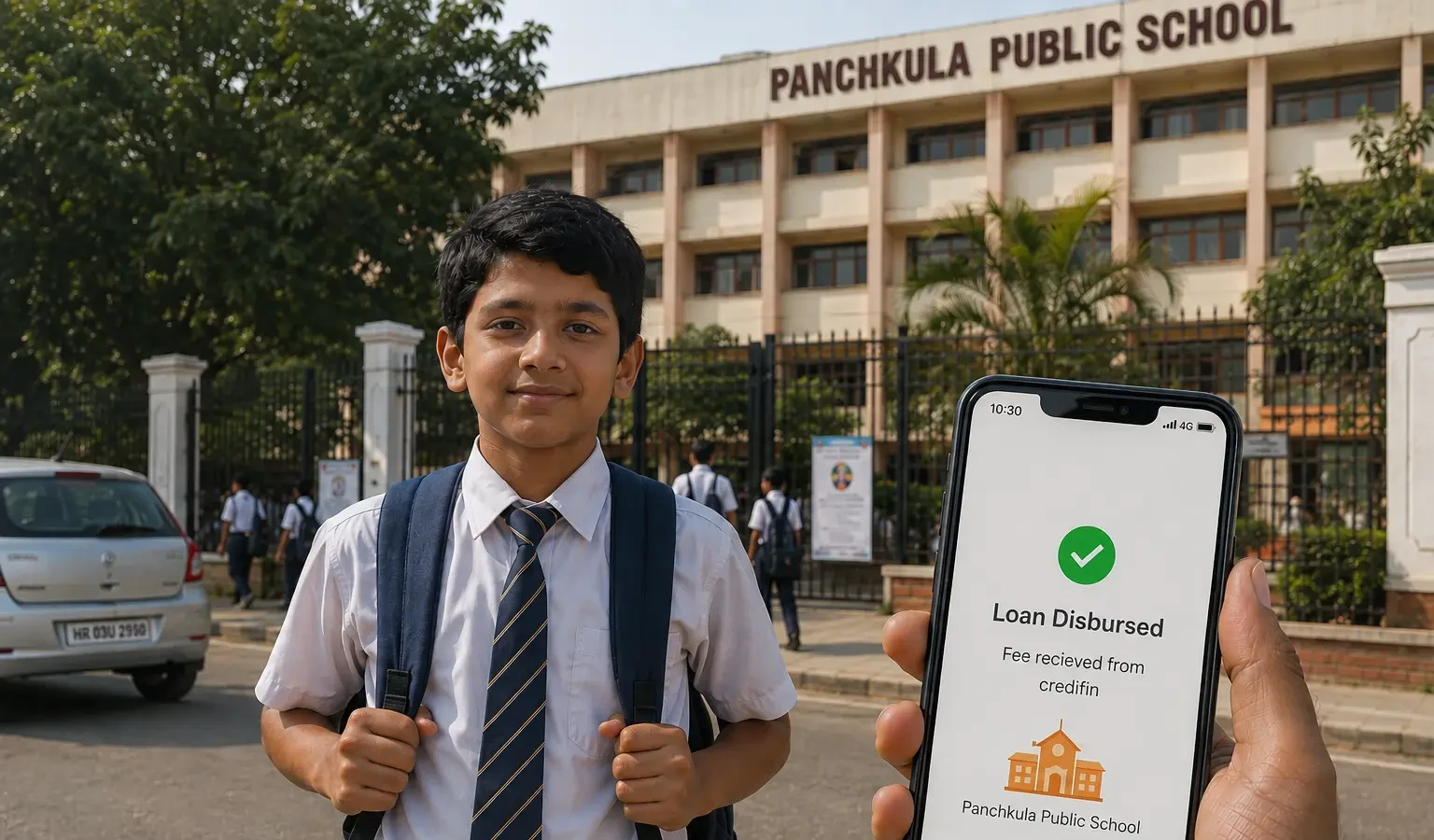
A friend of mine, Meena, teaches at a school in Panchkula. Not the fees side. She teaches Class 4. But because she is "the teacher," half the parents in her building treat her as the person who must know everything about school money. Last year one of them, a father who drives a taxi, came to her almost embarrassed.
He'd heard you could "pay school fees in EMI now." He didn't believe it. It sounded like one of those offers that turns out to have a catch you only find later. Who gives the money? Does it come to me? Do I hand cash to the school? What if I can't pay one month? He had a dozen questions and nobody to ask them to without feeling foolish.
Meena sent him to me. And his questions were good ones. Better than good. They're the exact questions every parent has and almost nobody explains properly. So here's the whole thing, start to finish, the way I explained it to him over one cup of tea. No jargon. Just how it actually works.
Curious how fee financing works for your family?
Credifin pays your child's school directly and you repay in easy EMIs. Online application, decision in 3 to 7 days.
Explore School Fee Finance →The one idea to understand first
Before any of the steps, understand the basic shape of the thing. It's simpler than people expect.
A lender, a bank or an NBFC like us, pays your child's full school fee to the school, upfront, on your behalf. The school gets its money the way it wants it, all at once. You then repay that amount to the lender in monthly EMIs over a set period.
That's it. The school is happy because it got paid in full. You're happy because a scary once-a-year lump sum became a small, predictable monthly figure. The lender sits in the middle and gets repaid over time with some interest. Everybody's problem gets solved.
The taxi driver's first real worry was this: does the money come to me? No. And that's actually the good part, which I'll get to. First, the journey.
The full journey, step by step
Here's what actually happens from the moment you decide to the moment your EMIs begin. I'll walk each one.
You check if you're eligible
Before anything else, a quick check to see whether you qualify and roughly how much you can get. This usually takes a few minutes online. You put in basic details: who you are, what you earn, which school, roughly what the fee is. The lender gives you a quick read on whether to proceed. No documents needed at this stage, no commitment.
You apply and share documents
If the first check looks good, you fill the actual application. This is where you share your papers: proof of who you are, proof of where you live, proof of income, and the school's fee demand. The list is short and sensible, more on it below.
The lender verifies you
Someone checks that everything is real and matches up. Your identity, your income, the school, the fee amount. This might be a quick call, a video verification, or an online check of your bank statement. It's not an interrogation, just confirmation that you are who you say and the fee is genuine.
The lender pays the school directly
This is the heart of it. Once approved, the lender pays the fee straight to the school. The money never lands in your account. It goes from lender to institution, directly. The school marks your child's fee as paid, in full.
You repay in monthly EMIs
From the next cycle, you start repaying the lender in monthly instalments, usually by an auto-debit set up on your bank account so you never have to remember a date. Fixed amount, fixed day, over the agreed number of months. When the last EMI clears, you're done.
Laid out as a table, the whole journey looks like this.
| Step | What happens | Who does it | Rough time |
|---|---|---|---|
| 1. Eligibility check | Quick read on whether you qualify | You, online | A few minutes |
| 2. Application + docs | You fill the form and upload papers | You | 15 to 20 minutes |
| 3. Verification | Lender confirms identity, income, school | Lender | 1 to 3 days |
| 4. Disbursal to school | Lender pays the fee straight to the school | Lender | On approval |
| 5. Repayment begins | You pay monthly EMIs by auto-debit | You | Over the tenure |
Start to finish, for a clean application, this often wraps up in a matter of days, not weeks. The slow part, when there is one, is almost always a document mismatch: a name spelled differently on two papers, or an address that doesn't agree. Get those right upfront and it moves fast.
That's the whole process. Want to start it?
The eligibility check takes a few minutes and needs no documents. Credifin pays your school directly once approved.
Check Your Eligibility →Why paying the school directly is a good thing, not a catch
The taxi driver kept circling back to this. "Paisa mujhe kyun nahi milta?" Why doesn't the money come to me? He half-suspected the direct-payment thing was a trick to control him.
It's the opposite. It protects you. Here's why. When loose cash lands in your account in a tight month, it's under pressure from every direction. A pending bill, an EMI, a relative who needs help, a slow week of earnings. Even with the best intentions, money meant for school fees has a way of quietly getting used for something else. Then the fee deadline arrives and you're short again. That's not a character flaw, it's just how a squeezed household budget works.
Direct-to-school payment removes that risk entirely. The money does the one job it was borrowed for. The school is paid, your child's seat is secure, and there's no temptation and no leak. You're left with a clean monthly EMI and nothing to manage in between.
There's a second benefit. The school gets its full payment upfront, which is exactly what schools want. That's why many of them are comfortable with fee financing in the first place. It turns their slow, chase-the-parents collection problem into one clean payment. Everyone's incentives line up.
One thing worth saying plainly, because it's the sort of detail people find out too late. What I've described is how direct disbursal works in general. It isn't a promise about how any single lender runs it. The application process, the eligibility rules, the documents asked for and the time to approval all vary between banks and NBFCs. Some transfer to the school within a day of approval, others take longer. Some will only pay schools that are already on an approved list. Some charge a processing fee, some don't. Ask the lender you're actually dealing with, and get those answers before you sign rather than after — and check they are a regulated, RBI-registered entity.
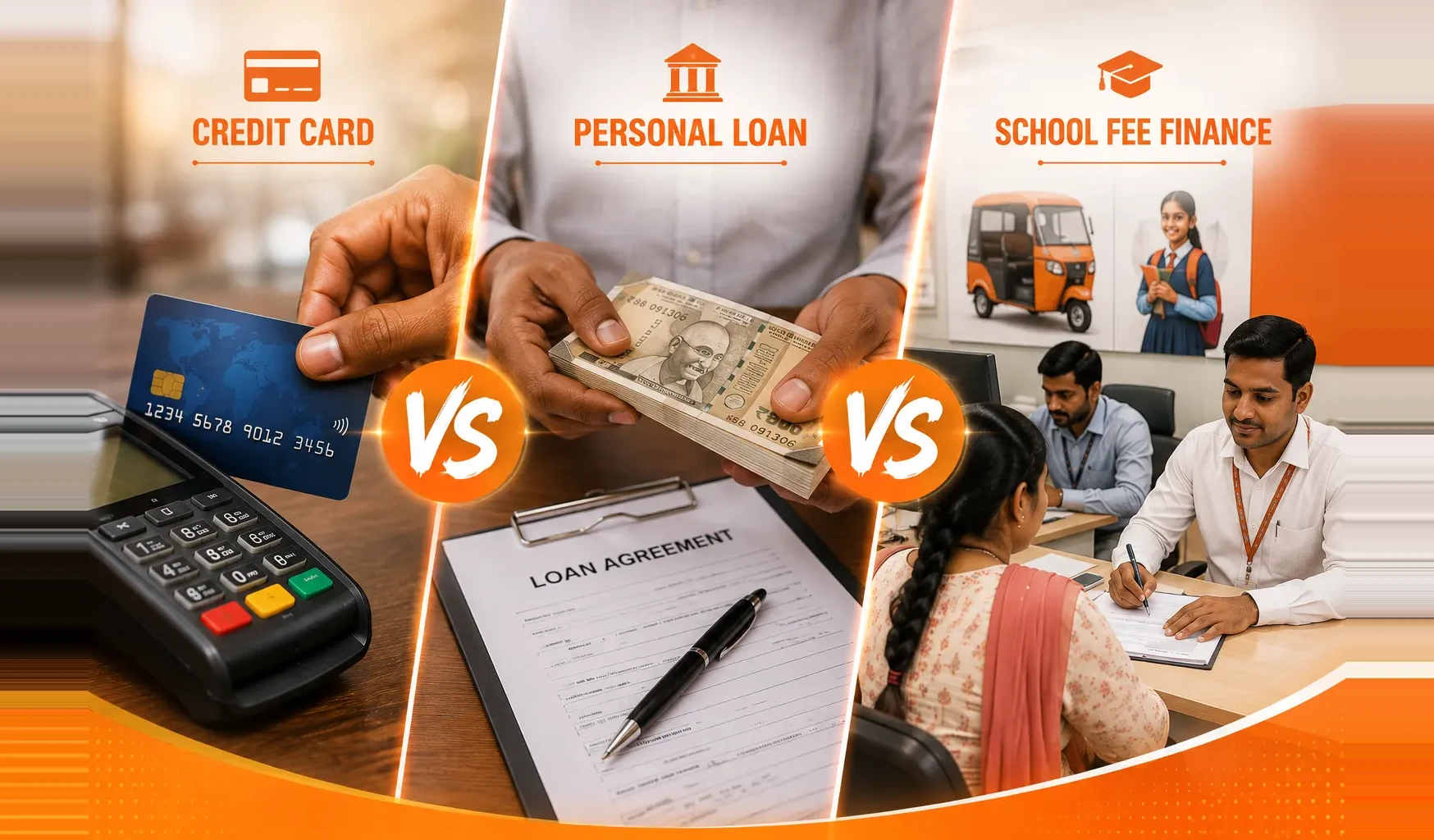
"Why not just use a credit card, or take a personal loan?"
He asked this too, and it's the right question. All three of them get the fee paid. They don't cost the same.
A credit card is the quickest route and the most expensive one if you can't clear the bill in the same cycle. Interest on a revolving card balance is brutal, and schools that accept cards often add a convenience fee on top of the fee itself. Fine if you're clearing it in full next month. Bad news if you're not.
A personal loan puts the money in your own account, which sounds better than it usually is. The rate is lower than a card's, but the loan isn't attached to the fee. It's attached to you, and so is the temptation, the same leak I described above. It also sits on your credit report as general unsecured borrowing, which can matter if you're planning to borrow for something bigger in a year or two.
Fee financing is deliberately narrower. One bill, paid to one place, over a tenure that lines up with the school's fee cycle instead of a generic 36 months.
Which one actually costs less in rupees depends on your amount, your tenure and your rate, and it's worth doing that maths rather than assuming. We ran the numbers side by side in School Fee Finance vs Personal Loan vs Credit Card. Worth ten minutes there before you decide.
What you'll actually need
The taxi driver braced himself for a stack of documents. It's genuinely short. The exact list varies by lender, but for a parent it usually comes down to this.
| What you need | Why the lender wants it |
|---|---|
| ID proof (Aadhaar, PAN) | To confirm you are who you say you are |
| Address proof | To confirm where you live |
| Income proof (bank statement / salary slip) | To see you can comfortably manage the EMI |
| The school fee demand / invoice | To confirm the amount and pay the right school |
| A bank account for auto-debit | So EMIs are collected automatically each month |
Lenders that work with self-employed and cash-income parents (taxi drivers, shopkeepers, small traders) read your bank statement and real cash flow to understand your income. If the money moves through your account, that gives them the picture they need. This is why the taxi driver, whose earnings never come as a fixed salary, could still qualify.
One quiet tip: before you apply, lay your Aadhaar, PAN, bank statement and the fee invoice side by side and check the name and address match across all of them. A one-letter mismatch is the single most common reason a clean application slows down — you can correct Aadhaar details on the UIDAI portal before you start.
When can you apply?
Two questions come up more than any others, and both are about timing.
The first one: my child is already studying, is it too late? It isn't. Fee financing has nothing to do with admission. If a fee bill is sitting in front of you right now, that bill is all a lender needs. A lot of parents come to us in the middle of the school year, not at the start of it.
The second: can I finance next term's fees, before the bill arrives? Usually not in advance. Lenders pay against an actual demand from the school, so there has to be a note with a real amount and a real due date on it. What you can do is apply the week that note reaches you instead of the week before the deadline. Verification takes a few days, and a comfortable gap beats a scramble.
Beyond those two, admission time is the most common moment to apply. The first-year bill from a new school is usually the largest one you'll ever get from it. Mid-year is fine too, on whatever cycle the school runs, quarterly or half-yearly or annual — which is what annual fee finance is built around, alongside college fee finance for older children (if that's a degree course, our B.Tech education loan cost breakdown runs the four-year arithmetic) and uniform and book finance for the smaller costs that land in the same month. And it's generally one loan per fee cycle, so next year means a fresh application. If you repaid the first one cleanly, the second goes faster.
What happens if a month goes bad
His last worry, and a fair one. What if a bad month comes and he can't pay an EMI?
First, the honest part. An EMI is a real commitment. Miss it and it can affect your credit record, and repeated misses cause bigger problems. So the golden rule is to size the EMI to your real income from the start, not your best month. If your average month is tight, choose a smaller EMI over a longer tenure rather than a big one that only works when business is good.
Second, the practical part. If a genuinely bad month hits, the worst thing you can do is go silent. Call your lender before the date, not after. A regulated lender would much rather work something out with a borrower who communicates than chase one who disappears. There's usually more flexibility than people assume, but only if you talk to them early.
That reassured him more than anything. The idea that the lender is a system you can actually speak to, not a trap that snaps shut the moment you slip.
Back to the taxi driver
He applied. His documents were clean except for one thing. His bank had an old mobile number on file, the classic problem, so we fixed that first. The application itself took him about twenty minutes, most of it spent hunting for his PAN card. Verification was a short call. A few days later the school messaged him to say his son's fee was paid in full.
He told Meena afterward that the strangest part was how un-strange it turned out to be. "Socha tha koi bada chakkar hoga. Kuch nahi tha." He'd expected some big complicated mess. There was nothing. A form, some papers, a call, done. His son's fee handled, and a small EMI leaving his account each month that he barely noticed against a taxi's daily earnings.
That's the honest picture of school fee financing. Not a trick, not a mountain of paperwork. A lender pays your school, you repay monthly, and the once-a-year panic turns into something you can plan around.
Bottom line
School fee financing works in one simple loop. You apply and share a short set of documents. The lender verifies you and pays your child's school directly, in full. You repay in monthly EMIs over a set tenure. The direct payment isn't a catch. It protects the money from leaking away and gets the school paid upfront, which is why the whole thing works for everyone.
Get your documents matching before you apply, size the EMI to your real income rather than your best month, and talk to your lender early if a month goes bad. Do that, and a scary annual lump sum becomes a small monthly figure you barely notice.
Where Credifin fits
If that process sounds like the right fit for your family, here's how we approach it.
The application is online and takes a few minutes. We assess you on your bank statement and actual cash flow. That's why self-employed and cash-income parents, the people banks often can't read, get through with us. Once approved, we pay the school directly, so the money does exactly the job you borrowed it for. Then you repay in EMIs sized to your real income, by auto-debit, so there's nothing to remember.
The decision comes in 3 to 7 working days for a clean file. And if you'd rather sit across a desk than fill a form on your phone, you can walk into your nearest branch and do it there.
Ready to get your child's fee handled?
We pay the school directly and size the EMI to your real income — bank-statement assessed, so self-employed and cash-income parents qualify. Decision in 3 to 7 working days.
Apply for School Fee Finance →Talk to Credifin
Credifin is an RBI-registered NBFC financing school fees across India. We pay the school directly, you repay in easy EMIs.
079651-74500 | info@credif.in
Find your nearest branch →
FAQs
Does the fee money come to me or go to the school?
Straight to the school. The lender pays the institution directly, so the money does the job it was borrowed for and there's nothing for you to hand over.
How long does the whole process take?
Often just a few days for a clean application. The eligibility check is minutes, the form is 15 to 20 minutes, and verification plus disbursal usually wraps up in 3 to 7 working days.
What documents do I need for school fee financing?
Usually ID proof, address proof, income proof (a bank statement works), the school's fee invoice, and a bank account for auto-debit. The exact list varies slightly by lender.
Can I apply if my child is already studying?
Yes. It isn't tied to admission. If you're holding a fee bill from the school, you can apply against it, whatever point of the year you're at.
Can I finance next semester's fees in advance?
Usually not before the bill exists, since lenders pay against an actual fee demand from the school. Apply as soon as that demand reaches you and you'll have a comfortable gap before the due date.
How do I repay?
In fixed monthly EMIs, usually by auto-debit from your bank account, over an agreed tenure. When the last EMI clears, you're done.
What if I can't pay one month?
Contact your lender before the due date, not after. A missed EMI can affect your credit record, so size the EMI to your real income from the start, and talk to the lender early if a genuine bad month hits.
Do schools accept this?
Many do, precisely because they receive the full fee upfront instead of chasing parents. The lender pays them directly, which suits how schools prefer to be paid.
Fee bill in front of you?
Credifin pays your child's school directly and sizes the EMI to your real income — bank-statement assessed, so self-employed and cash-income parents qualify. Online application, decision in 3 to 7 days.
Apply for School Fee FinanceThis might catch your interest