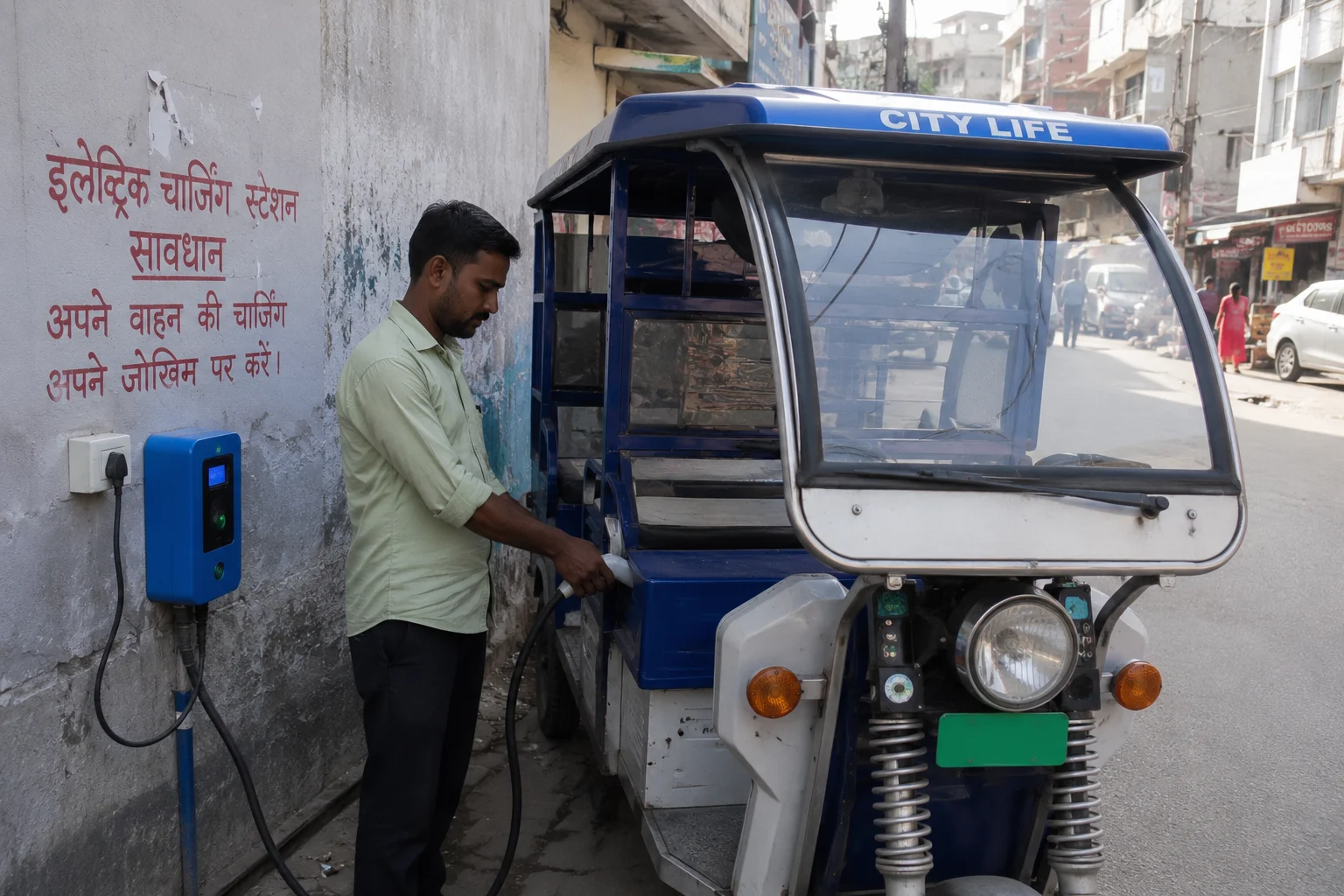
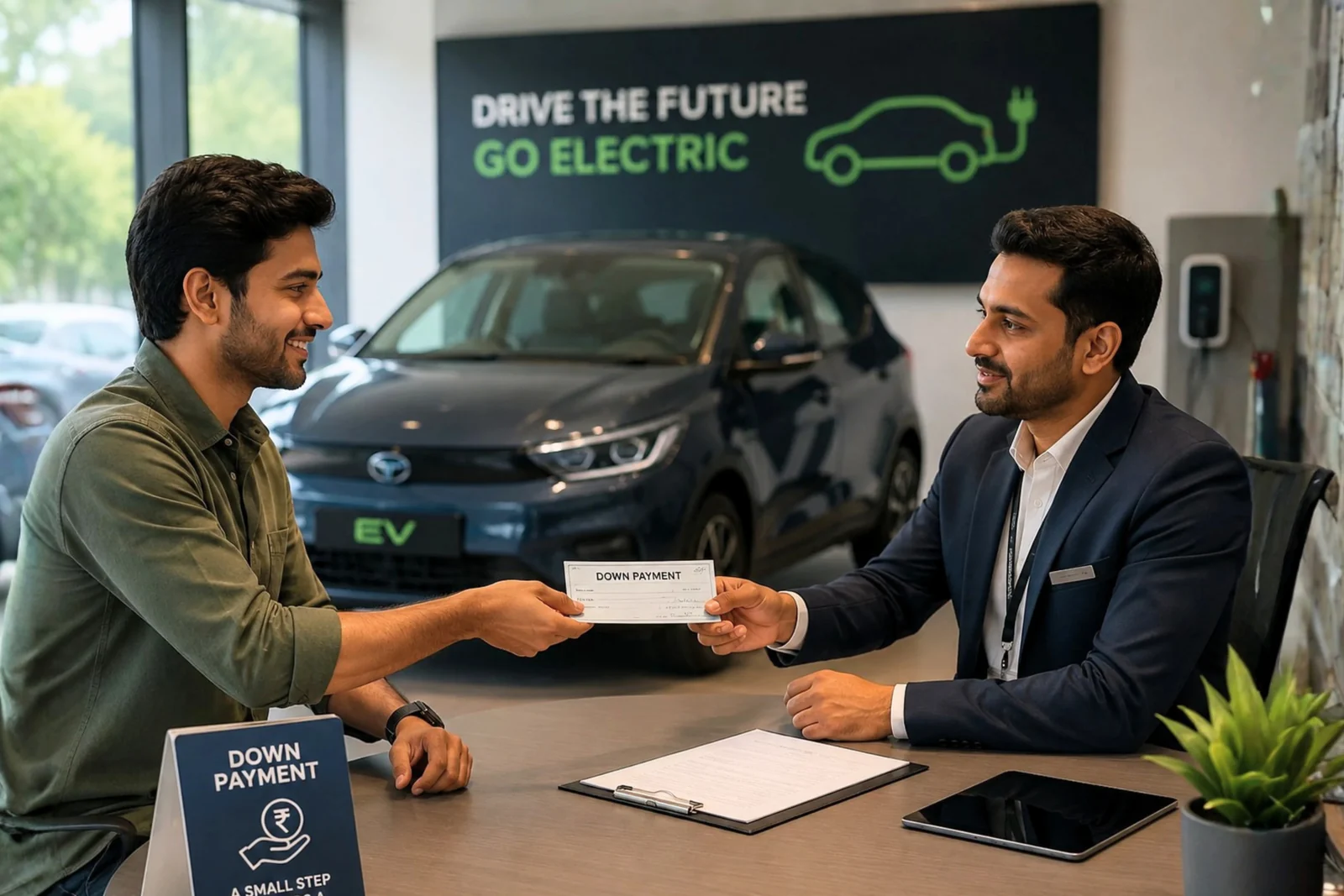
Electric Three Wheeler Loan: EMI, Interest Rates & How to Apply Online
Lakshay Khanna·18 July 2026
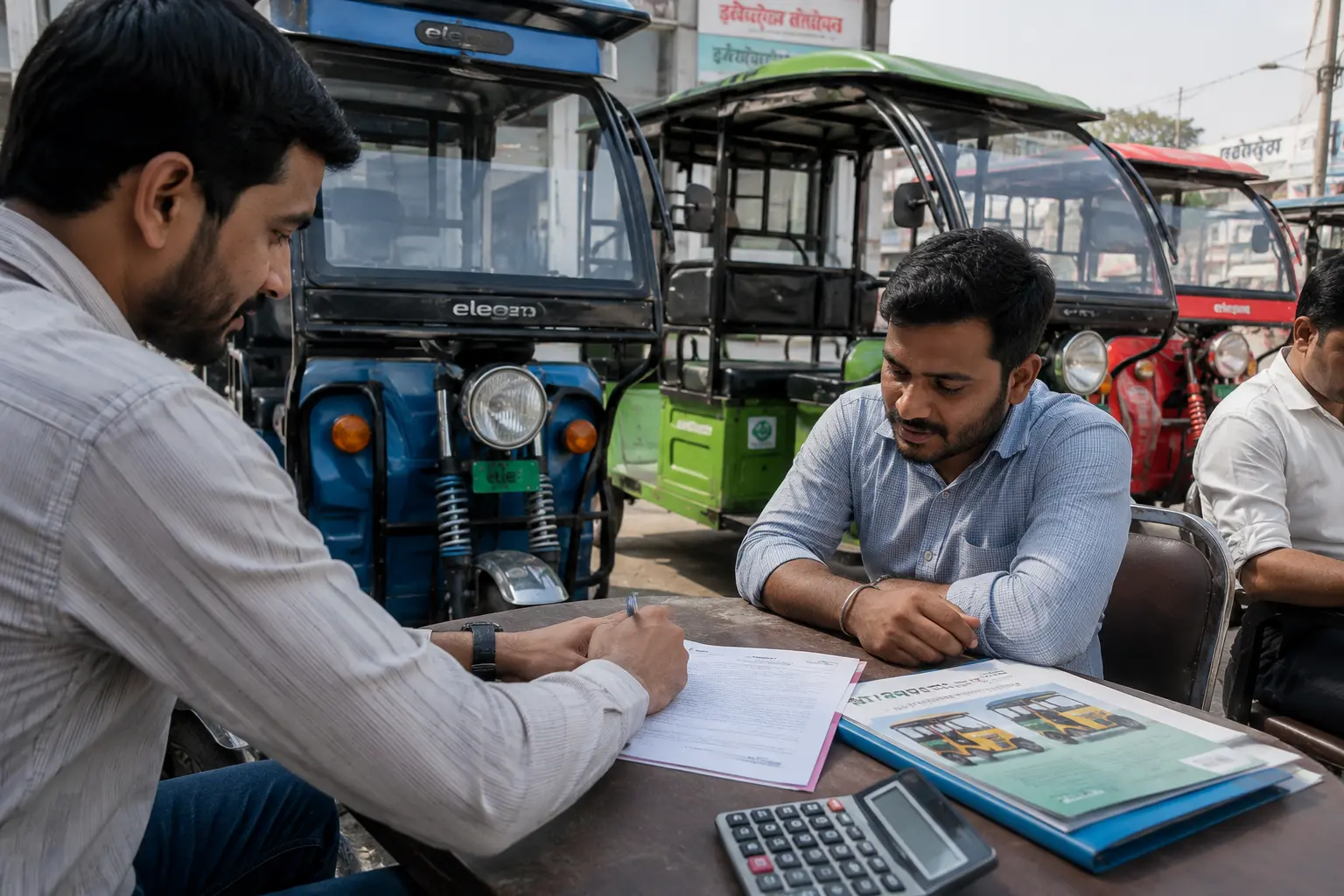
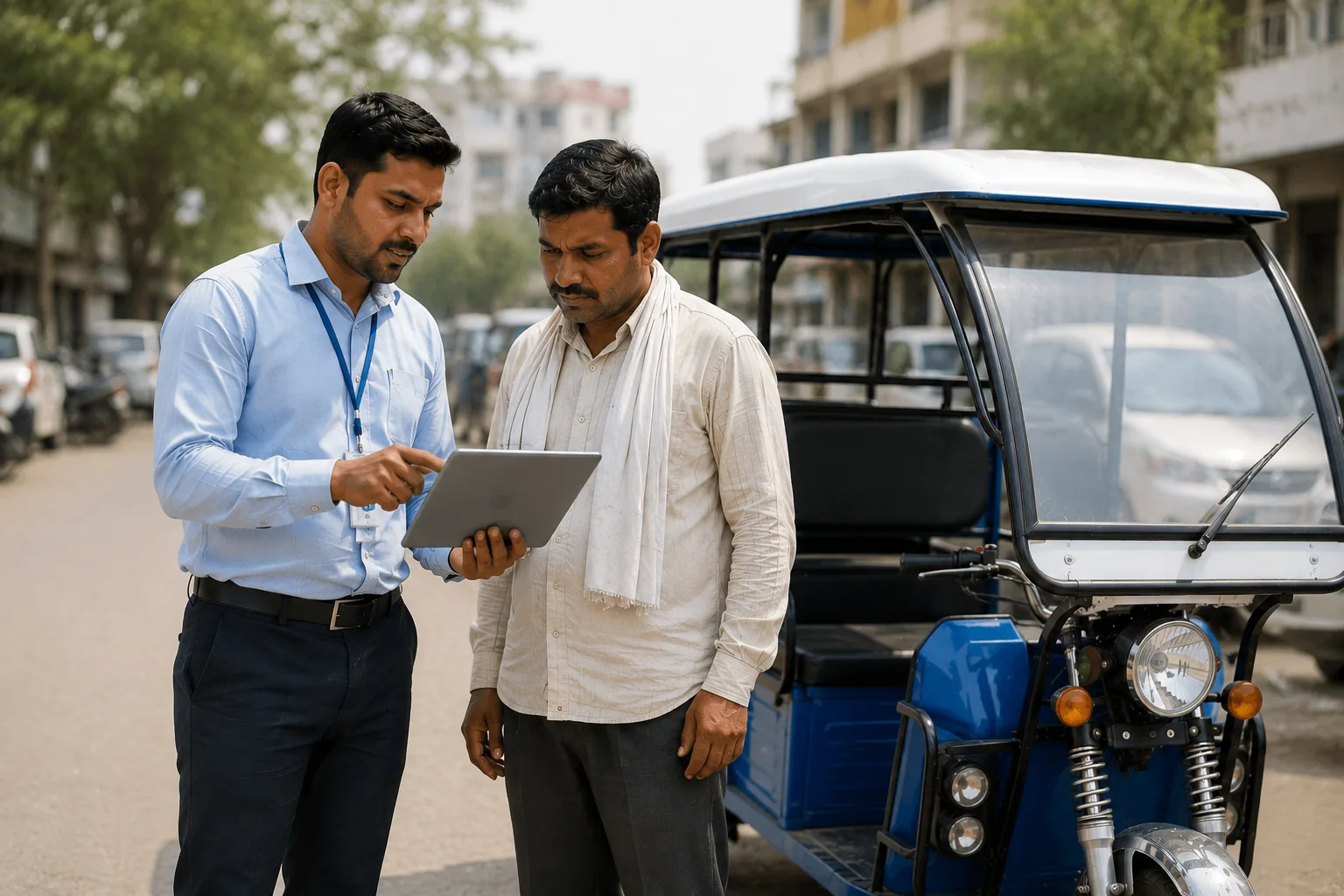
Gurpreet runs an e-loader out of Phagwara. Vegetables, three shops, every morning before the sun is properly up. Six days a week, ten years now.
Last month he wanted a bigger vehicle. The dealer sat him down, wrote a number on a pad, and slid it across. Rs 12,800 a month.
Gurpreet nodded. What else do you do? He doesn't know finance. He knows vegetables. He knows which crate goes on the bottom so the tomatoes survive the Kapurthala road. That number could have been anything and he'd have nodded the same way.
He mentioned it to me at a tea stall a few days later. So I did the sum on my phone. It should have been Rs 10,700. Two thousand a month. Over three years, that's more than seventy thousand rupees of his money, walking away, because nobody ever told him what a fair EMI on a three-wheeler looks like. He nearly signed. Most people do.
Here's the thing about an electric three-wheeler. The vehicle isn't the hard part. It's one of the best income-per-rupee purchases available in India today — it earns money the day you bring it home, and it pays its own EMI out of what it earns. The loan is the hard part. Dealer markups. "In-house" schemes. Rates that swing five percent for no reason anyone will explain to you. Know your numbers before you walk in, and you keep the money. Don't, and somebody else keeps it.
Earning on a three-wheeler but the bank wants an ITR you don't have?
Credifin finances electric three-wheelers on your bank-statement income, not just the tax return. No ITR needed. Decision in 3 to 7 days. Full application online.
Apply Online →What drivers assume vs what's actually true
Every week I hear the same four sentences. Every week they're wrong in the same four ways.
| What drivers say | What's actually true |
|---|---|
| "The dealer's rate is the rate" | It's one rate, and usually the worst one |
| "Longer tenure means a cheaper loan" | Smaller EMI. Much bigger total interest |
| "The cheapest vehicle is the cheapest loan" | Not if its payload makes you refuse work |
| "No ITR means no loan" | NBFCs read your bank statement instead |
Left column is what people feel. Right column is what the maths says. Everything on the right is checkable in one afternoon. Let me take them one at a time.
First, which vehicle are we even talking about?
The loan changes with the vehicle. Three types on Indian roads, and people mix them up constantly.
They all finance the same way. But the loan amount, the tenure and the downpayment shift with the price. So when a lender quotes you a number, make sure you are both picturing the same vehicle. Gurpreet wasn't. The dealer was quoting a cargo vehicle a full size up from what he asked about.
What you're actually borrowing
An electric three wheeler loan covers 70 to 85 percent of the on-road price. The rest comes out of your pocket, on the day.
| Vehicle Type | On-Road Price | Loan Amount (80%) | Your Downpayment |
|---|---|---|---|
| Basic passenger e-rickshaw | Rs 1,50,000 | Rs 1,20,000 | Rs 30,000 |
| Lithium passenger e-rickshaw | Rs 2,50,000 | Rs 2,00,000 | Rs 50,000 |
| E-loader (cargo) | Rs 2,20,000 | Rs 1,76,000 | Rs 44,000 |
| E-auto (L5 taxi) | Rs 3,50,000 | Rs 2,80,000 | Rs 70,000 |
Some lenders will stretch to 90 percent for a first-timer with a solid guarantor. Most stop at 75 or 80. Why? A three-wheeler loses resale value fast in its first year. The lender wants your money in the game alongside theirs. Which is fair, honestly. It's the same logic that runs our EV down payment guide, and it's worth reading before you decide how much to put in.
Electric three wheeler interest rates: the honest version
Not the banner-ad version. The one drivers actually get. Banks technically have schemes. SBI has one. Bank of Baroda has one. Walk into a PSU branch and ask about it, though, and watch what happens. The executive stares for a moment. Then he gently starts talking about a "personal loan" instead. The scheme exists on paper. Approvals are rare unless your file is spotless. So the real market is NBFCs and dealer-tied financiers. Here's the landscape.
| Lender Type | Interest Rate | Tenure | Approval Time |
|---|---|---|---|
| PSU bank schemes | 12% to 14% | Up to 4 years | 3 to 6 weeks |
| NBFCs (Revfin, Credifin) | 14% to 17% | 2 to 3 years | 3 to 7 days |
| Local financiers (dealer-tied) | 16% to 22% | 18 to 30 months | 1 to 3 days |
| Microfinance institutions | 18% to 24% | 1 to 2 years | 5 to 10 days |
Your band is 12 to 18 percent. Write it on your hand if you have to. Anyone quoting above 22? Stand up and leave. There is always another lender. Always. Nobody's rate is so special that you are stuck paying 24 percent to a man in a plastic chair behind a showroom.
EMI at a rate you'll actually be offered
This is the only number most drivers care about, so here it is. Fifteen percent, indicative.
| Loan Amount | 18 Months | 24 Months | 30 Months | 36 Months |
|---|---|---|---|---|
| Rs 1,20,000 | Rs 7,486 | Rs 5,819 | Rs 4,830 | Rs 4,160 |
| Rs 1,50,000 | Rs 9,357 | Rs 7,274 | Rs 6,038 | Rs 5,200 |
| Rs 2,00,000 | Rs 12,476 | Rs 9,699 | Rs 8,050 | Rs 6,934 |
| Rs 2,80,000 | Rs 17,466 | Rs 13,578 | Rs 11,270 | Rs 9,708 |
Look at the 30 and 36-month columns. Tempting, no? Smaller number. Easier month. Now look at what they cost. On a 2 lakh loan, stretching from 24 months to 36 adds roughly 25,000 in extra interest. That is a great deal of vegetables. Most drivers I've watched settle on 24 months for a passenger e-rickshaw and 30 to 36 for a pricier e-auto. Which makes sense. The e-auto earns more per day, so it carries the longer tenure without hurting.
One rule worth remembering: keep your EMI under 30 percent of your monthly take-home. Clear 900 a day, work 26 days? That's 23,400 a month. Your EMI belongs under 7,000. Cross that line and the first bad week eats your buffer whole.
The vehicles people are actually financing right now
Enough with the generic slabs. Let's talk about what's parked outside the showroom.
On the passenger side, four names come up again and again. The Mahindra Treo Yaari is the budget door-opener — Mahindra lists it between Rs 1.96 lakh and Rs 2.04 lakh. It's a 25 kmph L3 that charges in about 2 hours 30 minutes and gives roughly 80 km real-world. Step up to the full Mahindra Treo and you're at Rs 3.23 lakh ex-showroom for a proper L5 e-auto: 8 kW motor, 42 Nm, about 110 km real-world on a 7.4 kWh pack, full charge in roughly 3 hours 50 minutes. The Piaggio Ape E City sits a little under at Rs 2.89 lakh, and Piaggio's whole pitch there is toughness — 220 mm of ground clearance and a 5 year / 2,00,000 km warranty. Which matters enormously if your route is more pothole than tarmac. Then there's the Bajaj RE E-TEC 9.0 at Rs 3.33 to Rs 3.35 lakh, the range king: an 8.9 kWh battery quoting 178 km ARAI, a 2-speed automatic, 29 percent gradeability. That's the one for long shuttle runs, or if you live on a hill.
Cargo is a different animal. The Mahindra Treo Zor starts near Rs 3.13 lakh ex-showroom with a 550 kg load capacity, though its range is honest and modest at 80 km per charge. Its bigger sibling, the Mahindra Zor Grand, jumps to Rs 4.12 lakh and up in Delhi for 12 kW, 50 Nm, and a certified range as high as 153 km. And the Piaggio Ape Xtra LDX undercuts everyone at Rs 2.45 to Rs 2.55 lakh, provided your payload is light and your routes are short.
Here's what the showroom counter will never say out loud: a cheaper cargo vehicle is not automatically a cheaper loan. A low payload cap means turning down work. And turned-down work does not pay your EMI.
Real models. Real prices. Real EMIs.
Prices below are ex-showroom, as listed by the manufacturers and dealer aggregators. On-road adds RTO, insurance and road tax — but PM E-DRIVE and your state subsidy claw a good chunk of that back. In practice the two roughly cancel out. EMI assumes 15 percent on an 80 percent loan.
| Model | Type | Ex-Showroom | Range / Payload | Loan @ 80% | EMI (24m) | EMI (36m) |
|---|---|---|---|---|---|---|
| Mahindra Treo Yaari | Passenger, L3 | Rs 1.96 L | 80 km real | Rs 1,56,800 | Rs 7,604 | Rs 5,436 |
| Piaggio Ape E City | Passenger, L5 | Rs 2.89 L | 110 km | Rs 2,31,200 | Rs 11,212 | Rs 8,016 |
| Mahindra Treo | Passenger, L5 | Rs 3.23 L | 110 km real | Rs 2,58,400 | Rs 12,531 | Rs 8,959 |
| Bajaj RE E-TEC 9.0 | Passenger, L5 | Rs 3.35 L | 178 km ARAI | Rs 2,68,000 | Rs 12,997 | Rs 9,292 |
| Piaggio Ape Xtra LDX | Cargo | Rs 2.45 L | ~450 kg | Rs 1,96,000 | Rs 9,505 | Rs 6,795 |
| Mahindra Treo Zor | Cargo | Rs 3.13 L | 550 kg / 80 km | Rs 2,50,400 | Rs 12,143 | Rs 8,682 |
| Mahindra Zor Grand | Cargo | Rs 4.12 L | 400 kg / 153 km | Rs 3,29,600 | Rs 15,983 | Rs 11,428 |
So which one do you actually buy?
It comes down to one number. What do you clear in a day?
If you carry passengers
In a tier-2 city you're realistically clearing 800 to 1,100 a day after charging. Twenty-six working days puts you between 20,800 and 28,600 a month. Apply the 30 percent rule and your EMI ceiling lands somewhere between 6,200 and 8,500. So the Treo Yaari at Rs 5,436 over 36 months fits almost anybody. The Ape E City at Rs 8,016 fits if you're at the top of that earning band. The Bajaj at Rs 9,292 does not fit.
Unless. Unless you're running airport shuttles, or aggregator shifts, or one long fixed route where that 178 km range turns straight into extra trips per charge and no midday charging break. That's the whole test, and it's worth saying plainly. Does the extra range earn back the extra EMI? Or does it just sit there in your parking spot, looking impressive? The real earning numbers are in our e-rickshaw income and ROI guide.
If you haul cargo
Now the logic flips entirely. A delivery contract is a fixed monthly number. So you size the vehicle to the contract, never the other way round. Hauling under 400 kg on short hops? The Ape Xtra LDX at Rs 6,795 a month is the sensible pick, and probably the smartest buy on this whole list. Signed with an e-commerce partner who wants 500 kg and 100 km a day? Then the Treo Zor's 80 km range will quietly cost you a second charging stop every afternoon, and the Zor Grand starts making sense despite the Rs 11,428.
This is exactly where Gurpreet went wrong, by the way. He was being sold up a size he didn't need, for a payload he'd never fill.
The part nearly everybody underrates
Your EMI is not your cost. Your EMI plus your running cost is your cost. These are not the same sentence.
A CNG auto burns 200 to 250 rupees of fuel a day. The Treo? Sixty to eighty rupees for a full charge. Mahindra reckons the vehicle saves up to Rs 4.4 lakh over five years against a CNG auto — roughly Rs 200 or more, every single working day. Sit with that for a second. Two hundred rupees a day is about six thousand a month. Six thousand a month is, near enough, the entire EMI on a Treo Yaari.
Then add maintenance. The Yaari runs at 6 paise per kilometre. No engine oil. No clutch. No gearbox to rebuild. Put that next to a CNG auto's workshop bills and the picture gets very clear, very fast. The fuel you stop buying is what pays the finance company. Which is why an EV loan at 15 percent can genuinely be cheaper to live with than a CNG loan at 11 percent. The interest rate is only half the equation. Nobody puts that on a banner ad. Keeping the pack healthy matters too — our battery replacement guide covers what a new set actually costs when the time comes.
How to apply online
It isn't complicated. It's just unfamiliar the first time, which is a different problem.
Pick the vehicle
Go to a dealer. Choose the model. Get the proforma invoice on WhatsApp. Treo, Ape, local brand — doesn't matter. Just have that price quotation in your hand before you start anything.
Fill the online form
For Credifin that's the website, about fifteen minutes. Name, address, PAN, Aadhaar, what you earn, the vehicle, the loan amount. Upload a selfie and your Aadhaar, both sides.
Share your bank statement
Six to twelve months, either through net-banking access or a PDF you upload. The lender isn't hunting for a salary. They want to see steady money moving in. Daily fares, passenger UPI, delivery payouts — all of it counts.
Verification
An executive video-calls you, or visits your address. Sometimes both. They're confirming three things: you're real, the dealer's real, and you plan to drive the vehicle rather than flip it.
Disbursal
The money goes straight to the dealer. You pay your downpayment. The RC gets made with the lender's name as hypothecation holder. Then you drive home. Three to seven working days for a clean file. An Aadhaar mismatch or no banking history can stretch that to ten — our rejection guide covers those traps.
Fifteen-minute form. No ITR. No salary slip.
Credifin reads your bank statement and your references. Decision in 3 to 7 days.
Start Your Application →What you'll need ready
Less than you'd think. The lender already assumes you have no ITR and no salary slip.
Electricity bill, ration card or rent agreement
Who aren't your wife or your brother
Buying an L5 e-auto? You'll also need a proper LMV driving licence. A learner's permit won't clear with most lenders, and people find this out on the day. Closed a loan before? Get the NOC from that lender and keep it in the folder. It helps more than people expect.
The subsidy reality
There is a great deal of noise here. Only the verifiable part below.
Central. PM E-DRIVE is currently active and it covers electric three-wheelers, e-rickshaws and e-autos included. It's applied right at the point of sale — your dealer deducts it from the invoice and you file nothing separately. It only applies to vehicles on the approved model list, so confirm your exact model qualifies before you book. Not the model family. The model.
State. These stack on top of the central one. Uttar Pradesh adds up to 12,000 plus a road tax exemption. Delhi adds up to 30,000 plus a registration waiver. Punjab and Haryana run smaller waivers, district by district.
Most dealers file these for you now. Check anyway. I have heard of dealers "forgetting" to file, and the driver quietly losing thirty thousand rupees he was fully entitled to and never knew about.
Back to Gurpreet
He walked out of that showroom. Didn't sign. Then he did three boring things. He worked out what he actually clears in a day. He worked out what payload he actually carries, which turned out to be nowhere near what the dealer was selling him. And he called an NBFC before he called the dealer back.
Smaller vehicle. Right size for his crates. Approved in five days on his bank statement, because he has no ITR and never has. EMI came to Rs 6,795. Not Rs 12,800. He saved six thousand a month by asking two questions and making one phone call.
He was quiet about it for a while, then said something I keep repeating to people. "Gaadi toh main pehchaanta hoon. Kaagaz nahi pehchaanta tha." He knows vehicles. He didn't know paper. Nobody had ever bothered to teach him, and the entire system around him was quite comfortable with that. That's really the whole point of this article. The vehicle is the easy part. The paper is where they get you.
Where Credifin fits
Electric three-wheelers are core business for us. Not a side product bolted onto something else. We're an RBI-registered NBFC. On the government's Parivahan portal, we're listed as the financer on the highest number of EV registration certificates among NBFCs in Punjab. Which means the RTO offices already recognise our paperwork. It also means we've underwritten just about every kind of three-wheeler borrower there is.
The file we approve is the one banks quietly struggle with. The driver with no ITR but a steady bank statement. The trader whose account shows a good deal more than his tax return ever admits to. Rates run 14 to 17 percent depending on your statement, your references, and whether you bring a guarantor. Full application online. Decision in 3 to 7 days.
Want the passenger-specific version of all this? Our e-rickshaw loan apply-online guide goes deeper on that vehicle. And if your battery ever stops for reasons that aren't the battery, our BAT-BMS app explainer covers what's been happening on the road.
Bottom line
An electric three-wheeler is one of the few vehicles that pays its own EMI out of daily earnings. Affordability was never the barrier here. The barrier is that the loan feels complicated, the rates are all over the place, and nobody in the showroom has any reason to explain it to you. So do four things.
That last one takes ten minutes. It is often worth thirty to forty thousand rupees over the life of the loan. Ask Gurpreet.
Talk to Credifin
Credifin is an RBI-registered NBFC financing electric three-wheelers, e-rickshaws, e-autos and e-loaders across India. Bank-statement income. No ITR needed.
079651-74500 | info@credif.in
Find your nearest branch →
FAQs
Can I get an electric three-wheeler loan without ITR?
Yes. Most three-wheeler drivers don't file one. NBFCs in this space underwrite on your bank statement and a daily earnings declaration instead.
What's the EMI on a 2 lakh three-wheeler loan?
At 15 percent, roughly 9,700 over 24 months, or 8,050 over 30 months. Longer tenure means a smaller EMI but more total interest.
Which electric three-wheeler has the lowest EMI?
Among mainstream models, the Mahindra Treo Yaari at Rs 1.96 lakh works out to about Rs 5,436 a month over 36 months, on an 80 percent loan at 15 percent. On the cargo side, the Piaggio Ape Xtra LDX is cheapest at roughly Rs 6,795.
How much downpayment do I need?
Usually 15 to 25 percent of on-road price for repeat borrowers. 25 to 30 percent for first-timers. Occasionally 10 percent, with a strong guarantor.
What interest rate applies to electric three-wheelers?
The working band is 12 to 18 percent. Banks sit lower but rarely approve. NBFCs land at 14 to 17. Dealer and microfinance rates run higher.
How long does approval take?
Three to seven working days for clean documents at an NBFC. PSU bank schemes can take three to six weeks.
Is a longer tenure cheaper?
Only per month. On a 2 lakh loan, going from 24 months to 36 adds around 25,000 in interest. The EMI drops. The loan gets more expensive.
Lithium or lead-acid?
Lithium costs more upfront but lasts 4 to 6 years, against 12 to 18 months for lead-acid. Run over 100 km a day and lithium pays itself back well inside the loan tenure.
Buying a three-wheeler?
Get a straight read on your EMI, your rate and how much to put down. Credifin assesses your real income and bank activity, not just a checklist. Online application, decision in 3 to 7 days, across India.
Apply for an E-Rickshaw LoanThis might catch your interest