Lithium vs Lead-Acid E-Rickshaw: Which One Actually Costs Less?
Lakshay Khanna·21 August 2026
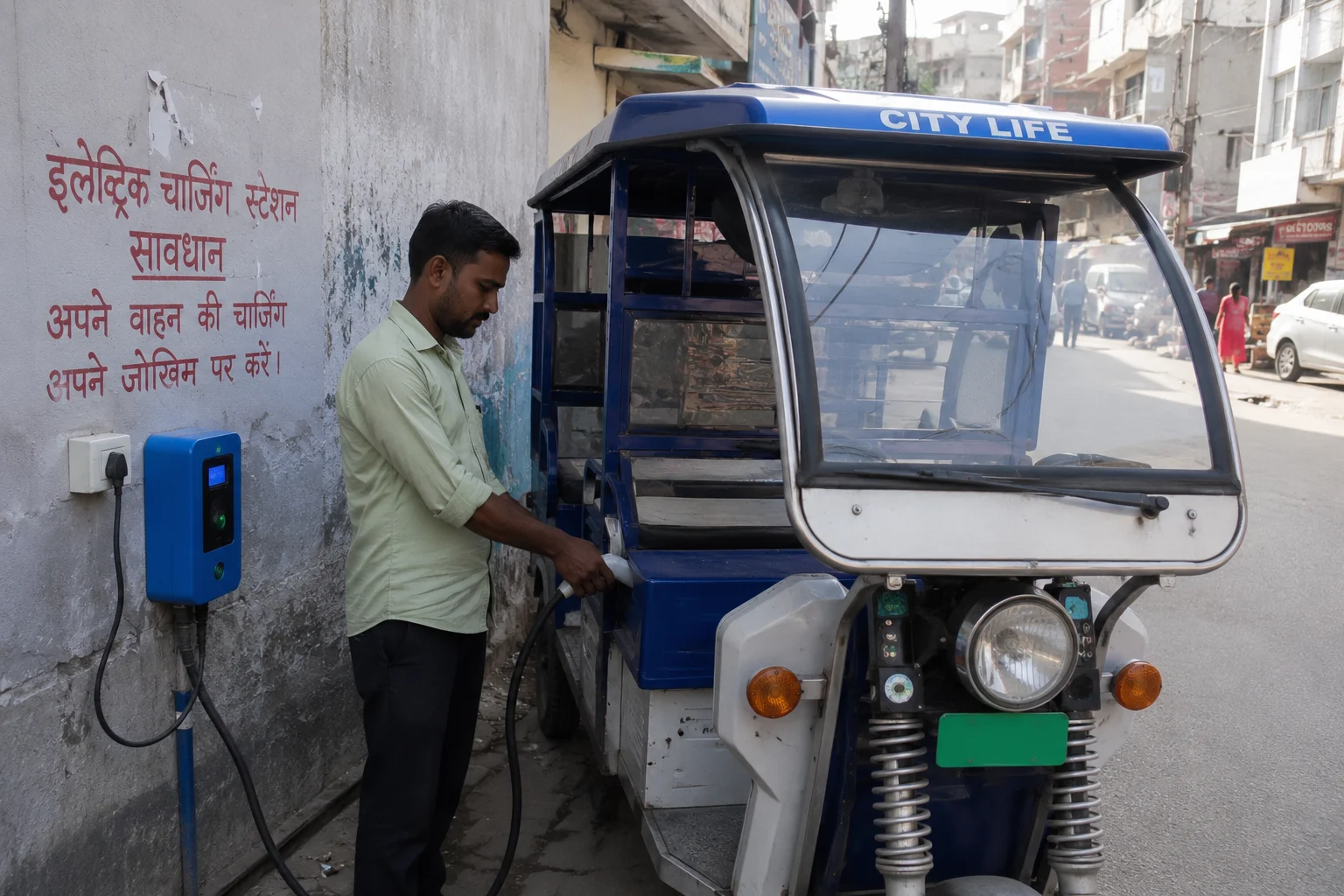
Rakesh has been driving an e-rickshaw in Meerut for six years. Same route most days, station side to the colonies behind it. He is not a man who gets excited about technology. He is a man who counts.
Last year he was buying his third vehicle and he asked me one question, over and over, in slightly different words.
"Lithium wala mehnga hai. Itna extra dene ka fayda kya hai?"
The lithium one is expensive. What is the benefit of paying that much extra.
Fair question. The showroom answer he had been given was the usual one. Lighter, faster charging, longer life, better technology. All true, all useless, because none of it told him whether he would have more money in his pocket after five years.
So we did what he actually wanted. We sat with a notebook and counted.
What came out surprised him, and it surprises most drivers, because the answer is not the one either salesman gives you. It depends almost entirely on how many hours a day the vehicle runs. And the tax rules quietly push things in a direction almost nobody notices.
About the numbers here: everything below is a range, and ranges are wide on purpose. Battery prices move with commodity markets, brands differ, and a vehicle running twelve hours a day is not the same machine as one running five. These figures show you the shape of the decision and the method for working it out. Get current quotes locally before you commit.
Buying an e-rickshaw and stuck on the battery choice?
Credifin finances both lithium and lead-acid e-rickshaws, and battery replacements separately when the time comes. Assessed on bank statements, not just ITR. Decision in 3 to 7 working days.
Apply for an e-rickshaw loan →The two batteries, in plain words
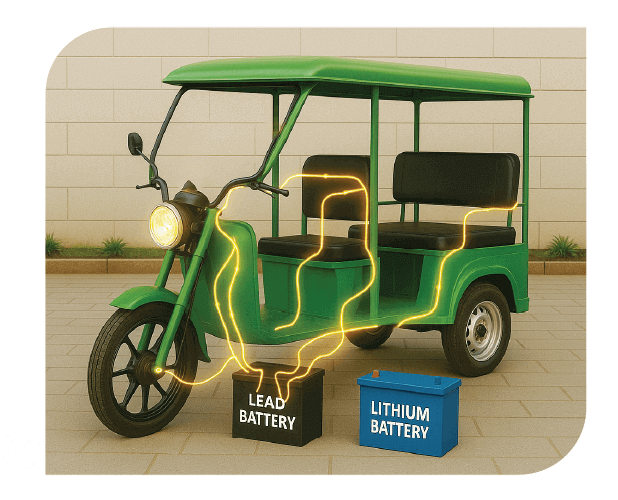
Lead-acid is the older technology. It is what most e-rickshaws in India still run on. Heavy, cheap to buy, well understood by every mechanic in every market. A set is usually four or five batteries wired together, and you replace the whole set when they go.
Lithium-ion is what your phone runs on, scaled up. Much lighter, charges faster, lasts several years instead of several months, and costs considerably more on day one.
That is genuinely the whole technical difference that matters to a driver. Everything else is detail.
Here is how they compare on the things that affect your day.
Lead-acid vs lithium, on what affects your day
| What matters | Lead-acid | Lithium-ion |
|---|---|---|
| Upfront cost of vehicle | Lower | Noticeably higher |
| Weight | Heavy, roughly 120 to 150 kg | Light, roughly 25 to 40 kg |
| Charging time | Around 8 to 10 hours | Around 3 to 4 hours |
| Typical usable life | Under a year of hard commercial use | Several years |
| Range on a full charge | Drops noticeably as the set ages | Holds up much better over time |
| Maintenance | Water topping up, terminal cleaning | Essentially nothing |
| Repair availability | Every market has someone | Fewer people, improving fast |
| Resale of the vehicle | Weaker, buyer assumes battery is due | Stronger, if life is left |
Indicative. Varies by brand, usage pattern and how well the vehicle is looked after.
Look at the charging row before anything else. That one is not a comfort feature. It is a revenue feature, and I will come back to it.
Where the real money hides
Almost every conversation about this happens at the showroom, about the sticker price. That is the wrong place to have it, because the sticker price is the small part of what a lead-acid e-rickshaw costs you.
The big number is replacement.
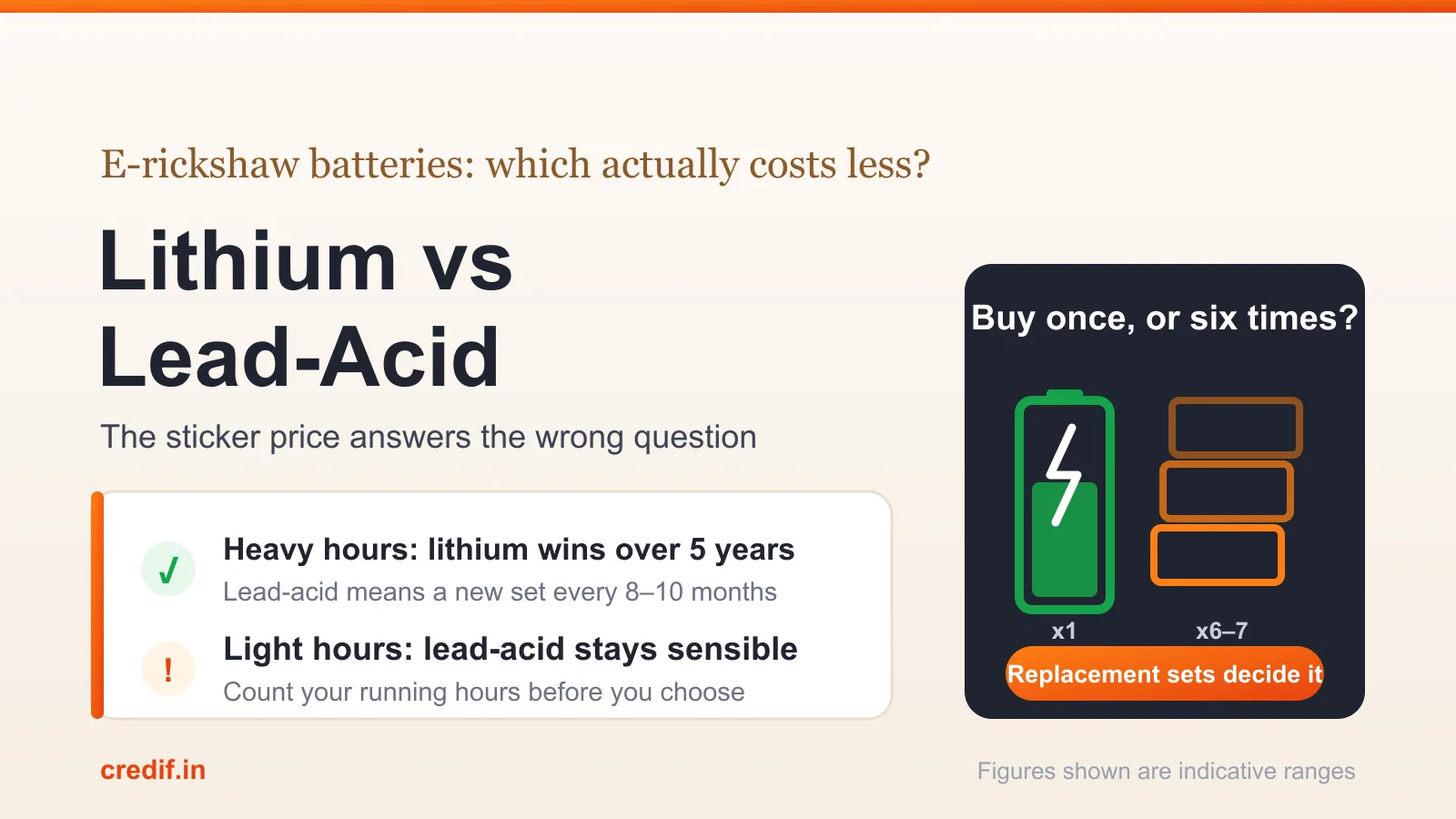
A lead-acid set on a commercial vehicle running full days does not last years. It lasts months. Reported replacement costs for a set sit at roughly Rs 15,000 to Rs 22,000, and hard commercial usage typically means changing it every eight to ten months.
Do that arithmetic across five years. You are not buying one battery set. You are buying six or seven.
This is the part that gets missed, and it gets missed for an understandable reason. The vehicle cost is one big painful number you feel once. The battery cost is a series of medium painful numbers spread across years, and the mind does not add them up the same way. It should.
Lithium flips that. You pay far more on day one and then, for several years, you mostly stop paying.
The GST detail nobody explains
Here is something worth knowing before you buy, because it affects the replacement number and it works in a direction most people would not guess.
When the battery comes fitted inside the vehicle at the time of purchase, it is part of the vehicle supply and taxed at the EV rate of 5%.
When you buy a battery on its own later, as a replacement, it is a standalone product and attracts 18%. That applies to lithium and lead-acid alike, both sitting under the same heading.
So every replacement set you buy carries more than three times the tax rate of the battery that came with the vehicle.
There is a second wrinkle. Battery rates were unified at 18% in late 2025. Before that, lead-acid replacements were sitting higher still, so on tax alone lead-acid replacements actually got a little cheaper. That helps, but it does not change the underlying problem, which is that you are buying six or seven of them.
| What you are buying | Rate applied | Why |
|---|---|---|
| Battery fitted in the vehicle at purchase | 5% | Part of the vehicle supply |
| Replacement battery bought separately | 18% | Standalone product, own heading |
| Battery swapping as a service | 18% | Treated as a service, not goods |
| EV charger as a physical product | 5% | Charging equipment |
Reflects the position as we understand it. Tax rules change and classification can be argued, so confirm current rates with your dealer or a tax professional before you plan around them.
The practical takeaway is small but real. Whatever battery you choose, the one that comes fitted in the vehicle is the cheapest battery you will ever buy for that vehicle. Buy the vehicle with the better battery in it rather than planning to upgrade later.
The five-year count, the way Rakesh did it
We did this on a notebook page, so I will lay it out the same way. Directional shape only, using ranges.
Over five years
| Over five years | Lead-acid vehicle | Lithium vehicle |
|---|---|---|
| Vehicle purchase | Lower | Higher by roughly Rs 40,000 to Rs 70,000 |
| Battery sets bought after purchase | Roughly 5 to 7 sets | Often zero, sometimes one near the end |
| Spend on replacement sets | Substantial and repeating | Little to none in the period |
| Charging electricity | Slightly more, older sets draw worse | Slightly less |
| Maintenance and water topping | Small but constant | Almost none |
| Downtime for charging | 8 to 10 hours, mostly overnight | 3 to 4 hours, can top up midday |
| Vehicle resale at year five | Weaker | Stronger if battery life remains |
Directional only. Your real numbers depend on daily running hours, local battery prices, brand and how the vehicle is treated.
When Rakesh added his own local prices into that shape, the lithium vehicle came out ahead over five years. Not marginally. Comfortably.
But that was his usage. Twelve to fourteen hours most days, six days a week, on a route where the vehicle rarely sits idle.
When lead-acid is genuinely the right answer
I want to be honest here rather than just selling you the expensive option, because for a decent number of drivers lead-acid remains the correct choice.
| Your situation | Likely better fit | Why |
|---|---|---|
| 10 to 14 hours daily, six days a week | Lithium | Replacement cycle is brutal at this usage |
| 5 to 7 hours daily | Either, run your own numbers | Lead-acid sets last much longer |
| Two shifts, two drivers on one vehicle | Lithium | Fast charging lets you turn the vehicle around |
| Cash purchase, tight budget, no finance | Lead-acid | Upfront gap is the binding constraint |
| Financed purchase, good route | Lithium | EMI difference is usually smaller than replacement cost |
| Small town, limited lithium service | Lead-acid for now | Repair access matters more than theory |
| Planning to sell inside two years | Lead-acid | Not enough time to recover the premium |
Guidance, not a rule. Every route and every driver is different.
The upfront gap is exactly what a loan is for
That Rs 40,000 to 70,000 difference is what stops most drivers choosing lithium. Spread across a tenure, it is often smaller per month than what lead-acid replacements cost you. Credifin finances both.
Check your eligibility →The charging time argument is really an earnings argument
I said I would come back to this, and it is the point salesmen state badly.
A lead-acid vehicle needs most of a night on charge. That is fine if you drive one shift and sleep the other. It becomes a hard ceiling the moment you want more out of the vehicle.
Three to four hours changes what is possible. Charge through the afternoon lull and go back out for the evening rush. Or run two drivers across two shifts on one vehicle, which is a different business entirely.
For a single-shift owner-driver, this is a convenience. For anyone trying to keep the vehicle earning more hours, it is the whole argument, and it usually dwarfs the battery cost comparison.
Work out what an extra two or three hours of running is worth on your route. That number belongs in this decision and almost nobody puts it there. Our piece on what an e-rickshaw actually earns monthly has the framework for it.
Six things to check before you pay
1. Ask what the battery warranty actually covers
Months, kilometres, or charge cycles? Does it cover degradation or only total failure? Get it written on the invoice, not explained across a counter.
2. Confirm the battery is fitted at purchase, not billed separately
This matters for the tax rate, and it matters for what your loan can cover.
3. Ask where it gets serviced
Specifically. A name and a location in your district, not "service available."
4. Ask the replacement cost of the exact battery
Not batteries in general. That model, that capacity, today's price. Write it down. That is your future liability.
5. Check whether the vehicle qualifies for a subsidy
E-rickshaws and e-carts continue to receive central support, and the benefit should show as its own line before your loan is sized. Ask the dealer for the approval reference and verify it rather than taking his word.
6. Talk to two drivers running that exact model
Not the brand. The model, in your city, for at least a year. Fifteen minutes at a charging point will teach you more than any brochure.
Point four is the one I would insist on. A driver who knows his replacement cost can make this decision properly. A driver who does not is guessing, and the guess almost always runs in the seller's favour.
What about financing the difference?
Most drivers buy on finance, so the real question is rarely "can I afford the lithium vehicle." It is "can I afford the EMI difference."
On the vehicle cost gap, spread over a typical tenure, the monthly difference between a lead-acid and a lithium e-rickshaw usually lands smaller than people expect. Then set that against a lead-acid replacement set every eight to ten months, paid as a lump sum, out of pocket, at whatever moment the batteries decide to fail.
That is the comparison that matters. A slightly higher EMI you have planned for, against a large irregular expense you have not.
And when a lithium pack does eventually need replacing, that can be financed too rather than coming out of a week's earnings all at once. There is more in our guide to battery replacement loans.
Back to Rakesh
He bought the lithium vehicle. Financed, with about a quarter down.
Two things he told me since, neither of which was on the notebook page.
The first is that he stopped thinking about batteries. For six years, roughly every eight or nine months, he had a bad week where the range dropped, then dropped again, and he knew what was coming and had to find fifteen or twenty thousand rupees quickly. That cycle just ended, and he said the relief of it was worth something he had not priced in.
The second is that he started doing an evening run he never used to do, because he can put the vehicle on charge after lunch for a few hours and go back out at six. On his route the evening is the good money.
"Battery ka hisaab toh theek tha. Par shaam ki kamai ka hisaab main laga hi nahi paaya tha."
The battery arithmetic was right. But he had not managed to count the evening earnings at all.
That is the honest ending to this. The battery comparison is real and it usually favours lithium for a hard-working vehicle. The bigger win, for a lot of drivers, turns out to be the hours the vehicle can now run.
And I will say the other side plainly, because Rakesh is not everybody. If your vehicle does short hours, or you are buying with cash you have counted twice, or lithium service in your area is a phone call to another city, lead-acid is a perfectly sensible choice and you should not feel talked out of it.
Bottom line
The sticker price answers the wrong question. What decides this is how many battery sets you buy after the sale, and that depends on how hard the vehicle works.
Run heavy hours and lead-acid replacements will out-cost the lithium premium, usually well inside five years. Run light hours and lead-acid holds up perfectly well.
Before you decide, do three small things. Find out the exact replacement cost of the battery in the vehicle you are considering. Count your real running hours honestly rather than optimistically. Work out what two extra hours of running is worth on your route.
Then choose. The answer will be obvious once those three numbers are on paper, and it will not be the same answer for every driver.
Where Credifin fits
We finance e-rickshaws and e-carts across 14 states, in both battery types, and we finance battery replacements separately when that day comes.
We assess on bank statements and how the route actually earns, rather than needing an ITR, which is why drivers and small operators get through with us when a salary-slip process cannot read them. The application is online, the decision on a clean file comes in 3 to 7 working days, and you can walk into a branch if you would rather ask questions in person.
One thing we will do that a dealer will not. If a quote looks high for that model and your profile, we will say so before you apply rather than after. If you are also weighing a dealer's in-house finance, put the two offers side by side. Our comparison of banks and NBFCs for vehicle loans shows what to actually compare.
Ready to buy the right vehicle rather than the cheap one?
Credifin finances lithium and lead-acid e-rickshaws across India, sized on the real post-subsidy price. Bank-statement assessed. Decision in 3 to 7 working days.
Apply for an e-rickshaw loan →Talk to Credifin
Credifin is an RBI-registered NBFC financing e-rickshaws, e-carts, electric two-wheelers and battery replacements across India.
079651-74500 | info@credif.in
Find your nearest branch →
FAQs
Which is better for an e-rickshaw, lithium or lead-acid?
It depends on running hours. For a vehicle working ten hours or more a day, lithium usually costs less over five years because lead-acid sets need replacing every eight to ten months. For lighter usage, lead-acid remains sensible.
How long does a lead-acid e-rickshaw battery last?
On hard commercial use, commonly around eight to ten months before the set needs replacing. Lighter usage stretches that considerably, sometimes past a year and a half.
How much does a lead-acid battery set cost to replace?
Reported figures sit roughly in the Rs 15,000 to Rs 22,000 range for a set, varying by brand, capacity and local pricing. Ask for the price of the exact set in your vehicle before you buy.
Why is a replacement battery taxed more than the one in the vehicle?
A battery fitted at the time of purchase is part of the vehicle and taxed at the EV rate of 5%. Bought separately later, it is a standalone product at 18%. Confirm current rates before planning around them.
Can I finance the battery separately from the vehicle?
Yes. Battery replacement finance is a separate, smaller facility, which suits drivers who would otherwise have to find a lump sum at short notice. Our battery replacement loan guide covers it.
Is a lithium e-rickshaw worth the extra upfront cost?
For a hard-working vehicle, usually yes over five years. The bigger benefit for many drivers is faster charging, which allows more running hours and often matters more than the battery saving itself.
Can I upgrade my existing lead-acid e-rickshaw to lithium?
Sometimes, but check the vehicle compatibility, whether it affects your warranty, and how it is treated for registration. Buying the battery fitted in a new vehicle is usually simpler and cheaper.
Does a lithium e-rickshaw hold better resale value?
Generally yes, provided meaningful battery life remains, because the buyer is not immediately facing a replacement. Lead-acid vehicles get discounted on the assumption a new set is due.
This might catch your interest