Home Loan Without ITR: How Self-Employed Buyers Actually Get Approved
Lakshay Khanna·18 August 2026
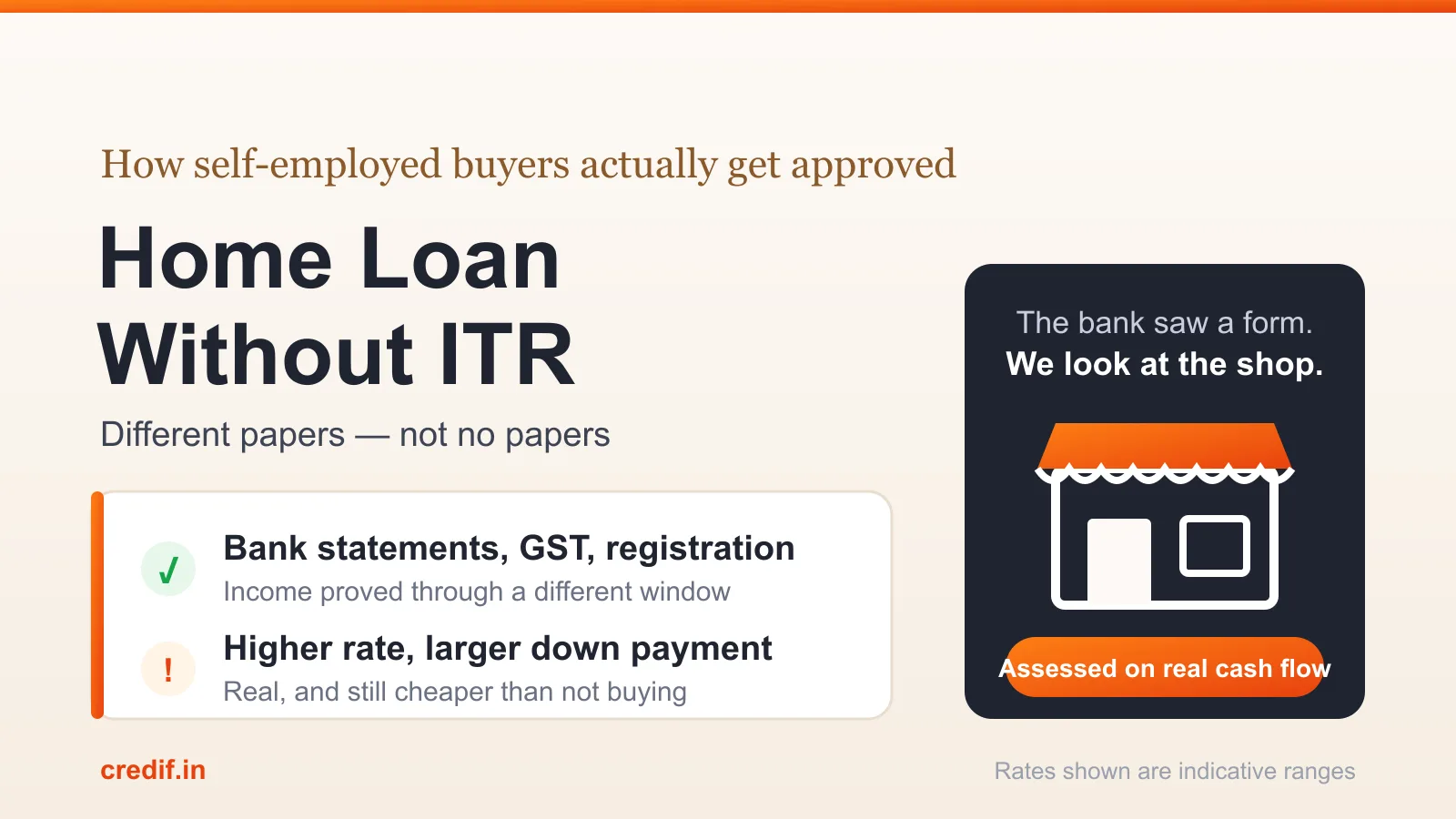
There is a sweet shop near my in-laws' place in Jalandhar. Been there thirty years. The man who runs it, Harjit, gets up at four, and by nine the counter is three deep on a Sunday. Everyone in that market knows what his shop does.
Last year he wanted to buy a flat. Not a big one. Something for his daughter's family to move into, two streets over.
He went to a bank with a friend who works in an office and knows how these things go. They sat down, the officer was perfectly polite, took the papers, and came back a fortnight later with a no.
Harjit could not understand it. He showed me the rejection.
"Bhai, main aadmi hoon jo tees saal se mithai bech raha hoon. Dukaan meri hai. Aur bank keh raha hai income nahi hai?"
I have been selling sweets for thirty years. The shop is mine. And the bank is saying I have no income?
He had income. Plenty of it. His ITR was filed at a number that would embarrass a junior clerk, because that is what his accountant had advised him to do for two decades, and nobody in his line questions the accountant.
The bank was not calling him a liar. The bank never saw him at all. It saw a form.
This one comes up constantly, and it is worth explaining properly, because "home loan without ITR" is not the impossible thing people assume. It just means a different set of papers and a different kind of lender.
On the numbers below: every rate and ratio in this article is a range. Home loan pricing depends on the lender, the property, the tenure, the loan size and the whole borrower profile, and it moves. These figures are here to show you the shape of the decision. Your own sanction letter is the only number that binds anyone.
Self-employed and been turned down on paperwork?
Credifin assesses home loans on bank statements and real business cash flow, not only on a filed return. Across 14 states and 200+ locations. Decision in 3 to 7 working days.
Check your eligibility →Start here, because the phrase misleads people
"Without ITR" does not mean without income proof. No regulated lender in India hands out a housing loan against a property on the strength of somebody's word.
What it means is this. Your income gets established through a different document than a tax return.
That is the whole idea. Once you see it that way, the anxiety drops and the task becomes practical. You are not asking anyone to skip due diligence. You are giving them a different, and often more honest, window into what you earn.
Which raises the obvious question.
Why the ITR problem exists at all
Because a great many self-employed Indians file returns that understate what their business actually produces. This is not a secret and lenders are entirely aware of it.
Sometimes it is deliberate. Sometimes the accountant claims every deduction available and the resulting figure is technically correct and practically useless. Sometimes the business is newer than the returns suggest. Sometimes the money simply moves in ways a return does not capture well.
Now put yourself at a bank counter. Its credit policy says eligibility is a multiple of declared income. The return in front of it says a number. The system does the arithmetic and produces an answer.
The bank is not being unreasonable and it is not doubting you personally. It is applying a rule to a document. The document is the problem, not you and not the bank. Which is exactly why changing the document changes the answer.
Harjit's shop turned over in a month roughly what his return claimed for a quarter. Neither figure was invented. They were just measuring different things.
What lenders accept instead
Here is what actually gets used in place of a return, roughly in order of how much weight it carries.
What stands in for the return
| Document | What it proves | How much it carries |
|---|---|---|
| Bank statements, 12 months | Money genuinely arriving, and the pattern of it | The most weight, by a distance |
| GST returns | Turnover, independently filed | Strong, where the business is registered |
| Shop or business registration | The business is real and how old it is | Establishes standing |
| Purchase and sales ledgers | Volume and margins | Useful supporting detail |
| Rent receipts or agreements | Additional income streams | Adds to eligibility |
| Co-applicant income | A second person on the hook | Often decisive |
| Existing loan repayment record | You have borrowed and repaid before | Quietly very persuasive |
| Property papers and valuation | The security behind the loan | Sets the ceiling on the amount |
Requirements differ between lenders. Ask exactly what your lender will accept before you gather anything.
Bank statements are the centre of this. Everything else supports them.
And what a lender wants from those statements is not perfection. It is a pattern they can read. Money arriving regularly. Balances that do not scrape zero every month. Deposits that broadly match the business you say you run.
A sweet shop with heavy Diwali months and quiet monsoon ones is normal. A trader whose business is seasonal is normal. What raises questions is money appearing in lumps with no explanation, or an account with almost nothing moving through it while the applicant claims a healthy income.
The habits that decide this a year in advance
This is the part I wish somebody had told Harjit five years earlier, and it is the most useful thing in this article for anyone not buying immediately.
Twelve months of these habits changes what a lender can lend you far more than any negotiation at the counter will. If a purchase is a year or two away, this is where the effort actually pays.
Not buying yet, but want to know where you stand?
The eligibility check takes a few minutes and no documents. Better to know now than to find out in a rejection letter.
Check your eligibility →What it costs, honestly
A file assessed on bank statements rather than a clean salaried package will usually price higher and lend a bit less against the property. Worth knowing before you start rather than discovering it at sanction.
| What changes | Full documentation, salaried | Bank-statement assessed |
|---|---|---|
| Indicative rate | Around 8 to 11% | Around 11 to 16% |
| Loan against property value | Often up to 80 to 85% | More often 65 to 75% |
| Down payment needed | Smaller | Larger, plan for a bigger share |
| Processing time | Two to four weeks at a bank | Often a week or so at an NBFC |
| Tenure available | Long | Usually shorter |
| Co-applicant | Helpful | Often expected |
Illustrative bands to show the shape. Actual terms depend entirely on the lender, the property and your profile.
Two things worth saying about that table.
The higher rate is real money over a long tenure and you should not shrug at it. But compare it against the alternative you actually have, which for most people in this position is not a cheaper home loan. It is no home loan, or a personal loan at a considerably worse rate, or years of continued rent.
And the loan-to-value line matters more than the rate line. If a lender will fund 70% rather than 85%, the extra you must find upfront is a much larger number than the rate difference will cost you in the first few years. Plan the down payment before you fall in love with a property. Our guide to how much home loan down payment you actually need works through it.
The property side still has to be clean
People focus so hard on the income question that they forget the other half. The property has to hold up regardless of how your income is proved.
That last one catches self-employed buyers hardest, because a lower valuation combined with a lower loan-to-value ratio compounds into a much bigger cash requirement than expected. Ask what the lender's valuation is likely to be before you sign an agreement to sell.
Home loan or loan against property?
Worth a moment, because for a lot of self-employed borrowers this is the actual choice and nobody presents it.
If you already own property and need funds, a loan against property may fit better than a fresh home loan. Lenders are generally more comfortable, because the collateral is established and the amount is set against something already yours.
If you are buying, it is a home loan. But if you own a shop or a plot and are trying to fund a purchase, a combination sometimes works where a straight home loan will not.
| Situation | Usually the better tool |
|---|---|
| Buying your first property, no assets yet | Home loan, with a co-applicant |
| Own a shop or plot, buying a house | Home loan, or a combination |
| Own property, need funds for any purpose | Loan against property |
| Documentation clean, score above 700 | Try a bank first, take the better rate |
| Documentation thin, need speed | NBFC, bank-statement assessed |
Guidance only. Which instrument fits depends on your assets, the purpose and the lender.
There is more in our comparison of loan against property versus a home loan in Punjab, which uses examples from Ludhiana and Jalandhar.
Five things that quietly sink these applications
1. A name that does not match across documents
PAN says one spelling, Aadhaar says another, the bank has a third. This is the single most common reason a good file stalls, and it is entirely fixable before you apply.
2. An old mobile number at the bank
Verification messages go nowhere and the file sits. Update it first.
3. Applying at five lenders simultaneously
Every application is a hard enquiry. Stacking them damages the score you are relying on. One at a time, three weeks apart.
4. Not knowing your own numbers
If you cannot state your monthly turnover and your existing EMIs when asked, the officer assumes you are guessing. Bring the figures.
5. Ignoring the co-applicant credit record
A spouse or son with a damaged report can sink an otherwise strong file. Check theirs as well as yours before applying.
Back to Harjit
He got the loan. It took about three months from the rejection, and most of that was preparation rather than processing.
What changed. He started depositing the shop's daily takings properly instead of banking the leftovers. His son-in-law, who is salaried, came on as co-applicant. He pulled together GST returns, the shop registration from 1994, and eleven months of statements that told a very different story from the tax return.
He also increased the down payment, because his brother put in some and the family had savings sitting idle. That single move did more for the application than anything else, because it dropped what he needed to borrow into a range the lender was comfortable with.
The rate is higher than his salaried friend pays on his flat. Harjit knows that. He is not thrilled about it, and I would not pretend he should be.
But his daughter's family moved in this March.
"Bank ne mera kagaz dekha tha. Inhone dukaan dekhi."
The bank looked at my paper. These people looked at the shop.
That is the difference, and it is not a criticism of banks. A bank's process is built for documented income and it does that job well and cheaply. If your income is documented, use a bank. If it is real but not documented, you need a process built to read it.
Bottom line
A home loan without an ITR is not a loophole and it is not a favour. It is a different assessment method for a borrower whose income is genuine but not captured well by a tax return.
Expect a higher rate, a lower loan-to-value and a larger down payment. Expect the property side to be examined just as closely. Expect a co-applicant to help significantly.
Three things to do before you apply. Get twelve months of bank statements that actually reflect the business, which may mean changing how you bank for a year first. Line up your name and address so they match across every document. And find out what the lender will value the property at before you commit to a price.
If you are a year out from buying, start banking properly now. That single habit will change what you can borrow more than anything you say at a counter.
Where Credifin fits
We finance home loans and loans against property across 14 states and more than 200 locations, and a large share of our borrowers are exactly this profile. Shopkeepers, traders, small manufacturers, contractors. People whose income is real and whose paperwork was never built for a bank's process. If you are buying in Punjab specifically, our Jalandhar home loan guide covers the local side.
We read bank statements and business cash flow. We will look at GST returns, registration, ledgers, rental income and a co-applicant, and we will tell you what your file supports before you formally apply, so you are not collecting hard enquiries while you find out. The application is online, the decision on a clean file comes in 3 to 7 working days, and you can sit across a desk at a branch if you would rather ask questions in person.
We will also tell you when a bank is the better door. If your returns are clean and your score is comfortable, a bank will price this better than we will, and you should take it. Knowing which door to knock on saves you the most money of anything in this decision.
Ready to be assessed on what your business actually earns?
Credifin lends on real cash flow, not just a filed return. Home loans and loan against property across 14 states. Decision in 3 to 7 working days.
Apply now →Talk to Credifin
Credifin is an RBI-registered NBFC. CRISIL BBB- / Stable, listed on the Metropolitan Stock Exchange, lending since 1992.
079651-74500 | info@credif.in
Find your nearest branch →
FAQs
Can I get a home loan without an ITR?
Yes, with several lenders and particularly NBFCs. Income gets established through bank statements, GST returns, business registration and supporting documents instead of a tax return. Expect a higher rate and a lower loan-to-value than a fully documented file.
How many months of bank statements do lenders want?
Usually twelve, sometimes six. They are looking for a readable pattern of income rather than a perfect one, so seasonal variation in a business is normal and explainable.
Will the interest rate be higher without an ITR?
Generally yes, by a few percentage points, because the lender is carrying more assessment risk. Compare it against your real alternative rather than against a salaried borrower rate.
How much down payment will I need?
More than a salaried applicant. Where a fully documented file might get 80 to 85% funded, a bank-statement assessed file is more often in the 65 to 75% range, so plan the difference in advance.
Does a co-applicant help?
Considerably. A co-applicant with documented income and a clean credit record improves both your approval odds and your pricing, because the lender has a second person responsible.
What if my business is only two years old?
Harder but not impossible. Business vintage matters, so a shorter history usually means a lower amount, a larger down payment, or a co-applicant carrying more of the file.
Can I get a home loan if I run a cash business?
Only to the extent the cash reaches your bank account. Cash that never gets deposited cannot be assessed by anyone. Start banking your takings well before you plan to apply.
Is a loan against property easier than a home loan for self-employed borrowers?
Often, yes, because the collateral is already yours and established. If you own property and need funds, it is worth comparing both rather than assuming a home loan is the only route.
This might catch your interest