Education Loan and Section 80E: Why the Old Tax Regime Can Save You Lakhs
Vansh Budhiraja·01 August 2026
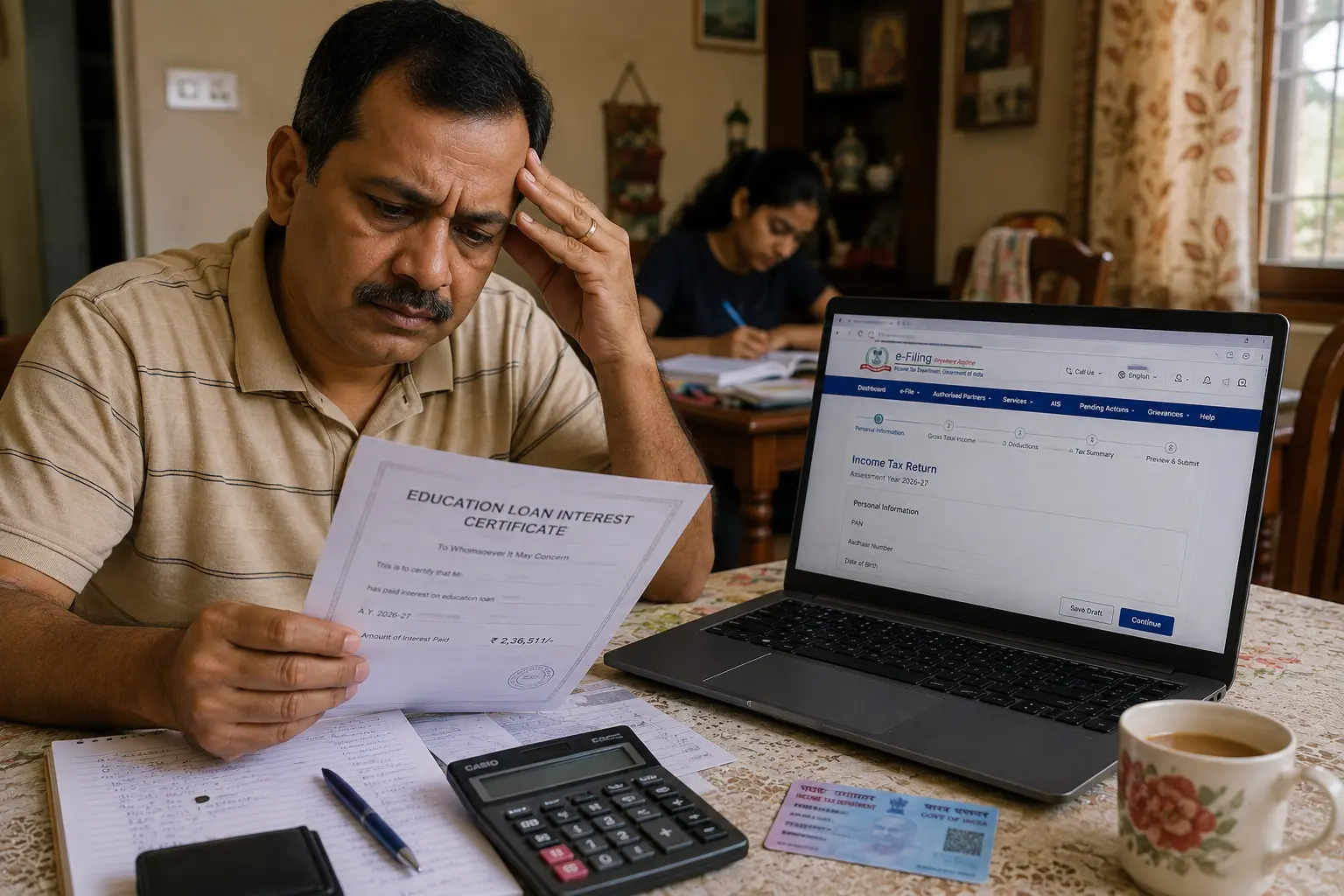
My neighbour's daughter, Ananya, got into a good college for her master's last year. The family took an education loan. A big one. Her father, Mr. Bhatia, is a careful man. Retired bank clerk, keeps every receipt in a plastic folder. So when he sat down to file his taxes this year, he did what half the country is quietly doing now. He picked the new tax regime, because everyone told him the rates are lower and the form is simpler.
Then he mentioned it to me over the gate one evening. Almost in passing. "Naya wala regime le liya, kam tax lagta hai."
I asked him one question. Did he claim the interest on Ananya's education loan?
Blank look. He did not know he could. And that is the part that stung a little once we sat down and worked it out. By choosing the new regime, he may have missed a deduction that could have been worth more to him than the lower tax rates he got in return. On a big education loan, in his slab, that can be a real number. Not a few hundred rupees. Possibly tens of thousands, every year, for years.
That is the trap sitting quietly inside a lot of education loans in India right now. Let me explain it properly, because almost nobody does.
Before we start: this article is general information, not tax advice. Tax rules, limits and even section numbers change from year to year, and the right answer for your return depends on your income and the year you are filing for. Please confirm the current position on the Income Tax Department portal or with a qualified CA before you file.
Taking an education loan?
Credifin finances education across India, with repayment built around your family's income. Online application, decision in 3 to 7 days.
Explore Education Finance →What Section 80E actually is
Forget the tax language for a minute. It is simpler than it sounds.
When you take an education loan and start repaying it, every EMI has two parts inside it. One part is the principal, which is the money you borrowed. The other part is the interest, which is what the lender charges you on top of it. Section 80E lets you take the interest part and cut it out of your taxable income, meaning the income the government actually charges you tax on.
This is not a small fixed allowance, and it is not a refund. It is a full deduction of the interest you paid in that year. And the best part is that there is no upper limit on the amount. Whatever interest you genuinely paid during the year on an education loan that meets the rules, all of it can come off.
For a family repaying a large loan, this is one of the biggest tax benefits available anywhere in the system. It is at its largest in the early years, when the interest part of the EMI is at its highest — the same front-loading we walk through in our B.Tech education loan cost breakdown. Mr. Bhatia had no idea it existed.
| Section 80E at a glance | |
|---|---|
| What is deductible | The interest paid in the year. Never the principal |
| Upper limit | None on the amount of interest |
| How long | 8 years from the year repayment starts, or until the interest is fully paid |
| Tax regime | Old regime only. Not available under the new regime |
| Whose education | You, your spouse, your children, or a student you are legal guardian of |
| Course | Higher education, in India or abroad |
One note on the name, so you are not confused when you read other articles. This article refers to the deduction by its widely used name, Section 80E. That is the name you will see on the income tax portal, on bank and lender documents, and from most CAs. If your filing software or your CA uses a different section number for it, ask them to confirm which one applies to your return for the year you are filing.
The catch that caught Mr. Bhatia: old regime only
Here is the most important line in this whole blog. Section 80E works only under the old tax regime. If you choose the new regime, you cannot claim it at all.
This matters a lot right now, because the new regime is the default. If you do not actively pick the old one, the system puts you on the new one. And most people simply go with the default, because the rates look lower and the process looks easier. Without knowing it, they give up 80E completely.
So the real question is not "which regime has better rates." It is "does my education loan interest, plus whatever else I can claim, save me more than the lower rates of the new regime?" For a family repaying a big education loan, the answer is often yes. Most of them never run the comparison.
Old tax regime
- Tax rates: higher
- Section 80E: fully deductible, no limit
- Other deductions (80C, etc.): available
- Suits: people who have real deductions to claim
New tax regime
- Tax rates: lower
- Section 80E: not allowed at all
- Other deductions (80C, etc.): mostly gone
- Suits: people with few or no deductions
The new regime is not the villain here. If you have no loan, no big investments and nothing much to claim, its lower rates can genuinely be the better deal. But the moment you are carrying a big education loan, the old regime plus 80E often works out better. That is the sum Mr. Bhatia never did.
What it is actually worth
Numbers make this real, so here is what I worked out on Mr. Bhatia's notepad. These are only examples. Your own saving depends on your tax slab and the interest you actually paid, and the figures below ignore surcharge and cess.
Say you paid Rs 2 lakh in interest on the education loan this year. Under the old regime, that Rs 2 lakh comes off the income you are taxed on. How much of it comes back to you depends on your slab.
| Interest paid in the year | Your tax slab | Roughly what you save |
|---|---|---|
| Rs 1,00,000 | 20% | About Rs 20,000 |
| Rs 2,00,000 | 20% | About Rs 40,000 |
| Rs 2,00,000 | 30% | About Rs 60,000 |
| Rs 3,00,000 | 30% | About Rs 90,000 or more |
Look at the last row. Someone in the 30% slab who paid Rs 3 lakh of interest saves around ninety thousand rupees in a single year. Repeat that across the years you are repaying, and the deduction quietly gives back a large part of what the loan cost you. That is not small money. It is the difference between an education loan that hurts and one you can actually live with.
And remember, the interest part of your EMI is biggest in the first few years of the loan. So this benefit is at its largest exactly when the family's money is most stretched. That is good design, if you actually use it.
The rules, in plain words
A few conditions decide whether you can claim 80E. None of them are hard to follow.
The eight year trap nobody warns you about
Here is a mistake I have watched careful families make. They take a long, comfortable education loan, say twelve or fifteen years, and pay only the minimum EMI, because the monthly amount feels light.
The problem is that the 80E benefit stops after eight years. If your loan runs longer than that, the interest you pay in year nine, year ten, year eleven and beyond gets you no deduction at all. You pay the full interest with no tax saving to soften it.
So if your loan period is longer than eight years, there is a smart move available. Try to clear most of the interest inside those first eight years, while the deduction still works. Pay a little more, a little sooner, during the years when the tax saving is still helping you. It is a small timing decision that saves real money, and almost nobody plans for it.
Simple rule: claim 80E every single year you are eligible. And if your loan runs past eight years, push to clear most of the interest inside that eight year window while the deduction still works.
How to actually claim it
The steps are boringly simple, which is why it is such a shame that so many people miss it.
Ask your lender for an interest certificate
Every financial year, ask your lender for an interest certificate. It states exactly how much interest you paid during that year. Banks and lenders give these out routinely, you just have to ask.
File under the old tax regime
The deduction is available only under the old regime. Since the new regime is the default, you have to actively choose the old one when you file, or you lose the deduction entirely.
Enter the interest amount as your deduction
That is really all there is to it. One certificate, one entry, one choice of regime. Only two things usually go wrong: forgetting to pick the old regime, or not knowing the deduction exists at all. Mr. Bhatia tripped on both.
Back to Mr. Bhatia
He could not change the year he had already filed under the new regime, so that one is behind him. But he learns fast. Before the next filing, we sat down and ran both regimes side by side, with Ananya's interest certificate in front of us. For him, the old regime with the 80E deduction came out clearly ahead. Not a close call.
He was a little sorry about the year he had lost. "Pichhle saal pata hota toh." If only he had known last year. But he was more relieved than upset, because now he has it for every remaining year of the loan.
He put it in a way I liked. The government was ready to hand back a good part of the interest on his daughter's education. He simply had not asked for it. That is exactly it. The benefit sits there quietly. You have to pick the right regime and actually claim it.
Bottom line
An education loan comes with a tax benefit that most families never claim. Section 80E lets you deduct the full interest you pay each year, with no upper limit, for up to eight years. The one catch is that it works only under the old tax regime, and since the new regime is now the default, many families give it up without realising.
If you are repaying an education loan, do not just accept the default. Run both regimes with your interest certificate in hand, or ask a CA to run them for you. For a big loan, the old regime plus 80E often comes out ahead, sometimes by tens of thousands of rupees a year, which adds up to lakhs across the eight year window. And if your loan runs past eight years, try to clear most of the interest inside the window while the deduction still works.
Ask for the benefit. It is your son's, or your daughter's, or your own education that the government is quietly helping to pay for.
Where Credifin fits
If this sounds like your family's situation, here is where we come in.
We finance education across India — college and semester fees, annual fee finance, and the smaller costs like uniforms and books — and part of doing that properly is making sure families understand the money around the loan, not only the EMI. The 80E benefit is not something a lender pays you. It is a deduction you claim from the government, and whether any particular loan qualifies depends on the lender and the rules that apply to your return, so check that with your CA rather than assuming. What we can do is give you clear annual statements of what you paid, and build repayment around what your family can actually manage. The application is online, and the decision comes in 3 to 7 working days.
One honest note. We are a lender, not a tax advisor, and tax rules do change from year to year. Amounts, conditions and even section numbers can be updated, and the right answer for your return can depend on your income and the year you are filing for. Before you file, please check the current position on the income tax portal or with a CA.
Funding a degree this year?
Credifin finances education across India, with EMIs built around what your family actually earns. Online application, decision in 3 to 7 working days.
Explore Education Finance →Talk to Credifin
Credifin is an RBI-registered NBFC financing education and more across India, with repayment built around your family's income.
079651-74500 | info@credif.in
Find your nearest branch →
FAQs
What is Section 80E on an education loan?
It is a tax benefit that lets you deduct the full interest you paid on a qualifying education loan from your taxable income, with no upper limit, for up to eight years.
Can I claim 80E under the new tax regime?
No. Section 80E works only under the old tax regime. If you pick the new regime, you lose this deduction.
Is the principal deductible too, or only the interest?
Only the interest part of your EMI. Unlike a home loan, the principal you repay on an education loan cannot be claimed.
Does it cover studying abroad?
Yes. The loan can be for higher education in India or abroad. There is no rule that the course has to be in India. Our international education funding roadmap covers that side in detail.
Whose education can the loan be for?
Your own, your husband's or wife's, your children's, or a student for whom you are the legal guardian. A parent claiming for a child's loan is a very common case.
How many years can I claim it for?
The year your repayment starts, plus the next seven. Eight years in total, or until the interest is fully paid, whichever comes first.
Does a loan from any lender qualify?
Not automatically. The deduction applies to a loan taken from a banking company, or from a financial institution notified by the government for this purpose, or from an approved charitable institution. Ask your specific lender whether their education loan qualifies before you count on the deduction.
Should everyone choose the old regime then?
Not automatically. If you have little to claim, the lower rates of the new regime may suit you better. But if you are repaying a meaningful education loan, run both and compare. The old regime plus 80E often comes out ahead.
Planning the next year's fees?
Credifin funds education across India and pays the institution directly, with EMIs sized to your family's real income. Online application, decision in 3 to 7 days.
Explore Education FinanceThis might catch your interest