Used EV Loan in India 2026: Finance a Pre-Owned Electric Scooter, Car or E-Rickshaw
Vansh Budhiraja·Last Updated
I was sitting at a chai shop in Ludhiana about three weeks back when this guy started talking to me about his iQube. Civil engineer, mid-twenties, just got married. He wanted to upgrade from his hand-me-down petrol Activa but couldn't quite swing the EMI on a new electric scooter without stretching his monthly budget. Then his cousin's neighbour mentioned he was selling a 2023 iQube — barely used, second owner had only put 8,000 km on it, asking Rs 78,000.
Brand new base iQube on-road in Punjab right now is around Rs 1.15 lakh. The used one at 78k was a serious saving. The engineer guy was excited but also nervous because nobody he knew had bought a used EV before. He asked me three questions in a row — does anyone even give a loan on used electric? What about the battery, how do I know it's still good? And what happens if it dies six months later, am I stuck?
Fair questions honestly. The used EV market in India was a complete graveyard two years ago. Sellers existed but no real buyers and definitely no lenders willing to touch it. That's changed in 2026 and it's worth understanding why before getting into the loan mechanics.
Found a used EV you like?
Credifin's used EV two-wheeler loan works on bank statement income, no formal salary slip required. Check your eligibility before you pay the seller.
Check your eligibility →What the used EV market actually looks like now
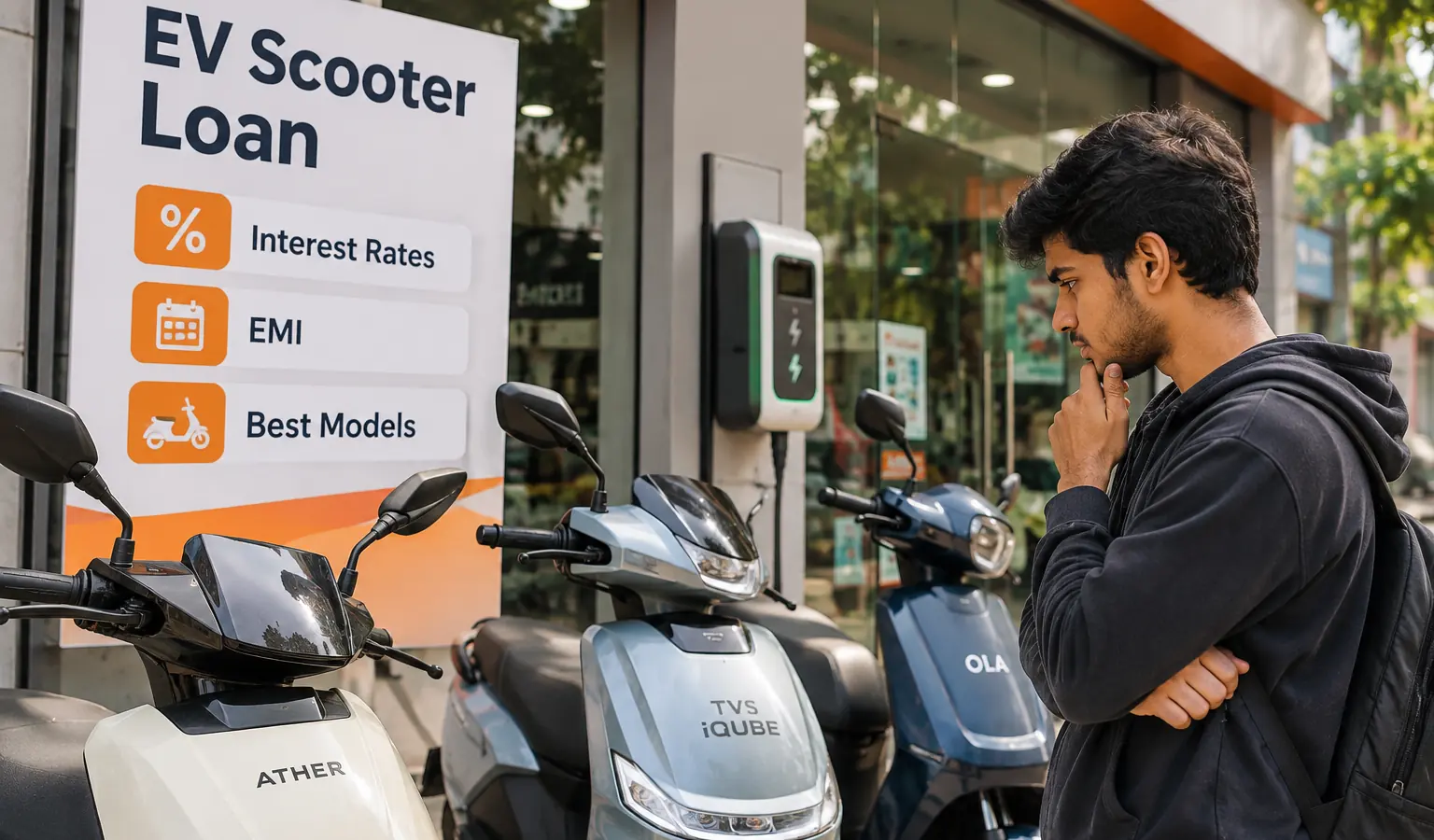
First, the inventory exists. Three years ago you couldn't find a used electric scooter for sale because nobody had owned them long enough to resell. Now there are thousands of them moving through OLX, BikeWale, BikeDekho, and physical second-hand vehicle markets in every major Indian city. Used Tata Nexon EVs are listed everywhere starting from Rs 5 lakh going up to Rs 13 lakh depending on battery health and age. Used Tiago EVs are even more affordable, sometimes Rs 4-6 lakh for a 2-3 year old vehicle. Two-wheeler resale is even bigger because the new market was huge — iQubes, Chetaks, 450X models from 2022 and 2023 are flooding the resale listings.
The lender side caught up too. Credifin has a used EV two-wheeler loan product, and a few other NBFCs now offer one as well. The product is structurally similar to a used petrol two-wheeler loan but with some EV-specific adjustments around how the battery gets valued.
And the pricing has stabilized which it hadn't before. A year-old iQube with 8,000-12,000 km sits around 30-35% below new price. Two-year-old around 40% below. Three-year-old 50% below. Used Nexon EV from 2022 with under 40,000 km is roughly 45-50% off new. This is actually pretty similar to petrol vehicle depreciation which surprised me when I first started tracking it — people assume EVs lose value way faster but the numbers don't really support that anymore.
So the market is real, lenders are real, depreciation is reasonable. The question becomes whether you should actually buy used or stretch a bit and buy new on EMI. That depends on your situation, which is what most of this post is about.
The honest case for used
There's a guy I know in Mohali — Karan, works at some IT services place, salary around Rs 42,000 a month. He'd been wanting an electric scooter for about a year but the new iQube EMI of Rs 3,295 plus existing rent and other bills was just over the line of comfortable. He couldn't bring himself to commit. He'd convince himself to buy on Saturday and back out by Tuesday.
In February he bought a used Chetak from a guy in Panchkula. 2023 model, 11,400 km, Rs 73,000 after some negotiation. NBFC loan for Rs 55,000 over 24 months at 15.5%. EMI Rs 2,680. The Rs 600 difference between this and a new scooter EMI is what flipped the decision for him from "I'll think about it" to "yes okay let's do this." That's not a small thing. Sometimes the right financial product is just the one your brain will let you sign for.
Same applies to first-time EV buyers who aren't sure if they'll even like the experience. The silent ride throws some people off. The charging routine isn't for everyone. Buying used at 65-80k gives you a year to figure out if EV ownership fits your life without betting Rs 1.15 lakh on it. If you decide it doesn't work for you, you can resell at maybe 10-15k loss and go back to petrol. Lower commitment, lower regret risk.
And honestly, for second-vehicle situations like a dedicated delivery scooter or an e-rickshaw running as side income while you keep your day job, used is almost always the smarter buy. You can't justify Rs 1.5 lakh on a vehicle that generates Rs 20,000 a month, but Rs 70,000 for one doing the same job changes the math completely. ROI happens faster, exit is cleaner if the side business doesn't work out.
Where used falls apart
There are situations where I'd genuinely tell people don't buy used.
If you're a full-time delivery rider doing 70+ km daily, new is usually the smarter call despite the higher EMI. The reason is battery health. A used scooter with say 65% battery capacity remaining gives you noticeably less range than new, which means fewer deliveries possible per day. The savings on purchase price often don't cover the income you lose to reduced range. Run the math on your specific situation but I've seen plenty of delivery riders regret buying used when their cheap second-hand scooter started giving them 50 km of range halfway through their shift.
If the loan EMI on a new vehicle fits comfortably in your budget without stretching anything, new is generally the better answer. Warranty matters way more on EVs than on petrol because EV repair costs are concentrated in expensive components — battery, motor, controller. Three years of warranty on a new scooter means you sleep better. Six months of residual warranty on a used one means you might wake up to a Rs 30,000 battery bill in month seven.
And if you don't have technical knowledge or access to a trusted mechanic who can evaluate used EVs, you're walking into territory where mistakes are very expensive. Used EV inspection is genuinely harder than used petrol because the battery is the most expensive component and you can't visually inspect it.
The battery thing is the whole game
I cannot overstate this enough. The battery is roughly 30-50% of the value of any EV. Everything else — frame, motor, controller, body, lights, the touchscreen if it has one — is secondary by a huge margin.
When you buy a used EV you're really buying a used battery with a vehicle attached. Healthy battery means the vehicle is a steal at the price. Dying battery means you're paying for a paperweight that's about to need Rs 25,000 to Rs 90,000 of additional work depending on the model.
So the question becomes how do you check the battery before buying. The proper way is a State of Health report from an authorized service centre. iQube, Chetak, Ather, all the major brands have dealer-level diagnostic tools that plug into the scooter and pull battery capacity numbers. A scooter that left the factory with say 3.0 kWh of usable battery capacity should still show 2.5-2.7 kWh if it's been treated reasonably.
Anything below 80% of original capacity is concerning. Below 70% you should walk away or negotiate hard on the price.
For four-wheelers like the Nexon EV, Tata's authorized service centres can run a full battery diagnostic for Rs 1,500-2,500. Honestly worth every rupee. Some large used-car platforms also include a battery health report in their used EV verification, which is one reason I generally trust them more than direct private sales for cars.
The shortcut method if you can't get a SoH report — ask the seller to fully charge the vehicle in front of you. Take it for a 15-20 km test ride. Watch how fast the range indicator drops. If you ride 15 km and the displayed range drops by 25 km, the battery is degraded. Not precise but it gives you a rough sense.
Also ask about charging habits straight up. Frequent DC fast charging kills batteries faster than slow home charging. Leaving the vehicle at 100% for long stretches or running it down to 0% both shorten battery life. Most sellers will be honest about this if you ask directly because they know lying gets caught quickly when you take the scooter for inspection. Our EV battery maintenance guide goes deeper on habits.
Where the loan part actually matters
NBFC used EV loans in 2026 are running roughly 14-17% interest depending on vehicle, profile, lender. That's about 2-3% higher than new EV loans because of the additional asset risk on a used vehicle. Loan tenure is typically 24-36 months for used two-wheelers — lenders don't want longer tenures on assets that depreciate further during the loan period. For used EV cars it goes up to 48 months.
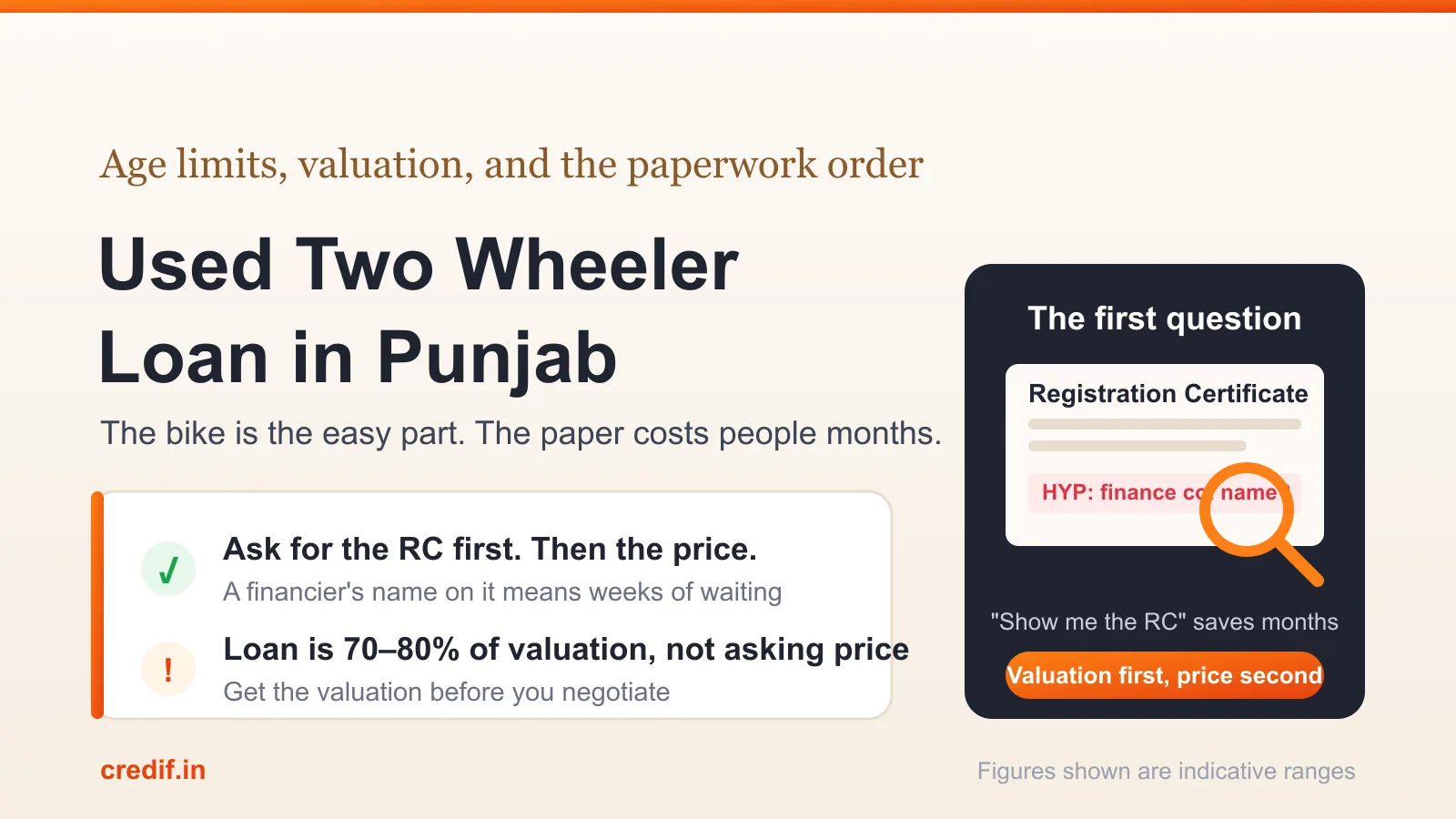
Loan-to-value depends a lot on vehicle age. A 1-year old EV scooter being sold at Rs 75,000 will typically get you a loan of around Rs 60,000-65,000 which is 80-85% of the purchase price. A 3-year old at Rs 50,000 might only get you Rs 35,000 — about 70% LTV. Lenders want bigger down payments on older vehicles. Same logic applies to cars — newer the vehicle, higher the LTV you can negotiate.
What you need to bring is basically what you'd bring for a new EV loan plus the used-vehicle specifics. KYC documents, six months bank statement, address proof — standard. From the seller side, you'll need the original purchase invoice, current RC, NOC from the existing lender if the vehicle was previously financed (this part trips up a lot of buyers), and proper transfer forms for RC ownership change. The battery SoH report I mentioned isn't strictly required by most lenders but it dramatically helps with both approval speed and the interest rate offered.
Something a lot of buyers get wrong — they assume the loan will cover the entire purchase plus any battery replacement they might need to do later. It won't. The loan amount is based on the vehicle's current value, not its post-repair value. If you're buying a Rs 80,000 scooter that's going to need a Rs 25,000 battery within six months, you need that Rs 25,000 in your own pocket separately. Plan that in, don't assume the loan will somehow stretch.
Rakesh from Adampur
Rakesh runs a small grocery shop in Adampur outside Jalandhar. Wanted an electric scooter for his college-going son's daily commute to Jalandhar city — about 18 km each way. Couldn't really afford a new Chetak at Rs 1.10 lakh plus an EMI he wasn't willing to commit to long-term.
Found a 2023 Chetak on OLX from a guy in Hoshiarpur. 14,500 km, single owner, asking Rs 72,000. Rakesh took the scooter to the authorized Bajaj service centre in Jalandhar for a proper check before paying anything. They charged Rs 1,200 and told him battery health was at 84%, brake pads needed replacement within another 3,000 km, everything else solid. No accident history flags on the diagnostic.
He negotiated down to Rs 67,000 because of the brake work coming up. NBFC loan for Rs 52,000 at 15.5% over 24 months. EMI Rs 2,534. Used some savings for the Rs 15,000 down payment, the Rs 1,200 inspection fee, and Rs 2,800 for brake pads in month two.
Total monthly running cost for him now — Rs 2,534 EMI plus around Rs 250 in electricity for the 540 km his son rides each month. Rs 2,784 a month for a working electric scooter. Compare that to a new Chetak EMI which would have been around Rs 3,495 plus electricity. Saved about Rs 960 a month just by going used. Across 24 months that's roughly Rs 23,000 in his pocket.
His review when I asked him six months in — "Scooter chal raha hai, son khush hai, paisa bach raha hai. Battery 80% pe hai abhi, do saal aur chala lega aaram se." Scooter running, son happy, money being saved. Battery is at 80% now, will easily run another two years.
The honest downside Rakesh mentioned — the warranty was finished so when the side stand sensor broke in month four, the Rs 1,800 repair came straight out of his pocket. With a new scooter that would have been free under warranty. Used means you quietly accept these small repair costs as the price of the lower purchase price.
What goes wrong for used EV buyers
The mistake I see most often is people falling in love with one specific vehicle and then ignoring obvious red flags during inspection. If the seller resists letting you take the vehicle to an authorized service centre, that resistance is the red flag. Walk away. There's another scooter or another Nexon EV in your inbox next week.
Paying too much because the seller anchored you to the new vehicle price is the second issue. The standard sales line you'll hear — "Bhai naye mein toh 1.15 lakh ka hai, main 90k mein de raha hu, samjho 25k bachat" — is designed to make you anchor on new price. Don't. Anchor on other comparable used listings instead. A 1-year-old iQube with 12,000 km should be Rs 70-80k, not Rs 90k. Look at five comparable listings in your city before negotiating with anyone seriously.
Then there's the RC transfer thing where buyers try to skip the proper paperwork to save the Rs 800-2,500 in stamp duty and transfer fees. Don't ever do this. If the RC stays in the seller's name, you're not the legal owner. Insurance is invalid. Any traffic violation or accident becomes your nightmare to untangle. Pay the transfer cost. Do it properly. There are no shortcuts here that don't come back to bite you.
Buying from someone who's still paying off the original loan is another trap. Some sellers will quietly ask you to take over the EMI payments while keeping the RC in their name. This is a legal disaster waiting to happen and it's actually quite common in the used market. Either insist on full loan closure with proper NOC before the purchase happens, or walk away. No amount of price savings is worth the documentation mess this creates.
People also assume the warranty transfers automatically when they buy used. Usually it doesn't. Most EV manufacturer warranties are transferable but the transfer requires formal paperwork and sometimes a fee. Verify this with the manufacturer's customer service before you sign anything. Some brands allow a transfer for a small fee, some are stricter about it, and some smaller brands don't allow warranty transfer at all and your purchase comes with zero warranty protection.
Used e-rickshaws are a different beast
The used e-rickshaw market moves through a parallel ecosystem in Punjab and UP. These don't really sell through OLX or BikeWale at scale. The actual market is local — vehicle markets in Ghaziabad, Meerut, Lucknow, Ludhiana have specific lots where used e-rickshaws change hands. Prices for a 2-year-old passenger e-rickshaw in decent shape with newer batteries sit around Rs 55,000-75,000 versus Rs 1.40-1.55 lakh new.
The catch with used e-rickshaws is even more pronounced than scooters because the batteries get hammered way harder. A passenger e-rickshaw battery that's done 18 months of commercial daily use is essentially at end-of-life regardless of how good the vehicle looks externally. When someone sells you a 2-year-old e-rickshaw, assume new batteries will be needed within the next 6 months. That's an additional Rs 22,000-30,000 you have to factor into your total purchase budget.
The math still works if the vehicle price is right. Rs 65,000 used plus Rs 28,000 batteries equals Rs 93,000 total versus Rs 1.50 lakh new — Rs 57,000 saved on the whole package. That savings is real if the rest of the vehicle is sound. Get an experienced e-rickshaw mechanic to inspect the motor, controller, frame, and suspension before paying anything. A bad motor controller alone can mean Rs 8,000-15,000 in repairs you weren't planning for.
NBFCs do finance used e-rickshaws but the tenure is short — usually 18-24 months — and rates are 16-18% reflecting the higher operational wear. Down payment expectation is 30-35% rather than 20% for new. The shorter tenure pushes the EMI higher than people expect, so calculate this carefully before committing.
Used EV cars deserve their own conversation
This is honestly the most interesting segment in the used EV market right now because the value proposition is real. A 2022 Tata Nexon EV with 35,000 km in good condition is going for Rs 8.5-10 lakh against the new price of Rs 12.5-17.5 lakh. That's serious savings on a vehicle whose driving experience is essentially identical to new.
Battery diagnostics for the Nexon EV are mandatory before buying — non-negotiable in my opinion. Tata service centres can run a full SoH report including individual cell-level data. A Nexon EV battery should still be at 85%+ capacity at 35,000 km. Anything substantially lower than that and you're looking at potential warranty claims or expensive replacement down the road.
On the Nexon EV specifically, Tata introduced a lifetime HV battery warranty in 2025 for first owners of newer versions like the Nexon EV 45. A second owner gets a shorter cover, and only if the ownership transfer is reported to Tata. An older car like a 2022 Nexon EV carries the standard battery warranty of 8 years or 1.6 lakh km from its first sale. Always verify warranty transfer status before purchase — the seller should be able to confirm this in writing from Tata customer service.
Used EV car loans in 2026 run 13-16% at most NBFCs. Tenure up to 48 months. LTV around 70-75% of agreed value. For a Rs 9 lakh purchase you're looking at a Rs 6.5 lakh used car loan with about Rs 2.5 lakh down payment from your side. EMI around Rs 17,500-18,500 over 48 months at 14%.
The interesting math — running cost on a 2022 Nexon EV is roughly Rs 1.20-1.50 per km versus a petrol Creta or Seltos at Rs 7-9 per km. For someone driving 12,000-15,000 km a year, the annual fuel saving alone is Rs 70,000-1,00,000. That fuel saving essentially covers half of your monthly EMI on the loan. The ownership economics on a used Nexon EV are surprisingly favourable if you can manage the upfront down payment.
How to actually approach a used EV purchase
Start with the budget you can comfortably commit to. EMI plus electricity plus maintenance buffer plus a battery replacement set-aside. If that total fits in your monthly outflow, you're ready to shop. If it's borderline, look at cheaper or older inventory rather than stretching.
Spend two weekends just looking at listings before contacting anyone. Get a feel for what 1-year, 2-year, 3-year vehicles are selling for in your city. Notice patterns. A 2022 iQube in Jalandhar will be priced very differently from one in Bangalore. Different supply, different demand.
Once you've shortlisted 3-4 specific vehicles, message all the sellers. Ask the same set of questions to each — how many kilometres, single owner or multiple, was it ever in an accident, has the battery been replaced, what's the charging routine been like, why are you selling. Compare answers across the four. A seller who gives detailed honest answers is telling you something useful. A seller who deflects or gives vague answers is also telling you something — just not the same thing.
Visit only the top 1-2 vehicles in person. Inspect physically. Body condition, tyre wear, brake feel, suspension response. Test ride for at least 15-20 km. If anything feels off during the ride, just don't buy.
If you're at all serious about the vehicle, take it to the authorized service centre for an inspection. The Rs 1,200-2,500 you'll spend is the best money you can put down on this entire transaction. Insist on a written report not just a verbal assessment.
Negotiate based on what the inspection finds. Brake pads needing replacement is a legitimate Rs 1,500-2,000 deduction. Battery at 78% health on a model where new ones are 95%+ is a Rs 5,000-8,000 deduction. Don't be embarrassed about these conversations — the inspection report gives you objective ammunition.
Then the paperwork has to be perfect. RC transfer, insurance change, warranty transfer if applicable, full loan closure with NOC if the vehicle was previously financed. None of this is optional. All of it protects you legally and financially.
Visit Us in Jalandhar
Credifin Limited
87, Radio Colony, New Jawahar Nagar, Mahavir Nagar
Jalandhar, Punjab 144001
079651-74500 | info@credif.in
Find your nearest branch →
FAQs
Can I get a loan on a used electric scooter?
Yes. NBFCs, including Credifin, finance used EV two-wheelers. In 2026 expect roughly 14 to 17 percent interest and a 24 to 36 month tenure, about 2 to 3 percent above a new EV loan.
How much will a lender finance on a used EV?
It depends on age. A 1-year-old EV scooter typically gets 80 to 85 percent of the purchase price, a 3-year-old closer to 70 percent. The older the vehicle, the bigger the down payment.
How do I check the battery before buying a used EV?
Get a State of Health report from an authorised service centre. Below 80 percent of original capacity is a concern; below 70 percent, walk away or negotiate hard. Without a report, do a 15 to 20 km test ride on a full charge and watch how fast the range drops.
Does the EV warranty transfer to the second owner?
Sometimes, with formal paperwork and occasionally a fee. It varies by brand, so confirm it in writing with the manufacturer before you pay.
Ready to finance a used EV
Buying a used electric scooter, e-rickshaw, or EV car anywhere in Punjab or Delhi NCR? Credifin underwrites used EV loans for two-wheelers and three-wheelers with practical eligibility — bank statement income works, formal salary slip not required. Get a quote online or visit our Mahavir Nagar branch in Jalandhar, next to Chirayu TVS Showroom.
Check your eligibility →Credifin Limited is an RBI-registered NBFC, CRISIL BBB-/Stable. Loans at the sole discretion of the company. Rates, prices and warranty terms mentioned are indicative and can change; they are not an offer.
This might catch your interest